

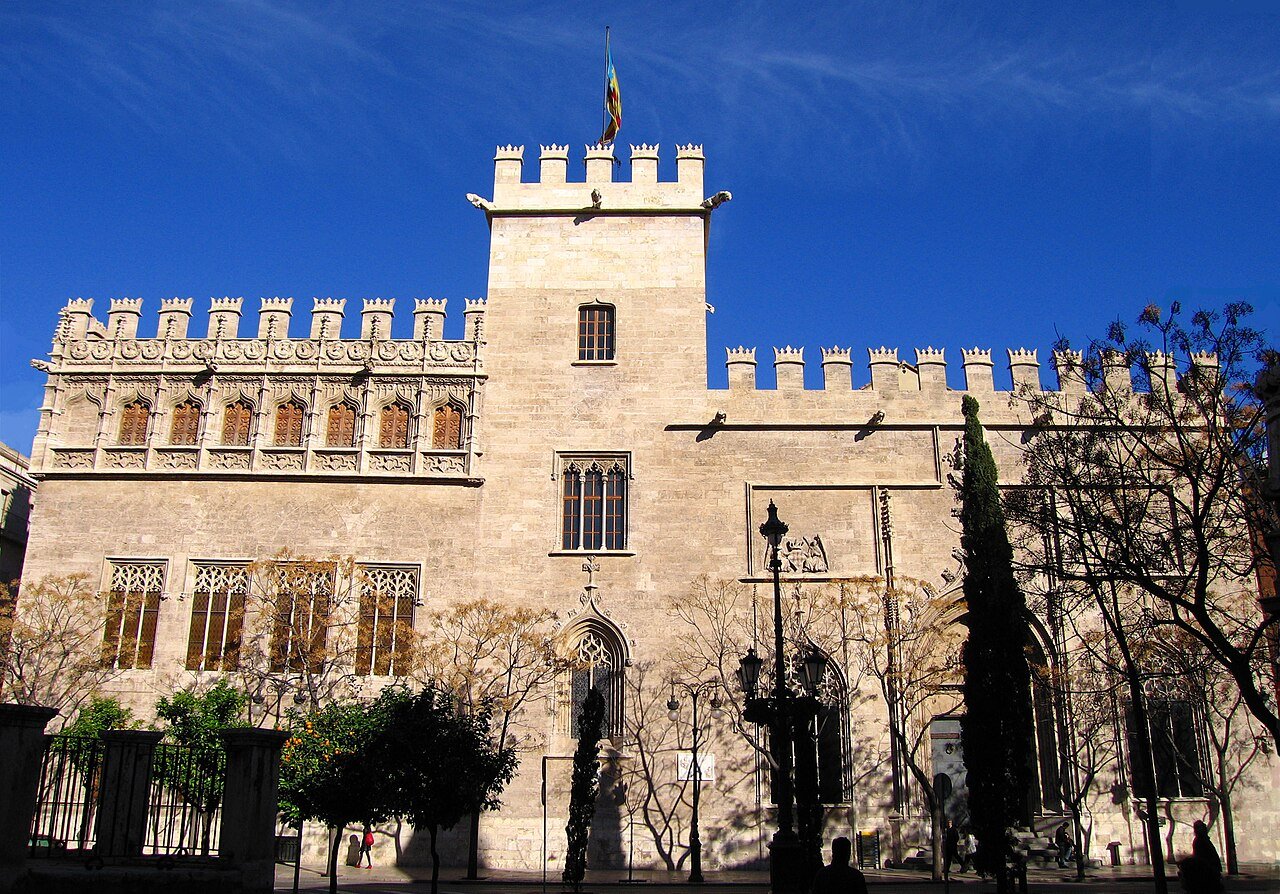
Columns twisted like trees: the trading hall of silk
In the centre of Valencia’s old city, between the central market and the cathedral, stands the building that expressed — more vividly than any other — the commercial triumph of medieval Valencia. The Lonja de la Seda (Silk Exchange), built between 1482 and 1533, is a late Gothic civil building of extraordinary spatial ambition: its Sala de Contratación (Contract Hall) is covered by a low-vaulted ceiling supported by eight columns that rise 17.4 metres and twist as they climb, like the trunks of some impossible stone forest. The effect, especially in low afternoon light, is of a space simultaneously monumental and alive.
UNESCO inscription: the pinnacle of Gothic civil architecture
Inscribed in 1996, La Lonja de la Seda was recognised as an outstanding example of secular Gothic architecture that testifies to the power and wealth of one of the greatest commercial cities of the late medieval Mediterranean. UNESCO specifically noted the building’s exceptional quality as an expression of secular rather than religious Gothic — a demonstration that the architectural ambitions of the period were not confined to cathedrals but extended to the places where merchants conducted their business.
The age of silk: Valencia’s commercial empire
In the 15th century, Valencia was among the most prosperous cities in Europe. Its silk industry — centred on the morería (Moorish quarter) where mulberry cultivation and silk weaving had been practiced since Moorish times — produced raw silk, woven silk, and velvet that were traded across the Mediterranean. The city’s merchants needed a dedicated meeting place to contract the purchase and sale of silk futures, arbitrate commercial disputes, and display the city’s wealth to foreign traders. The Lonja was the physical expression of this commercial power.
The three sections: contracts, consulate, and orange trees
The Lonja is composed of three distinct sections. The Sala de Contratación (Contract Hall) is where merchants gathered to trade; its twisted columns and ribbed vaults are the building’s defining space. The Torre del Consulado del Mar (Tower of the Sea Consulate, 15th century) housed the commercial court that adjudicated disputes between merchants; its upper floor retains the original coffered ceiling. The Patio de los Naranjos (Orange Tree Courtyard), enclosed by Gothic arcades, was a meeting place and the setting for the outdoor activities of the silk exchange — still planted with orange trees today, still fragrant in spring.
Pere Compte: the architect of the impossible column
The Sala de Contratación was designed by Pere Compte, the master builder of the Valencia Cathedral’s chevet, who also worked on Barcelona Cathedral. His achievement in the Lonja’s hall was to create a sense of effortless height and lightness in a very large interior (35 × 21 metres) using a structural system — the twisted column supporting branching ribs — that distributes loads invisibly and maximises the open floor area. The columns carry no capitals: their twisted surfaces flow directly into the rib branches above, in a structural logic that appears to defy gravity while obeying it precisely.
The inscription and the gargoyles: Gothic moralising
The exterior of the Lonja is richly decorated with Gothic imagery that mixes the sacred and the moralistic: gargoyles, grotesques, and inscriptions warning against usury and fraud. An inscription around the building’s cornice quotes a medieval proverb: “I am a famous house, built in fifteen years. He who desires to work honestly and without sin may rejoice, for there is no evil here.” The decoration serves both aesthetic and didactic purposes, advertising the building’s function as a place of legitimate commerce.
From silk to oranges: the building through five centuries
After the silk trade declined in the 17th and 18th centuries, the Lonja lost its commercial function and passed through various uses: warehouse, prison, barracks, tobacco store. It was declared a national monument in 1931 and underwent a major restoration between 1949 and 1956. Today it functions as an exhibition space and the site of official civic ceremonies; the Sala de Contratación is used for art exhibitions and cultural events that make use of the extraordinary Gothic interior as a backdrop.
Visiting La Lonja de la Seda
La Lonja is located on the Plaça del Mercat in central Valencia, directly opposite the Mercado Central (one of the largest covered markets in Europe). It is open Tuesday through Saturday 9:30–19:00 and Sunday 9:30–15:00; admission is free on Sundays. The building is 15 minutes on foot from Valencia Nord station and easily combined with a visit to the Mercado Central, the Cathedral, and the Carmen neighbourhood. The best light for photography of the Sala de Contratación is mid-morning when sunlight enters from the east-facing windows.
Find it on the map
See this place and what’s around it →📷 Become a Cultural Heritage Online photographer
Share your photos of places: they stay published under your name as the author. The more they're seen, the more you get noticed — and soon a contest will reward the most appreciated photos.
Log in or sign up free to add a photo