

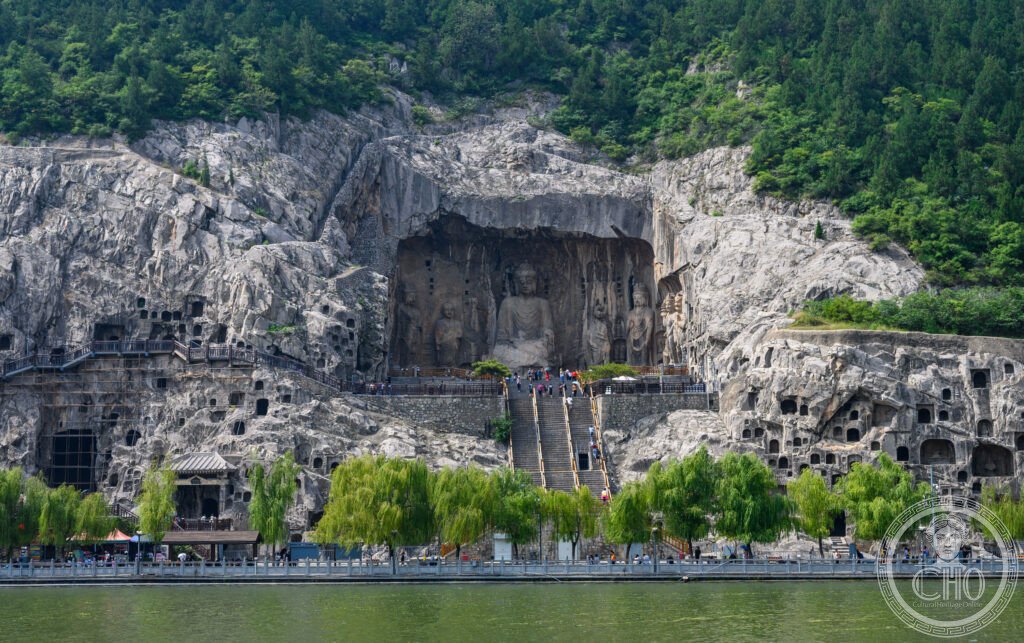
The supreme achievement of Chinese Buddhist rock-cut art. 2,345 caves and niches carved into the limestone cliffs of the Yi River gorge south of Luoyang over 400 years (Northern Wei to Tang Dynasty, 493–907 AD), containing 110,000 Buddhist stone figures ranging from 2 cm to 17 metres high. The Fengxian Cave with its 17-metre Vairocana Buddha (commissioned by Empress Wu Zetian in 675 AD) represents the peak of Tang Dynasty monumental sculpture and has no equal in the world.
At a glance
The Longmen Grottoes (龍門石窟, “Dragon Gate Stone Caves”) are a series of Buddhist rock-cut cave shrines on the two facing limestone cliffs of the Yi River gorge, approximately 12 km south of Luoyang city, Henan Province, central China. The site contains 2,345 caves and niches (on both cliffs: the west cliff has the principal shrines; the east cliff has smaller and later caves), 110,000 Buddhist figures, 60 stupas, and approximately 2,840 stone inscriptions. The figures range in size from 2 cm (small votive niches) to 17.14 m (the Vairocana Buddha in the Fengxian Cave). The carving activity spans the Northern Wei Dynasty (493 AD) through the Tang Dynasty (907 AD), with the peak of production in the late 7th century under Emperor Gaozong and Empress Wu Zetian. UNESCO inscribed the Longmen Grottoes in 2000.
Key facts
- The Fengxian Cave and the Vairocana Buddha (675 AD): the greatest single monument of the Longmen complex. An open-air shrine carved into the west cliff face under the patronage of Emperor Gaozong and Empress Wu Zetian of the Tang Dynasty, completed 675 AD. The central figure (Vairocana Buddha, the “Radiant Buddha of the Cosmic Law,” 17.14 metres high) sits in a posture of enlightenment flanked by his two principal disciples (Ananda and Kashyapa), two bodhisattvas, two divine guardians (each 17+ metres), and two heavenly kings. The nine figures together create a tableau of cosmic Buddhism that is the definitive statement of Tang imperial religious ideology. The face of the Vairocana is traditionally identified as a portrait of Empress Wu Zetian herself (the claim appears in contemporary Tang chronicles), though this is uncertain. The sculpture’s combination of spiritual serenity and physical grandeur is consistently cited as the highest achievement of Chinese stone carving.
- The Binyang Caves (Northern Wei, 523 AD): the oldest major shrine complex at Longmen. Three adjacent caves commissioned by Emperor Xuanwu of the Northern Wei and completed under Emperor Xiaoming between 493 and 523 AD. The Middle Binyang Cave contains the most important surviving Northern Wei sculpture at Longmen (the central Buddha flanked by two bodhisattvas, with an elaborate relief processional of the imperial court along the lower walls — though the processional panels were removed and sold to American museums in the early 20th century and are now in the Metropolitan Museum of Art and the Nelson-Atkins Museum). The Northern Wei sculpture style (elongated figures, linear drapery folds, frontal composition) at Binyang differs fundamentally from the rounded, naturalistic Tang style at Fengxian and shows the evolution of Chinese Buddhist art over 150 years.
- The stone inscriptions (stele): the cliffs of Longmen are covered with approximately 2,840 stone inscriptions. Votive inscriptions naming donors, dedicatory texts, sutras carved in full, and memorial texts. The calligraphy inscribed at Longmen (particularly the “Twenty Pieces of Longmen” — twenty exemplary inscriptions from the Northern Wei period) is the standard model for all subsequent Chinese regular script (kaishu) calligraphy and is studied in Chinese calligraphy education to this day. The inscriptions are as significant to the history of Chinese writing as the carvings are to the history of Chinese art.
- The looting problem: between approximately 1900 and 1940, a systematic campaign of head-cutting and panel-cutting by art dealers, collectors, and their agents removed approximately 150 Buddha heads and several major relief panels from the Longmen caves. Many are now in Western museum collections (the Avery Brundage Collection at the Asian Art Museum of San Francisco, the Metropolitan Museum of Art, the Freer Gallery, and the Fogg Art Museum have significant Longmen holdings). The decapitated statues visible on many caves are the result of this theft. Some heads have been returned or identified in Chinese diaspora collections and international museums.
- Luoyang and the ancient capital legacy: Luoyang was the capital of China for 13 dynasties over approximately 1,500 years (Eastern Zhou, Eastern Han, Northern Wei, Sui, and Tang among them). The Longmen Grottoes were carved because Luoyang was the capital. They were imperial patronage projects. The White Horse Temple (12 km east of Luoyang), built 68 AD, is traditionally considered the first Buddhist temple in China (built for the Indian monks who first brought Buddhism to China in the reign of Emperor Ming of Han).
- Heritage: UNESCO World Heritage Site, Longmen Grottoes, inscribed 2000.
- GPS: 34.5734° N, 112.4734° E.
History
The carving of the Longmen cliffs began in 493 AD when the Northern Wei Dynasty moved its capital from Datong (where the Yungang Grottoes had been the principal Buddhist patronage project) to Luoyang. The Emperor Xiaowen relocated the capital partly to move the dynasty toward Chinese cultural assimilation and away from its nomadic Xianbei traditions. The Longmen project was the new capital’s equivalent of Yungang, expressing the imperial court’s Buddhist patronage in the new location. The Northern Wei carving (493–534 AD) produced the Binyang complex and dozens of smaller shrines. After the Northern Wei collapsed, carving at Longmen was intermittent under the Eastern Wei, Western Wei, Northern Qi, and Sui dynasties. The Tang Dynasty (618–907 AD) produced the major second phase, concentrated in the late 7th century under Emperor Gaozong and Empress Wu Zetian. The Fengxian Cave complex (675 AD) is the culmination of Tang Buddhist patronage at Longmen. Further Tang-period carving continued through the 8th century (the Wanfo Cave, with 15,000 small votive Buddhas carved on the walls, dates to 680 AD).
The site was damaged by iconoclastic anti-Buddhist campaigns (the Huichang Suppression, 842–845 AD, ordered by Emperor Wuzong) and by subsequent abandonment. The systematic Western collecting of heads and panels began in the late Qing Dynasty and intensified during the Republican period (1912–1949). The People’s Republic designated Longmen a protected site in 1961 and opened it to tourism. The UNESCO inscription in 2000 led to significant conservation investment and the return of several looted pieces from Chinese diaspora collectors.
What you see
The site visit follows the west cliff face (the main sequence of important caves, approximately 1.5 km walking distance from the entrance to the furthest major cave) and optionally the east cliff (accessible by bridge at the far end). The sequence on the west cliff moves from the earliest Northern Wei caves (Binyang) through smaller Tang caves to the Fengxian Cave complex. The grandest, most photogenic, and most historically important section of the entire site. The scale of the Vairocana Buddha requires standing some distance back (the approach path gives the full frontal view) to appreciate. The flanking guardian figures are as impressive as the central Buddha at close range.
The carved cave interiors (those that have survived with significant sculpture) are lit by daylight through the entrance openings. The combination of the carved limestone, the river below, and the tree-covered cliffs gives the site a distinctive quality of natural integration that the Yungang Grottoes (carved into a sandy cliff in a treeless landscape) do not have. The Yi River reflection of the cliff face is visible from the east bank. Allow 3–4 hours for a thorough visit.
Practical information
- Admission: approximately CNY 100 adult (about €13). Open daily 7 am–7 pm (summer) or 8 am–5 pm (winter). The included audio guide (English available) is highly recommended for identifying the historically significant caves among the 2,345 total. The Fengxian Cave and the Binyang Caves are the essential stops. The east cliff is less important and can be skipped if time is limited. Guided tours in English available from tour operators in Luoyang city centre.
- Getting there: Luoyang is on the Zhengzhou–Xi’an high-speed rail line (CRH). Zhengzhou East to Luoyang Longhua (Luoyang high-speed station) approximately 1 hour (trains every 30–60 min). Xi’an North to Luoyang Longhua approximately 1.5 hours. From Luoyang city centre to the Longmen site: bus 71 (approximately 40 min, CNY 1.5) or taxi (15 min, CNY 25–35). Luoyang Beijiao Airport (LYA) has connections to Beijing (1h), Shanghai (1.5h), and major Chinese cities.
- Luoyang circuit: the standard Luoyang heritage circuit (2 days) covers the Longmen Grottoes (half day), the Luoyang Museum (the finest collection of Shang and Zhou bronzes in central China), the White Horse Temple (founded 68 AD, China’s first Buddhist temple, 12 km east of city), and (if peony season, April) the Luoyang National Peony Garden. Luoyang is the “Capital of Peonies” and the Luoyang International Peony Cultural Festival (early April) fills the gardens with tens of thousands of varieties in bloom.
Getting there
High-speed rail: 1h from Zhengzhou, 1.5h from Xi’an. Bus 71 or taxi from Luoyang city centre (~15–40 min). GPS: 34.5734, 112.4734.
Nearby
- Shaolin Monastery. 80 km south-east of Luoyang. The birthplace of Chan (Zen) Buddhism in China (founded 495 AD by the Indian monk Batuo) and the world headquarters of Shaolin martial arts (wushu). The Pagoda Forest (248 stone stupas covering the graves of Shaolin abbots over 1,400 years — the largest group of brick pagodas in China), the Shaolin Abbot’s Hall, and the performance demonstrations of Shaolin wushu monks are the primary attractions. The site is extremely tourist-developed but the Pagoda Forest and the Bodhidharma Cave (where Bodhidharma is said to have meditated for nine years) retain genuine atmosphere. UNESCO WHS 2010 (as part of the Historic Monuments of Dengfeng).
- Yungang Grottoes, Datong. 500 km north of Luoyang (3 hours by high-speed train to Datong). The Northern Wei predecessor to Longmen. 252 caves with 51,000 Buddhist figures carved between 460 and 524 AD in the sandstone cliffs of the Wuzhou Mountains. The colossal Caves 16–20 (the “Five Great Caves,” commissioned by the Northern Wei emperor Wencheng as portraits of himself as the living Buddha) are the grandest and most immediately impressive monuments. UNESCO WHS 2001. Seeing both Yungang and Longmen gives the complete arc of Northern Wei to Tang Buddhist sculpture.
- Xi’an Terracotta Army. 340 km west of Luoyang (1.5h by high-speed train). The 8,000-strong army of life-size terracotta warriors buried in three pits to guard the mausoleum of Qin Shi Huang (first Emperor of China, died 210 BC), discovered in 1974. UNESCO WHS 1987. The Luoyang–Xi’an high-speed rail connection makes a 2-day Luoyang + 2-day Xi’an circuit one of the standard ancient China heritage itineraries.
Sources
- Wikipedia, Longmen Grottoes. Fengxian Cave. Vairocana Buddha (Longmen), accessed June 2026.
- UNESCO, Longmen Grottoes, WHS reference 1003, inscribed 2000.
- Seiichi Mizuno and Toshio Nagahiro, Ryūmon sekkutsu no kenkyū (Study of the Longmen Cave Temples), Kyoto, 1941.
- Luoyang Museum, Longmen Grottoes Research Institute Reports, 2019.
Find it on the map
See this place and what’s around it →📷 Become a Cultural Heritage Online photographer
Share your photos of places: they stay published under your name as the author. The more they're seen, the more you get noticed — and soon a contest will reward the most appreciated photos.
Log in or sign up free to add a photoIs this page about you?
This page is read by travellers and heritage enthusiasts who find it on Google. Tell us how you are connected to this place and we will take it from there.