
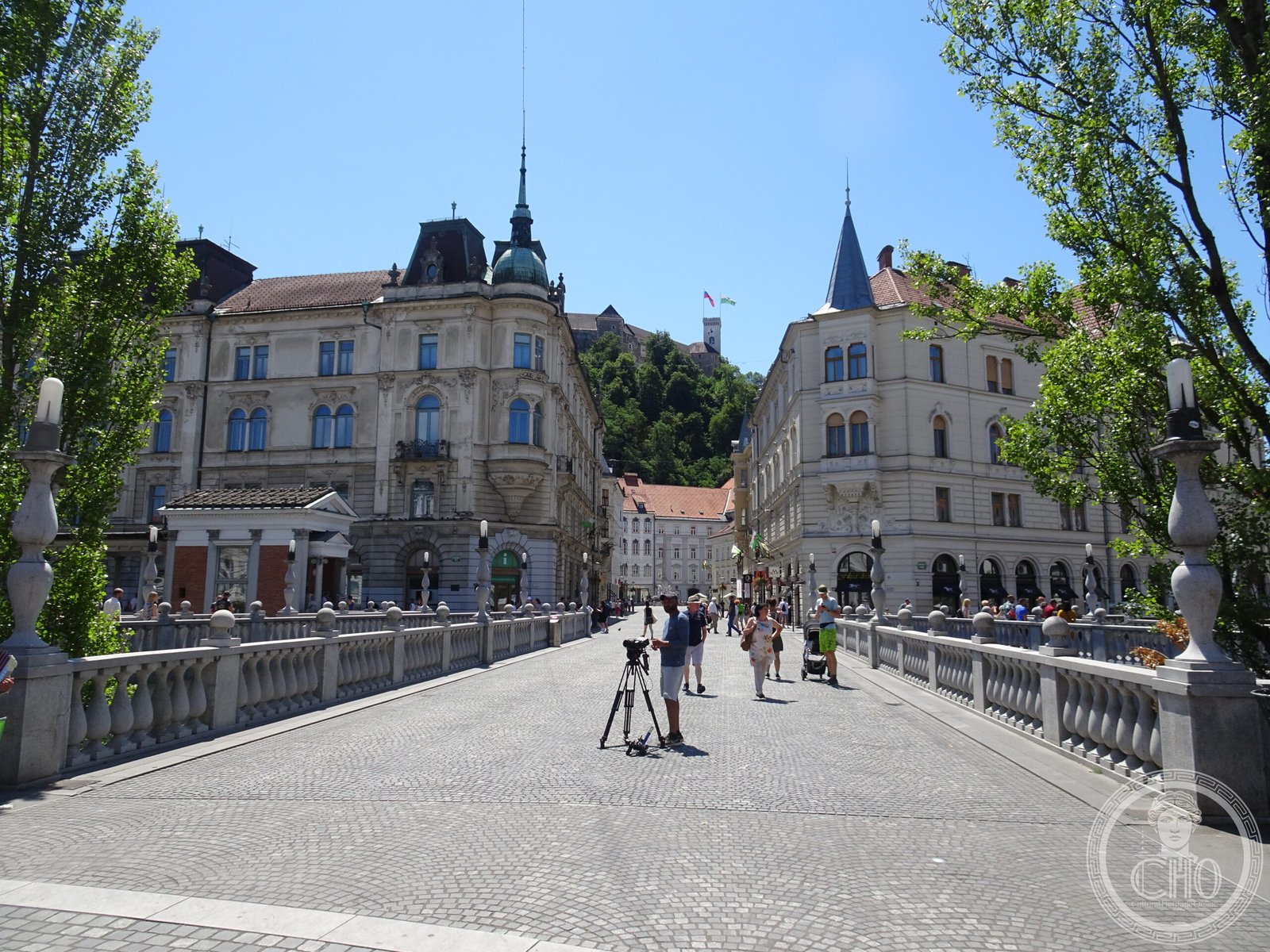
The Tromostovje — literally Three Bridges — is the defining landmark of Ljubljana and one of the most architecturally ingenious bridge designs of the twentieth century. What appears at first glance to be a single stone crossing of the Ljubljanica River is in fact three bridges standing side by side, their approaches fanning outward from a broad pedestrian plaza to form an unmistakable inverted Y. The central bridge dates from 1842, a modest single-arch stone span by the engineer Giovanni Picco. It was Jože Plečnik, Ljubljana’s visionary architect and urban designer, who transformed it in 1932 by adding two flanking pedestrian bridges angled at roughly thirty degrees on either side of the original span. The effect was immediately celebrated: a grand civic threshold to Ljubljana’s old town, carried on masonry arches, lined with stone parapets and Plečnik’s characteristic street lamps and poplar trees in terracotta urns. The bridges have been pedestrianised since 1961 and now form the social heart of the city, linking Prešeren Square on the west bank with the old town market and castle hill on the east.
At a glance
- Type
- Triple pedestrian bridge
- Period
- Original 1842; Plečnik flanking bridges 1932
- Style
- Plečnik Modernism / Slovenian Functionalism
- Location
- Prešeren Square, Ljubljana, Slovenia
- Coordinates
- 46.0510, 14.5066
- Architect
- Jože Plečnik (1932 expansion); Giovanni Picco (original 1842)
Overview
The Triple Bridge spans the Ljubljanica River at its narrowest point in the old town, connecting the baroque western bank — dominated by the pink Franciscan church on Prešeren Square — with the medieval eastern bank of market arcades, the covered market, and the path up to Ljubljana Castle. Plečnik’s intervention created not merely a crossing but a ceremonial plaza: the triangular pedestrian space formed by the three bridges on the western side is large enough to hold public gatherings and is de facto the living room of Ljubljana. The bridges are covered in dressed stone, the parapets topped with Plečnik’s distinctive urn-shaped lamp posts, and in spring and summer the poplar trees in terracotta planters frame the view of the river and the old town. The overall composition — asymmetrical but balanced, civic but intimate — is characteristic of Plečnik’s approach to urban design throughout Ljubljana.
History
The original central bridge, a single stone arch known as the Špital Bridge, was built in 1842 and rebuilt after an earthquake in 1895. By the 1930s, Ljubljana’s growing population and the traffic demands of the interwar period made it clear that a single narrow bridge was insufficient for the main crossing point of the city. The city commissioned Jože Plečnik — who had returned to Ljubljana in 1921 after years in Vienna and Prague — to redesign the crossing. Plečnik’s solution was radical: instead of demolishing the old bridge and building a wider one, he proposed keeping the original span and adding two new pedestrian bridges flanking it. The angle of the flanking bridges was calculated to maximise pedestrian flow from Prešeren Square while creating the triangular civic plaza on the western bank. The project was completed in 1932 and was immediately recognised as a masterpiece of civic design. The bridges were closed to vehicular traffic in 1961, which proved to be an act of preservation as much as urban planning: the pedestrianisation of the triple bridge helped catalyse the broader transformation of Ljubljana’s city centre into one of Europe’s most walkable historic cores.
Architecture and Design
Plečnik’s design achieves its effect through geometric precision and material restraint. The two flanking bridges are each approximately four metres wide, carried on semicircular stone arches that echo the proportions of the original central span. The bridges are faced in dressed limestone, the parapets built as solid stone balustrades with a subtly profiled coping — functional as a barrier, but refined enough to read as civic furniture. The lamp posts — one of Plečnik’s most reproduced details — are octagonal stone columns topped by spherical lanterns, spaced rhythmically along all three bridges. At the Ljubljana end, the three bridges converge on a paved triangular plaza whose geometry is emphasised by three steps descending to the river level. Plečnik placed terracotta planters with Lombardy poplars at the angle points of the flanking bridges, introducing a vertical green element that frames the view without obstructing it. The overall composition reads as classical in material and detail, but the geometry — the fan-shaped plan, the triangular plaza — is unmistakably modern in its spatial thinking.
Cultural significance
The Triple Bridge is Slovenia’s most internationally recognised piece of architecture and a touchstone for the study of Plečnik’s urbanism. Plečnik’s work in Ljubljana — which includes the covered market, the National and University Library, the cemetery of Žale, and dozens of smaller interventions — was rediscovered by Western architectural critics in the 1980s after decades of relative obscurity under Yugoslav socialism. The publication of François Burkhardt and Claude Eveno’s monograph on Plečnik in 1986 coincided with growing interest in postmodern historicism, and the Triple Bridge appeared on the cover of multiple architectural journals. Today, Plečnik’s Ljubljana is inscribed on the UNESCO World Heritage List as part of the serial nomination “Works of Jože Plečnik in Ljubljana — Human Centred Urban Design” (2021). The Triple Bridge is the centerpiece of this inscription and is considered one of the finest examples of contextual urban design in twentieth-century Europe.
Visiting today
The Triple Bridge is freely accessible at all hours and forms the natural starting point for any exploration of Ljubljana’s city centre. Prešeren Square on the western bank is the city’s main gathering place, lined with cafes, the Franciscan church, and the Plečnik-designed colonnade. The eastern bank leads immediately to the covered market arcade — also designed by Plečnik — and the path up to Ljubljana Castle. Guided walking tours of Plečnik’s Ljubljana depart regularly from Prešeren Square in summer; the Ljubljana Tourism Office offers maps and audio guides. The bridges are lively from early morning to midnight and are most photogenic at dusk when the lamp posts are lit and the reflection of the stone arches appears in the Ljubljanica.
Getting there
The Triple Bridge is in the heart of Ljubljana’s pedestrian zone, a ten-minute walk from Ljubljana Central Station. City buses stop at the edge of the pedestrian zone on Slovenska cesta; from there it is a five-minute walk to Prešeren Square. If arriving by car, park at one of the garages on the city periphery — the old town is closed to private vehicles. Ljubljana’s Jože Pučnik Airport is twenty-five kilometres north of the city; the Arriva shuttle bus runs to the central station regularly.
Sources and resources
Find it on the map
See this place and what’s around it →📷 Become a Cultural Heritage Online photographer
Share your photos of places: they stay published under your name as the author. The more they're seen, the more you get noticed — and soon a contest will reward the most appreciated photos.
Log in or sign up free to add a photo