
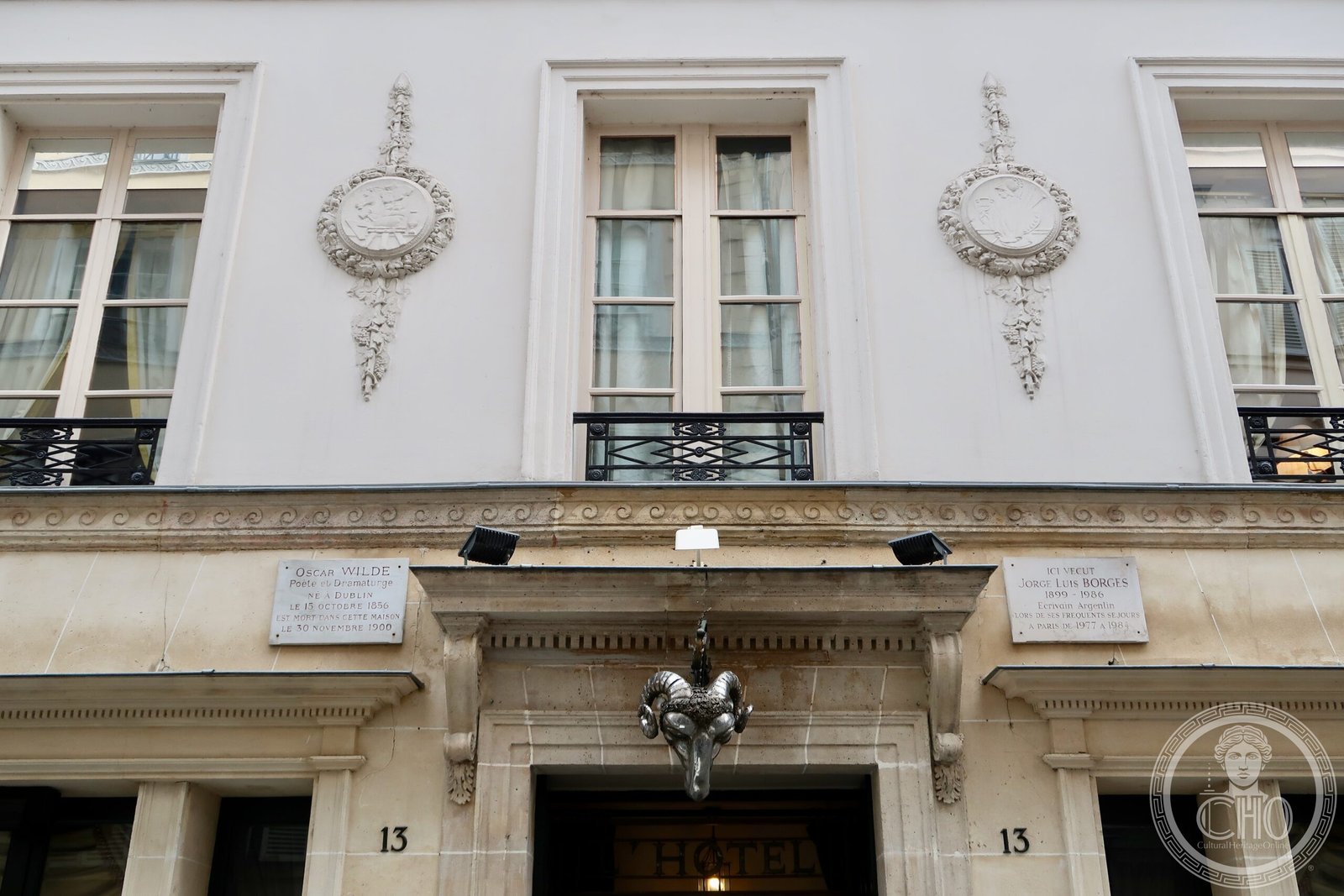
Oscar Wilde died here on 30 November 1900, in the room he called his “ugly wallpaper.” Today L’Hôtel is a five-star address that wears its literary history without apology.
At a glance
Built in 1828 in the heart of Saint-Germain-des-Prés, the building that became L’Hôtel has borne three names in its nearly two centuries of life. As the Hôtel d’Alsace it sheltered a destitute Oscar Wilde through his final weeks; under its current name since 1963, it operates as one of Paris’s most intimate luxury hotels, with twenty rooms spread across six floors. The layered history — literary, bohemian, aristocratic — makes it a living document of Left Bank cultural life.
Key facts
- Built: 1828, architect unknown
- Style: 19th-century Parisian townhouse; Belle Époque interiors
- Status: Operating five-star boutique hotel (20 rooms)
- Address: 13 Rue des Beaux-Arts, 75006 Paris, France
- GPS: 48.8563, 2.33512 — Open in Google Maps
- Listed: No national monument listing
History
The building opened in 1828 as the Hôtel d’Allemagne, a modest establishment on a street already thick with artists’ studios and the École des Beaux-Arts a few steps away. After the Franco-Prussian War of 1870–71 made the German name commercially awkward, the house was renamed Hôtel d’Alsace, taking its identity from the contested borderland province.
It was in this incarnation that Oscar Wilde checked in during the autumn of 1900, exiled from England, nearly broke, and in failing health following a prison term at Reading Gaol. He occupied room 16 on the upper floors, sustained by the goodwill of the proprietor Dupoirier. Wilde reportedly remarked of his surroundings: “I am dying beyond my means.” He died of cerebral meningitis on 30 November 1900. The hotel received other celebrated guests across the following decades — Marlon Brando, Mistinguett, and Jorge Luis Borges among them — the last of whom found the interior “sculpted by a cabinet maker.”
In 1963 the hotel was renamed simply L’Hôtel and began its transformation into a luxury address. The Wilde connection was preserved and celebrated: room 16 was redecorated in the spirit of his London apartment, with period furniture and peacock motifs. The hotel is now a five-star property managed with care for its Belle Époque and literary inheritance.
What you see
The façade is a restrained six-storey Parisian townhouse — stone, shuttered windows, a discreet entrance that betrays nothing of the interiors. The street is narrow and quiet, a few metres from the Boulevard Saint-Germain. Nothing announces a luxury hotel; that understatement is deliberate.
Inside, a circular staircase wound around a small lightwell gives the building its intimate vertical character. Each room is individually decorated; the Oscar Wilde Suite retains a theatrical flair with bold colours and decorative motifs drawn from Wilde’s own aesthetic writings. A small basement swimming pool, carved from the cellars, completes the sense of a private house rather than a hotel.
Practical information
- Hotel guests only for rooms; bar and restaurant open to non-residents
- The Oscar Wilde Suite can be booked and visited as part of a stay
- No formal guided tours; the front desk provides historical notes on request
- Best season: spring and autumn, when the 6th arrondissement is at its quietest
Getting there
The closest Métro stations are Saint-Germain-des-Prés (Line 4, two minutes on foot) and Mabillon (Line 10, four minutes). Charles de Gaulle airport is linked to central Paris by the RER B line; the journey to Saint-Michel–Notre-Dame takes approximately 45 minutes. From there, L’Hôtel is a ten-minute walk across the Seine.
Nearby
- École nationale supérieure des Beaux-Arts — the historic fine arts school directly opposite, with public exhibitions in its courtyards.
- Église Saint-Germain-des-Prés — Paris’s oldest church (6th century origins), two minutes on foot.
- Musée d’Orsay — the Impressionist and Art Nouveau collection in a converted railway station; fifteen minutes on foot along the river.
- Musée Delacroix — the painter Eugène Delacroix’s studio apartment, a five-minute walk through Place de Fürstenberg.
Sources
Find it on the map
See this place and what’s around it →📷 Become a Cultural Heritage Online photographer
Share your photos of places: they stay published under your name as the author. The more they're seen, the more you get noticed — and soon a contest will reward the most appreciated photos.
Log in or sign up free to add a photo