
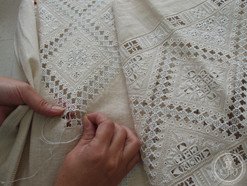
In the mountain villages of Lefkara, generations of lace-makers have practiced an exacting art, drawing threads through linen to build geometric patterns in white, brown, and ecru. Their needles move in practiced rhythms: hemstitching, satin filling, needlepoint edging—each technique refined over centuries into a craft of geometric precision and quiet mastery.
In UNESCO’s words
The tradition of lace-making in the village of Lefkara in southeastern Cyprus dates back to at least the fourteenth century. Influenced by indigenous craft, the embroidery of Venetian courtiers who ruled the country beginning in 1489, and ancient Greek and Byzantine geometric patterns, Lefkara lace is made by hand in designs combining four basic elements: the hemstitch, cut work, satin stitch fillings and needlepoint edgings. This combined art and social practice is still the primary occupation of women in the village who create distinctive tablecloths, napkins and show pieces while sitting together and talking in the narrow streets or on covered patios. Unique mastery of the craft is passed to young girls through years of informal exposure and then formal instruction by their mother or grandmother in applying cotton thread to linen. When she has learned her art thoroughly, the lace-maker uses her imagination to design work that embodies both tradition and her own personality. Testament to the ability to appreciate multiple influences and incorporate them into one’s own culture, lace-making is at the centre of daily life for women of Lefkara and a proud symbol of their identity.
Official description, UNESCO Intangible Cultural Heritage List — Lefkara laces or Lefkaritika
At a glance
Lefkara lace is a handmade tradition combining four basic techniques: hemstitch, cut work, satin stitch fillings and needlepoint edgings. Lace-makers produce distinctive tablecloths, napkins and show pieces using cotton thread on linen. The craft draws from indigenous practice, Venetian embroidery introduced in the late fifteenth century, and ancient Greek and Byzantine geometric patterns, blending these influences into a distinctive local art.
Origins & history
The tradition dates back at least to the fourteenth century in the village of Lefkara. It was shaped by indigenous craftsmanship and the embroidery techniques brought by Venetian courtiers who ruled the region from 1489 onward. The practice also absorbed ancient Greek and Byzantine geometric patterns, creating a layered heritage that artisans continue to draw upon.
The practice
Women of Lefkara learn lace-making through years of informal exposure followed by formal instruction from their mother or grandmother. They work sitting together in narrow streets or on covered patios, applying cotton thread to linen by hand. Once fully trained, each lace-maker designs her own work, combining the four basic techniques while expressing both tradition and personal creativity.
Cultural significance
Lace-making remains the primary occupation of women in Lefkara and stands at the centre of their daily life. The craft demonstrates the community's ability to appreciate multiple cultural influences and weave them into their own identity. It serves as a proud symbol of Lefkara women's skill and resourcefulness, passed down through generations as a valued mark of cultural belonging.
Key facts
- Country: Cyprus
- Inscribed: 2009
- UNESCO list: Representative List of the Intangible Cultural Heritage of Humanity
- UNESCO reference: 00255
- UNESCO vocabulary: Lace; Textile arts
- Map: Lefkara — the locality named in UNESCO’s official description of this element
Where to experience it
Lefkara, a village in southeastern Cyprus, remains the living centre of this centuries-old craft. Visitors can observe lace-makers at work in the narrow streets and covered patios where women gather to create distinctive tablecloths, napkins and show pieces while talking together. The villages preserve the spatial and social context in which the practice thrives, with the craft continuing to be transmitted informally from mother and grandmother to young girls through years of exposure and formal instruction.
Sources & resources
- UNESCO — official element page: Lefkara laces or Lefkaritika
- UNESCO — open data record: Intangible Heritage List, reference 00255
- UNESCO — official video: UNESCO film on this element — embedded on this page
- UNESCO — official photograph: Photograph of this element — Marketway, "Lefkara" Magazine — 2008 by Lefkara Municipality / Ministry of Education and Culture
- Reference — Wikipedia (secondary): Lefkara lace — consulted as a secondary reference, not as confirmation
- Cultural Heritage Online: Our archive and city guides

Find it on the map
See this place and what’s around it →📷 Become a Cultural Heritage Online photographer
Share your photos of places: they stay published under your name as the author. The more they're seen, the more you get noticed — and soon a contest will reward the most appreciated photos.
Log in or sign up free to add a photo