
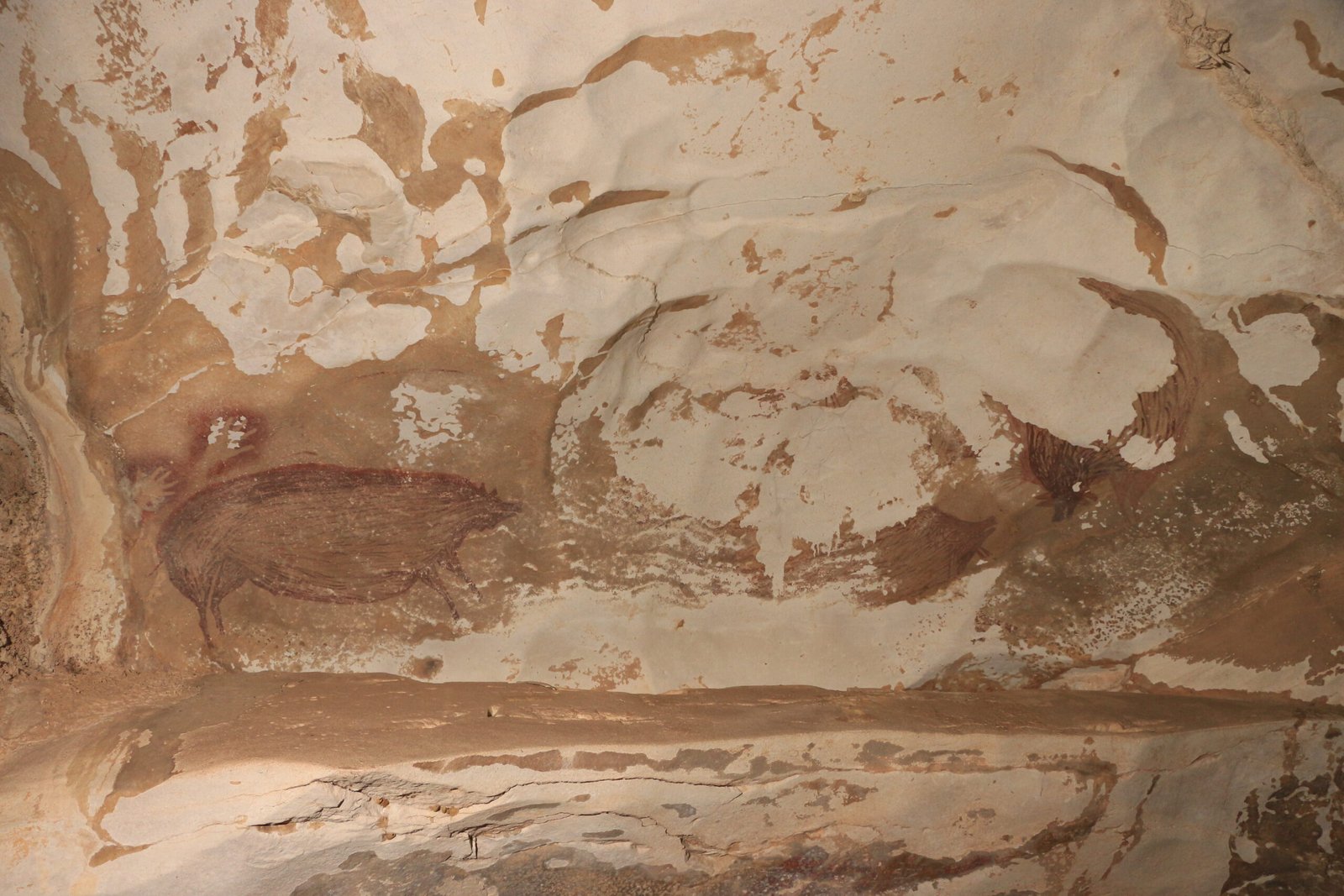
A remote limestone cave on the island of Sulawesi contains the world’s oldest known figurative painting: a warty pig rendered in reddish-purple pigment at least 45,500 years ago, pushing the origin of representational art from Europe to Southeast Asia and back by at least 9,500 years.
At a glance
Hidden inside a steep karst canyon in Maros Regency, Sulawesi — accessible only at low tide along a muddy path — Leang Tedongnge shelters a painting that rewrote the timeline of human artistic consciousness. In 2021, uranium-series dating of calcite crusts over the image confirmed a minimum age of 45,500 years, making it the oldest verified figurative artwork anywhere on Earth. The painting depicts a Sus celebensis (Sulawesi warty pig) in confident profile, flanked by three hand stencils. The discovery relocated the birth of figurative art from Pleistocene Europe to island Southeast Asia and raised profound questions about when and where modern human symbolic behaviour first emerged.
Key facts
- Age: Minimum 45,500 years (uranium-series dating, published 2021)
- Subject: Sus celebensis (Sulawesi warty pig), approximately 136 cm wide × 54 cm tall
- Technique: Reddish-purple pigment (ochre or haematite); three hand stencils by blow-spraying pigment around the hand
- Discovery: Site reached by researchers in 2017, dated and published by Maxime Aubert and team (Griffith University) in January 2021
- Complex: Part of the Maros-Pangkep karst, one of the world’s richest concentrations of Ice Age cave art with over 300 decorated caves
- Access: Closed to the public; academic permits required from Indonesian authorities (BRIN)
- Significance: Predates the oldest known European figurative paintings (Chauvet c. 36,000 BP) by at least 9,500 years
History
For decades, the consensus in prehistoric art held that figurative painting began in western Europe: Chauvet (c. 36,000 BP), Altamira and Lascaux (c. 17,000–35,000 BP) were the canonical reference points. This Eurocentric view was fundamentally challenged by fieldwork in the Maros-Pangkep caves of Sulawesi. In 2014, Aubert and colleagues published uranium-series dates for hand stencils at nearby Leang Timpuseng establishing a minimum age of 39,900 years — immediately comparable to the oldest European examples. The 2021 publication of Leang Tedongnge data moved the horizon back further: 45,500 years for the warty pig, the oldest confirmed figurative image in the world. Since comprehensive dating of the Maros-Pangkep complex continues, the actual oldest image may be older still.
The people who made this painting had reached Sulawesi by island-hopping from Southeast Asia during glacial periods when sea levels were lower. Their art — pigs, dwarf buffalo (anoa), hand stencils — and at nearby Leang Bulu’ Sipong 4 a narrative hunting scene with therianthropes (half-human, half-animal figures) dated to at least 43,900 years — demonstrates that figurative representation, narrative composition, and conceptual blending were already fully formed cognitive capacities tens of thousands of years before the same skills appeared in Europe. The cave was unknown to outsiders until 2011, when local informants led researchers to the canyon. The path through the gorge is only passable at low tide for part of the year.
The calcite crusts that had grown over portions of the painting were precisely what made scientific dating possible. Researchers drilled tiny samples of calcium carbonate from the crust, measured the ratio of uranium-238 to its daughter isotope thorium-230, and calculated the minimum elapsed time since the calcite began forming over the pigment. The underlying figure must be at least 45,500 years old; it may be older still if time passed before calcite began to accumulate.
What you see
On the back wall of the cave chamber, the warty pig occupies a prominent position on the pale limestone surface. Painted in dark reddish-purple pigment, the animal faces right in a confident profile. Its characteristic facial warts are clearly indicated, the ears are raised alertly, and the body proportions — rounded barrel torso, strong neck, short legs — accurately reflect the species. Two further animals are faintly visible at the compositional edges, their forms eroded by millennia of humidity and mineral deposition. Three hand stencils — made by pressing a hand against the wall and blowing pigment around it — appear in association with the pig.
The cave chamber is modest in size, its walls smoothed by ancient water action, the limestone a warm cream colour where it has not been darkened by time. The placement of the painting on the back wall means it was the focal point for anyone standing in the space — not a hidden mark but a deliberate composition in a deliberate location. The calcite now overlaying parts of the surface has preserved as much as it has obscured: without it, uranium-series dating would have been impossible and the painting’s age might never have been established.
Practical information
- Access status: Not open to the public. Research visits require authorisation from Indonesia’s BRIN (National Research and Innovation Agency) and Ministry of Education, Culture, Research and Technology.
- Visitor alternative: The Leang-Leang Prehistoric Park (Taman Prasejarah Leang-Leang) in Maros Regency is open to the public and contains accessible decorated caves with hand stencils and animal paintings.
- Region: Maros Regency, South Sulawesi Province, Indonesia. The karst area is approximately 40 km north of Makassar.
- Best season: Dry season (June–September) for path access; canyon passable only at low tide
Getting there
The nearest international airport is Sultan Hasanuddin International Airport (UPG) in Makassar, served by direct flights from Jakarta, Bali, Singapore, and Kuala Lumpur. The Maros-Pangkep karst area lies roughly 40 km north of Makassar by road. Leang Tedongnge itself is not signposted and its precise location is not publicly disclosed; the path through the karst canyon is only passable at low tide. Visitors wishing to engage with the broader cave art heritage should head for the publicly accessible Leang-Leang Prehistoric Park, where guided tours are available.
Nearby
- Leang-Leang Prehistoric Park — Public archaeological park in Maros with accessible painted caves and hand stencils, open daily
- Leang Bulu’ Sipong 4 — 43,900-year-old hunting scene with therianthropes in the same karst complex (restricted research access)
- Bantimurung–Bulusaraung National Park — Biodiversity hotspot adjacent to the cave complex, known for waterfalls and butterfly diversity
- Makassar (Fort Rotterdam) — 17th-century Dutch fortification in the South Sulawesi capital, 40 km south
Sources
- Brumm, A. et al. (2021). “Oldest cave art found in Sulawesi.” Science Advances 7(3), eabd4835. DOI: 10.1126/sciadv.abd4835
- Aubert, M. et al. (2019). “Earliest hunting scene in prehistoric art.” Nature 576, 442–445.
- Aubert, M. et al. (2014). “Pleistocene cave art from Sulawesi, Indonesia.” Nature 514, 223–227.
- Wikipedia: “Leang Tedongnge” — en.wikipedia.org
- Griffith University news release: “World’s oldest known cave painting discovered in Indonesia” (January 2021)
Find it on the map
See this place and what’s around it →📷 Become a Cultural Heritage Online photographer
Share your photos of places: they stay published under your name as the author. The more they're seen, the more you get noticed — and soon a contest will reward the most appreciated photos.
Log in or sign up free to add a photo