
The first city named in the ancient Mesopotamian king lists — and quite possibly the oldest continuously occupied urban centre on Earth — Eridu is a low mound in the southern Iraqi desert where 19 superimposed temples, stacked across three thousand years of unbroken worship, preserve the earliest known sequence of human religious architecture.
At a glance
Eridu (Tell Abu Shahrain) sits in the alluvial plain of southern Iraq, 20km southwest of Nassiriya. The Sumerian king lists declare it the first city of creation — where kingship descended from heaven to earth — and archaeology broadly supports that claim. Excavated principally by Fuad Safar between 1946 and 1949, the site revealed 19 superimposed temples spanning from c. 5400 BC to the Neo-Babylonian period, making it the type site of the Ubaid culture and the ancestral seed of all Mesopotamian urban civilisation. Today the site is part of the UNESCO World Heritage inscription of the Ahwar of Southern Iraq (2016).
Key facts
- Founded: c. 5400 BC (Ubaid period, oldest confirmed occupation)
- Dedicated to: Enki (Ea) — Sumerian god of wisdom, freshwater, and creation
- Temple sequence: 19 superimposed temples, covering c. 3,000 years of continuous religious use
- Cultural period: Ubaid (6500–3800 BC) — its type site; later Uruk, Ur III, Neo-Babylonian
- UNESCO status: Part of Ahwar of Southern Iraq WHS (2016)
- Excavated: Fuad Safar / Seton Lloyd, Iraq Department of Antiquities, 1946–1949
- Coordinates: 30.8117° N, 45.9939° E — near modern Abu Shahrain, Dhi Qar Governorate
History: the first city of creation
The ancient Sumerian myth of origins begins with a single sentence: After kingship had descended from heaven, Eridu became the seat of kingship. No other city in the ancient world carries a founding myth so explicitly tied to the dawn of civilisation — and for once, archaeology and mythology point in the same direction.
The Ubaid culture (c. 6500–3800 BC) is the foundational cultural horizon of all Mesopotamian civilisation: it introduced mud-brick architecture, irrigation canals, the temple-centred city, and the characteristic Ubaid painted pottery that marks its sites from the Persian Gulf to the Levant. Eridu is its type site — the place where this entire cultural package first appears in its mature, complete form. The earliest settlement dates to c. 5400 BC, when a small agricultural community established itself at the edge of a freshwater lagoon fed by the Euphrates. That community built the first of the 19 temples — a mud-brick platform barely 3 metres square, with an altar niche and an offering table — dedicated to Enki, the god of wisdom and the abzu (primordial freshwater ocean beneath the earth).
Over the following three millennia, each temple was ritually decommissioned, filled with clean sand, and a larger, more elaborate structure built directly above it. This practice of building on the bones of the previous temple is characteristic of Mesopotamian religious architecture: the accumulated mound (tell or ziggurat) was itself a sacred object, a visible record of continuous divine presence. By the Ur III period (c. 2100 BC), a full ziggurat rose from the summit. The city declined after the mid-second millennium BC as the water table dropped and the lagoon receded, but continued to be visited as a sacred site into the Neo-Babylonian period (c. 600 BC).
Eridu’s importance for understanding human history cannot be overstated: it is the ancestor of Uruk (the world’s first true large city), of Ur (the city of Abraham), of Babylon, and of every urban culture that followed. The sequence of temples stacked here constitutes the oldest continuous architectural record of human religious practice anywhere on the planet.
What you see: the tell and the temple sequence
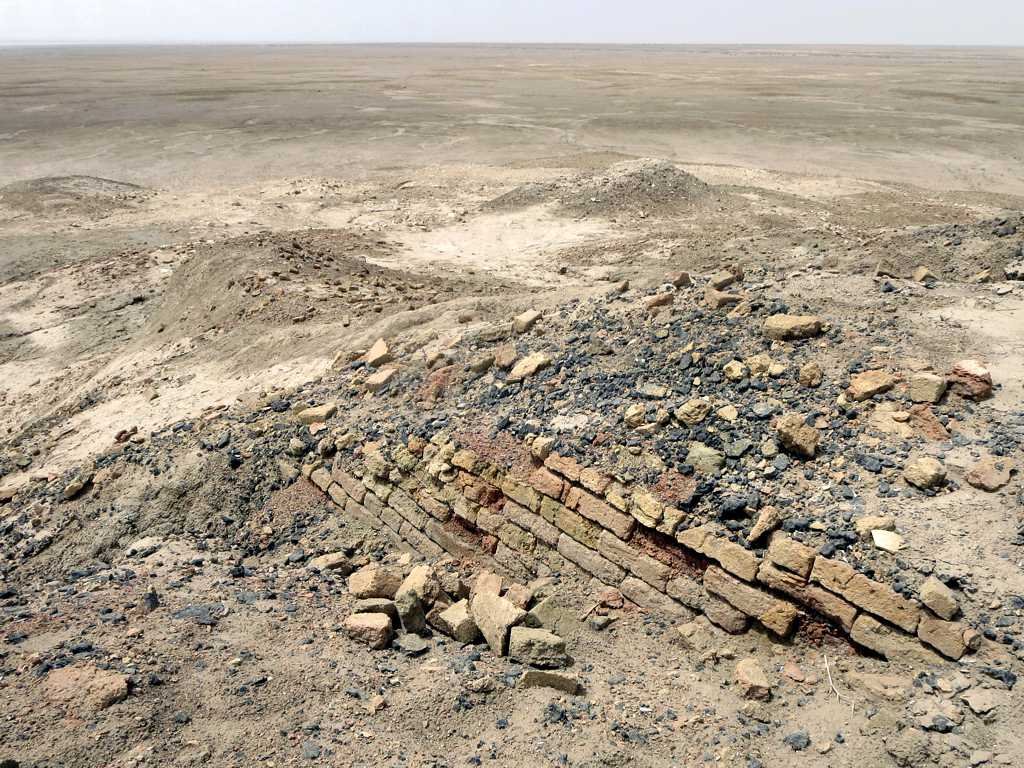
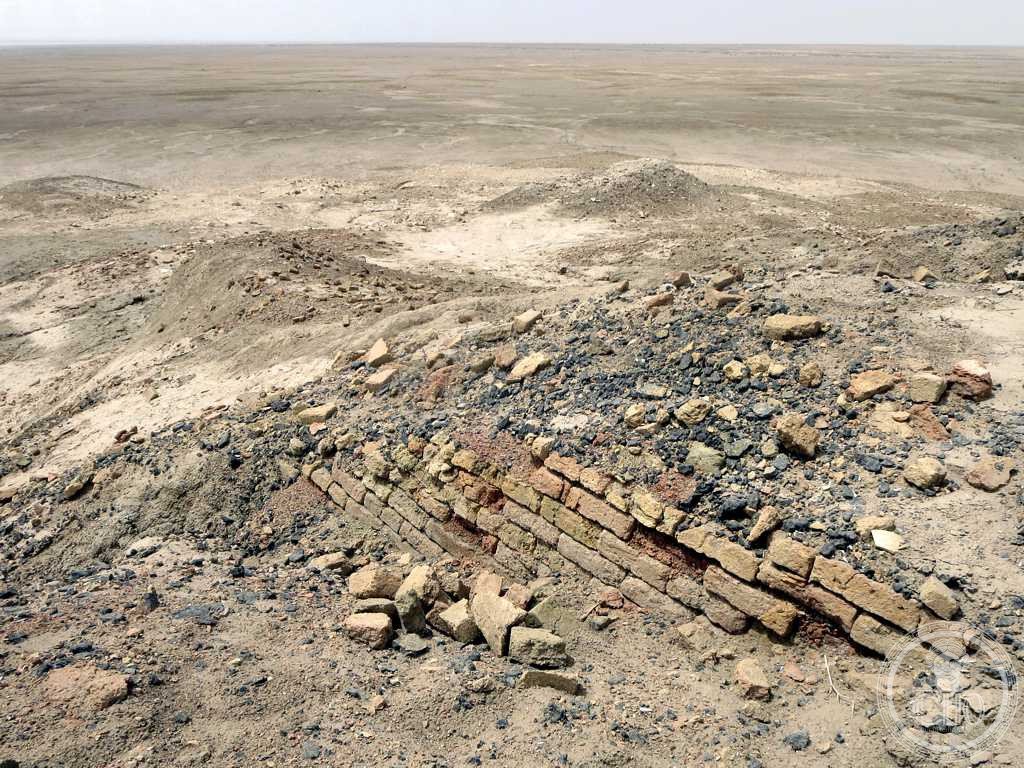
The site today is dominated by the eroded mound of accumulated ruins — a low, sandy hill rising perhaps 8 metres above the flat alluvial plain, its sides cut in several places by Safar’s excavation trenches. The scale is modest compared to Babylon or Ur, but what lies inside is extraordinary.
Temple I (c. 5400 BC): The earliest structure, a mud-brick platform approximately 3 × 3.5 metres, with a central offering table and a wall niche for a cult statue. This is the simplest possible temple form — barely distinguishable from a domestic shrine — but it is unmistakably dedicated religious space, and its axis aligns with every subsequent temple built above it across three thousand years.
Temple VIII (c. 4000 BC): By this stage, the temple had grown to a complex of multiple rooms on an elevated platform with an elaborate approach. The architectural evolution from Temple I to Temple VIII documents the emergence of the temple as the centre of civic and economic life — the model that would define Mesopotamian urbanism for three millennia.
The Ur III Ziggurat (c. 2100 BC): The topmost structure, now heavily eroded, was a multi-stage ziggurat — the towering stepped platform that is the canonical image of ancient Mesopotamia. Though less well-preserved than the Great Ziggurat of Ur (50km to the northeast), its summit would have been visible across the flat plain for many kilometres, a cosmic mountain connecting earth to heaven.
The excavation also revealed a large cemetery with over 1,000 burials dating to the Ubaid period, containing pottery, tools, and personal ornaments — one of the largest prehistoric cemeteries in Mesopotamia, providing extensive evidence for Ubaid burial practices and social organisation.
Practical information
- Location: Tell Abu Shahrain, Dhi Qar Governorate, southern Iraq — approximately 20km southwest of Nassiriya
- Access: The site is in a remote desert area; travel to southern Iraq requires careful security assessment and advance planning. Contact the Iraqi State Board of Antiquities and Heritage (SBAH) for current access conditions.
- On-site: There is no visitor infrastructure at the site itself. The excavation trenches and the ziggurat mound are visible; the major finds (pottery, grave goods) are in the Iraq Museum, Baghdad.
- Best season: October–April; summer temperatures exceed 45°C
- Nearest city: Nassiriya (Dhi Qar province capital) — gateway to several major Mesopotamian sites
Getting there
Eridu is approximately 20km southwest of Nassiriya, the principal city of Dhi Qar Governorate. Nassiriya is served by Nassiriya Airport (XNH) with connections to Baghdad. From Nassiriya, the site is accessible by road via Abu Shahrain village. Travel to southern Iraq for archaeological tourism is currently limited; travellers should consult current Foreign Office / State Department advisories and consider engaging a specialist archaeological tour operator with Iraq experience.
Nearby
- Great Ziggurat of Ur (50km NE) — the best-preserved Sumerian ziggurat, rising 30 metres from the plain; UNESCO WHS
- Uruk (Warka) (80km NW) — the world’s first large city (c. 3500 BC), birthplace of writing; UNESCO WHS
- Ahwar of Southern Iraq (Mesopotamian Marshes) — the ancient wetlands that surround this region, UNESCO WHS 2016 (natural + cultural double inscription)
Sources
- Safar, F., Mustafa, M. A., Lloyd, S. (1981). Eridu. Baghdad: State Organization of Antiquities and Heritage.
- Crawford, H. (2004). Sumer and the Sumerians (2nd ed.). Cambridge University Press.
- Potts, D. T. (1997). Mesopotamian Civilization: The Material Foundations. Cornell University Press.
- UNESCO World Heritage Centre — Ahwar of Southern Iraq: Refuge of Biodiversity and the Relict Landscape of the Mesopotamian Cities. whc.unesco.org/en/list/1481
- Wikipedia contributors. Eridu. Wikipedia, The Free Encyclopedia. en.wikipedia.org/wiki/Eridu
Find it on the map
See this place and what’s around it →📷 Become a Cultural Heritage Online photographer
Share your photos of places: they stay published under your name as the author. The more they're seen, the more you get noticed — and soon a contest will reward the most appreciated photos.
Log in or sign up free to add a photo