
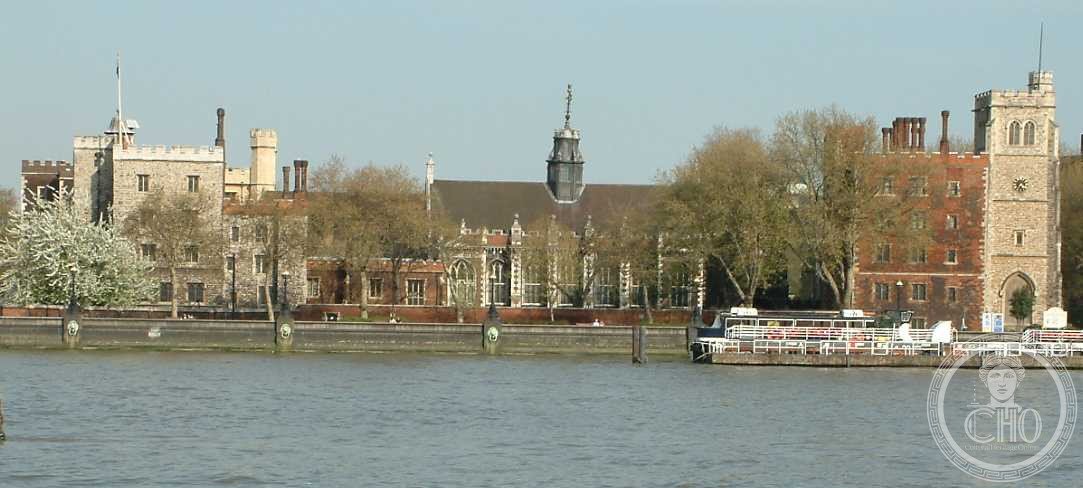
The official London residence of the Archbishop of Canterbury, commanding a strategic position on the south bank of the Thames opposite Parliament.
At a glance
Lambeth Palace stands on the south bank of the River Thames in north Lambeth, just 400 yards south-east of the Palace of Westminster. For over eight centuries, it has served as the primary London home of the Archbishop of Canterbury, one of the Church of England’s most senior figures.
History
The archbishopric acquired the estate around 1200, establishing a residence close to Westminster and the City of London. The proximity to Parliament and royal power made the location strategically valuable for the church’s leadership. The Archbishop of Canterbury maintains an additional residence at Old Palace in Canterbury.
What you see
The palace occupies a significant position on the Thames riverbank, its position commanding views across to Parliament. The estate’s layout reflects centuries of ecclesiastical use and architectural development.
Cultural significance
Lambeth Palace embodies the historical relationship between the Church of England and secular power. As the London residence of the Archbishop of Canterbury—the spiritual leader of the Anglican Communion—the palace represents both religious authority and institutional continuity spanning medieval to modern times.
Key facts
- Country: United Kingdom
- City: Lambeth, London
- Acquired: circa 1200
- Coordinates: 51.4956, -0.1197
- Current use: Official residence of the Archbishop of Canterbury
Practical information & getting there
Lambeth Palace is located on the south bank of the River Thames in central London, within walking distance of Westminster Bridge and other central London landmarks. Access to the palace itself is restricted, though the exterior can be viewed from the riverside. For visiting information, consult the Church of England’s official website.
Sources & resources
Find it on the map
See this place and what’s around it →📷 Become a Cultural Heritage Online photographer
Share your photos of places: they stay published under your name as the author. The more they're seen, the more you get noticed — and soon a contest will reward the most appreciated photos.
Log in or sign up free to add a photoIs this page about you?
This page is read by travellers and heritage enthusiasts who find it on Google. Tell us how you are connected to this place and we will take it from there.