
Eleven churches carved downward from living volcanic rock, not built up from blocks, make Lalibela one of the most singular achievements of medieval Christian architecture. It remains, eight centuries on, a working pilgrimage site rather than a monument frozen in the past.
At a glance
Lalibela is a small highland town in Ethiopia’s Amhara Region, built around eleven monolithic churches hewn from volcanic tuff during the reign of King Lalibela, roughly between 1181 and 1221 CE. Every church was excavated downward from the surface, leaving a stone monolith standing in an open pit, then carved with windows, doors and an interior space. The complex is inscribed as a UNESCO World Heritage Site and functions today as the most important pilgrimage centre of Ethiopian Orthodox Christianity.
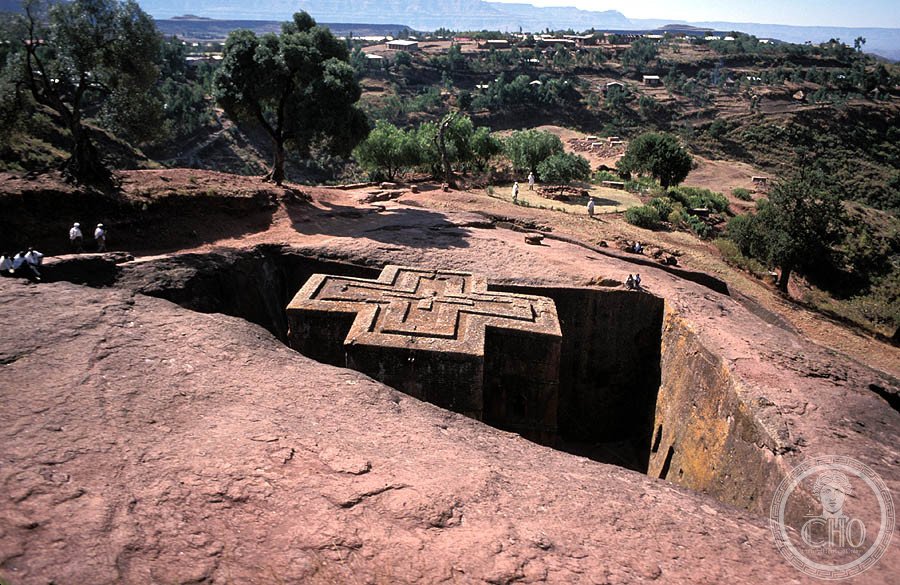
The best known of the eleven, Bete Giyorgis, or the Church of Saint George, stands isolated from the others in its own 15-metre-deep pit. Its flat roof is carved with three concentric Greek crosses aligned to the cardinal points, and the same cross pattern is repeated on the ceiling inside, where light entering through cross-shaped window openings falls across the walls.
Key facts
- Location: Lalibela, Amhara Region, Ethiopia
- Built: approximately 1181-1221 CE, reign of King Lalibela
- Dynasty: Zagwe Dynasty, which ruled northern Ethiopia from around 900 to 1270 CE
- Number of churches: 11 rock-hewn churches in two main groups plus the isolated Bete Giyorgis
- Status: UNESCO World Heritage Site, inscribed 1978
- Function: active Ethiopian Orthodox pilgrimage site, not a museum
History
Lalibela’s churches emerged from a period of change in the Ethiopian highlands. The Christian kingdom of Aksum, which had flourished for over a millennium, was weakened as Arab expansion along the Red Sea coast cut off the maritime trade on which it depended. Inland Agaw communities that had long been in contact with Aksum gave rise to the Zagwe Dynasty, which ruled from its capital at Roha, later renamed Lalibela.
The town’s namesake ruler, born Gebre Meskel and said to have been surrounded by bees as an infant, a sign read as divine favour, commissioned or personally inspired the church complex during his reign, roughly 1181 to 1221 CE. Ethiopian tradition holds that the churches were conceived as a New Jerusalem, built after pilgrimage to the real Jerusalem became impossible under Muslim control, and that angels assisted the work at night, doubling its pace. A German-Ethiopian archaeological team studying the mortar and construction techniques has suggested that parts of the complex may predate Lalibela’s reign and others postdate it, though the core construction belongs to the 12th and 13th centuries.
In 1270 the Zagwe Dynasty was displaced by the Solomonic Dynasty, which claimed descent from Solomon and the Queen of Sheba. The new rulers promoted the legend of Lalibela’s angelic builders, a story that helped establish the churches as a sacred site independent of the deposed Zagwe line.
What you see
The Northern Group is the largest cluster. Bet Medhane Alem, the House of the Saviour of the World, is the biggest of the eleven churches, measuring 33.5 by 23.5 by 11.5 metres and built on a basilica plan with 34 columns arranged in four rows, a four-aisled interior and five apses. Nearby stands Bet Maryam, the House of Mary, thought to be the oldest of the churches and possibly predating Lalibela’s reign; it is also the most visited, and its walls and ceiling carry frescoes dated to the 12th or 13th century, among the most visible medieval paintings in the complex.
The Golgotha cluster, comprising Bet Debre Sina, Bet Golgotha, Bet Mikael and the Tomb of Adam, is considered the holiest group; only men are admitted to Bet Golgotha, and Lalibela’s tomb is traditionally placed here. The Southeast Group includes Bet Amanuel, noted for the sophistication of its carved exterior, and Bet Gabriel-Rufael, perched on a cliff and reached by a long rock-cut bridge.
Bete Giyorgis stands apart from both groups, isolated in its own pit and cut as a precise 12-metre cube in the form of a Greek cross. It is the most photographed of the eleven churches and is widely regarded as the most accomplished piece of carving in the complex.
Practical information
- Guides: a licensed local guide is strongly recommended, since they know the liturgical calendar, current church closures and details easy to miss when visiting alone
- Entry: a ticket covers the full circuit of the eleven churches; check current prices through official channels before travelling
- Best time to visit: the dry season from November to May; Lalibela sits at around 2,500 metres and stays cool year-round
- Festivals: January brings Genna, Ethiopian Christmas, and Timkat, Ethiopian Epiphany, both major pilgrimage events and the most crowded and spectacular time to visit; September, at the end of the rainy season, brings muddy trails and flooded church pits
Getting there
Lalibela has its own airport with a limited number of weekly flights from Addis Ababa. An alternative route is to fly to Bahir Dar and continue overland, a journey of several hours by road. Travellers should check current flight schedules and road conditions with official carriers and tourism authorities before planning a visit.
Nearby
- Northern Group churches — clustered together in the town centre around Bet Medhane Alem and Bet Maryam
- Golgotha cluster — adjoining the Northern Group, the holiest section of the complex
- Bete Giyorgis — a short walk from the other groups, standing alone in its own carved pit
- Bahir Dar — reachable overland or by short flight, an alternative gateway to the region
Sources
- UNESCO
Find it on the map
See this place and what’s around it →📷 Become a Cultural Heritage Online photographer
Share your photos of places: they stay published under your name as the author. The more they're seen, the more you get noticed — and soon a contest will reward the most appreciated photos.
Log in or sign up free to add a photoIs this page about you?
This page is read by travellers and heritage enthusiasts who find it on Google. Tell us how you are connected to this place and we will take it from there.