
Baalbek

Baalbek Lebanon Temple of Jupiter Roman columns Heliopolis UNESCO World Heritage
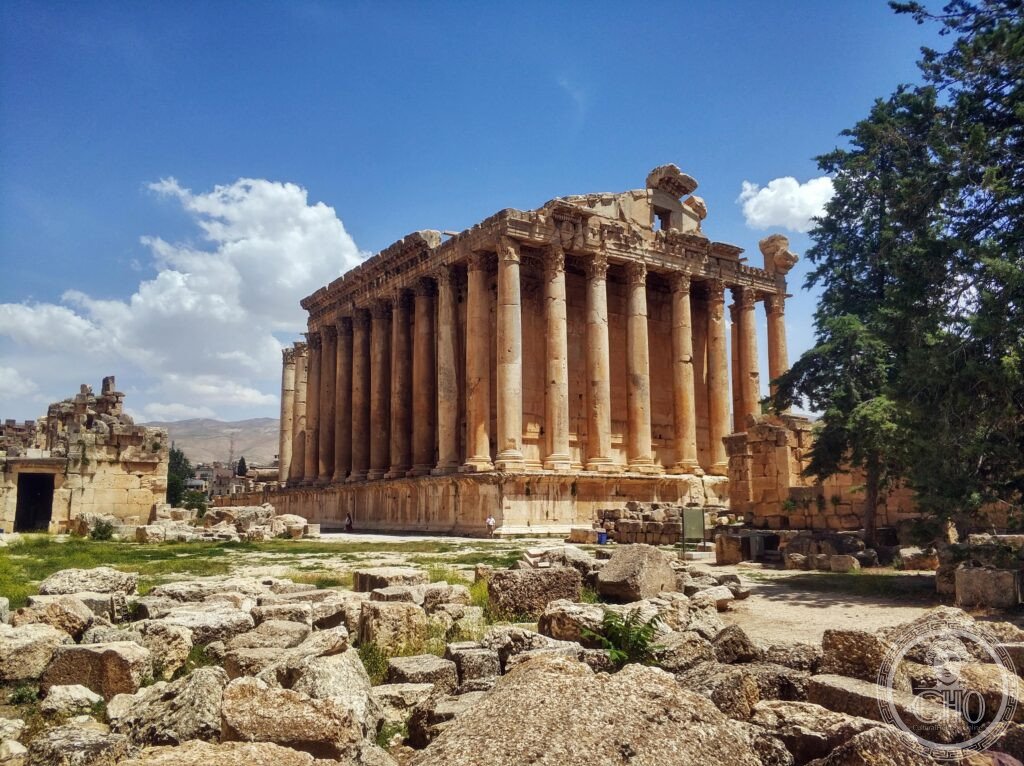
Temple of Jupiter and the six surviving Corinthian columns, Baalbek (Heliopolis), Beqaa Governorate, Lebanon (the most precisely BaalbekLebanon single Temple of Jupiter Heliopolitan Zeus Roman imperial architecture largest temple complex Roman world 89m wide 88m long 6 of 54 original columns surviving 20m tall 2.2m diameter monolithic granite quarried Aswan Egypt Phoenician platform fills trilithon three largest stone blocks ever placed human construction 750 tons each 21m long Jupiter Optimus Maximus Heliopolitanus the most sacred site of Roman Syria Jupiter temple 88m long 89m wide UNESCO heritage: the Temple of Jupiter (the largest Roman temple ever built: 88m wide × 89m long × 52m tall (the original full height with the roof); 54 Corinthian columns (each 20m tall; 2.2m diameter at the base; the 6 surviving columns (of the original 54; 54-6=48 columns either destroyed by earthquakes, used as building material, or dismantled for the Byzantine church built inside the temple after 535 CE when the Emperor Justinian ordered the pagan temples closed); the monolithic columns (each column is cut from a single block of Egyptian granite quarried at Aswan (the Aswan granite appears in its distinctive orange-grey color); the transportation of 20m × 2.2m granite monoliths from Aswan, Egypt (2,500 km by Nile barge and Mediterranean ship) to Baalbek (120 km inland from the Lebanese coast) is one of the great engineering feats of antiquity)); the Trilithon (the most enigmatic element of Baalbek: the three largest stones ever placed in a construction in human history (750 tons each; 21m × 4m × 3.5m); laid in the western wall of the Temple of Jupiter’s podium at a height of 7m above the ground level; how the Roman engineers moved 750-ton stones is not known from any surviving Roman text)), Baalbek (Heliopolis), Beqaa Governorate, Lebanon. UNESCO World Heritage Site 1984. Photo via Wikimedia Commons.
Beqaa Governorate, Lebanon · Roman Heliopolis 1st-3rd century CE; Temple of Jupiter (largest Roman temple); Trilithon 750-ton stones; Temple of Bacchus; UNESCO WHS 1984

Baalbek

The largest Roman temple complex in the world and home to the three heaviest stones ever placed in a human construction — Baalbek (Beqaa Governorate, Lebanon; UNESCO WHS 1984) was the Roman city of Heliopolis, where from the 1st to 3rd centuries CE the Roman emperors built the Temples of Jupiter, Bacchus, and Venus using Egyptian granite columns and a podium of stones weighing up to 750 tons each.

At a glance

Baalbek (the most precisely BaalbekLebanon single Roman Heliopolis 1st 3rd century CE Temple Jupiter largest Roman temple complex world 88m wide 89m long 54 Corinthian columns 20m tall 2.2m diameter Egyptian granite Aswan 6 surviving 20m columns earthquakes Byzantine 535 CE Justinian pagan temples closed Trilithon three stones 750 tons each 21m long 4m wide 3.5m thick largest human construction stones Quarry stone 1000 tons unfinished still in situ Temple Bacchus 69m long best preserved Roman Corinthian temple 42 columns UNESCO heritage: the name (Baalbek = “Lord of the Beqaa Valley” in the Phoenician language; Baal = “Lord/Master” in Phoenician; Bek/Beq = the local name for the Beqaa Valley; the Romans renamed the city Heliopolis (“City of the Sun”; the same name as the ancient Egyptian sacred city near Cairo); the Heliopolitan Triad (the three deities worshipped at Baalbek under Roman rule: Jupiter Heliopolitanus (a Romanized version of the Phoenician Baal, associated with storms and the sky), Venus Heliopolitana (the fertility goddess), and Mercury (equated with the Phoenician Adonis)); the scale (the Temple of Jupiter at Baalbek is larger than the Parthenon in Athens by area; larger than the Temple of Hadrian at Ephesus; the largest column drums ever quarried)) — the most precisely BaalbekLebanon single Baal Beqaa Valley Phoenician Heliopolis City Sun Roman Heliopolitan Triad Jupiter Venus Mercury Temple Jupiter 88m 89m 54 columns 20m 2.2m Egyptian granite Aswan 6 surviving earthquakes Byzantine 535 CE Justinian Trilithon 750 tons 21m 4m 3.5m largest human construction stones UNESCO heritage in any UNESCO world heritage site)).

Key facts

  • The Trilithon: the most precisely BaalbekLebanon single Trilithon three stones 750 tons each 21m × 4m × 3.5m podium height 7m above ground Quarry Stone 1000 tons fourth largest stone ever quarried still in situ 500m quarry Roman engineering mystery no ancient text explains how Roman cranes pulleys capstans calculated UNESCO heritage — the defining engineering mystery: the Trilithon (three individual stones; 750 metric tons each (a modern loaded semi-truck weighs approximately 40 tons; these stones are 18 loaded semi-trucks each); placed at a height of 7m above the Roman ground level; in the western podium wall of the Temple of Jupiter; the quarry (500m southwest of the temples; the Quarry Stone (the Stone of the Pregnant Woman in Arabic; Hajar el-Hibla) is the largest single stone ever quarried: approximately 1,000 tons, still in situ, cut and abandoned (possibly too heavy to move); the two other similar stones at the quarry were quarried in 2014 CE (the largest at approximately 1,650 tons; the second-largest at approximately 1,240 tons); the mystery (no Roman text, plan, or engineering manual survives that describes how 750-ton stones were moved and placed at 7m height; the proposed methods (earthen ramps, wooden sleds, levers, wooden wheels) are all controversial))
  • GPS: 34.0040° N, 36.2090° E

History

From Phoenician sacred site to Roman imperial complex to Arab fortress (the most precisely BaalbekLebanon single Phoenician Bronze Age sacred site Baal worship 2nd millennium BCE Hellenistic Seleucid Antiochus IV Epiphanes 175 163 BCE first Greek temple Roman colony Julius Caesar 47 BCE Augustus Heliopolitan Triad Temple Jupiter 1st century CE Domitian Trajan Antoninus Pius 138 161 CE Temple Bacchus best preserved Byzantine 535 CE Justinian Arab Umayyad fortress earthquake 1759 CE UNESCO heritage: the Bronze Age sacred site (the site at Baalbek was sacred in the 2nd millennium BCE: the ancient cult of Baal (the storm god) at the spring/water source at the foot of the anti-Lebanon mountains; the Phoenician sanctuary at the site before Greek or Roman occupation)); the Hellenistic period (333-63 BCE: Alexander the Great passed through the Beqaa Valley in 332 BCE; the Seleucid ruler Antiochus IV Epiphanes (reigned 175-163 BCE) began a Hellenistic sanctuary at the site)); the Roman period (47 BCE-285 CE: Julius Caesar established Baalbek as a Roman colony (Colonia Julia Augusta Felix Heliopolitana) in 47 BCE; the Temple of Jupiter construction began under Augustus; the complex was built over 250 years (approximately 1st century BCE-3rd century CE); the Temple of Bacchus (completed approximately 150 CE under the Emperor Antoninus Pius (r. 138-161 CE); the best-preserved Roman Corinthian temple in the world)); the medieval period (634 CE: Islamic conquest; the Arab fortress reused the Roman stones; the Mamluks (13th-16th centuries CE) modified the Arab fortress further; 1759 CE: an earthquake destroyed the northern colonnade of the Temple of Jupiter (reducing the 54 columns to 6 survivors)) — the most precisely BaalbekLebanon single Phoenician Bronze Age Baal worship 2nd millennium BCE Hellenistic Antiochus IV 175 163 BCE Julius Caesar Roman colony 47 BCE Augustus Jupiter Temple 1st century BCE Antoninus Pius 138 161 CE Temple Bacchus completed Byzantine 535 CE Justinian pagan closed Arab fortress earthquake 1759 CE 54 columns reduced to 6 UNESCO heritage in any UNESCO world heritage site)).

What you see

Temple of Jupiter, Temple of Bacchus, and Temple of Venus (the most precisely BaalbekLebanon single Temple Jupiter 6 of 54 surviving Corinthian columns 20m tall 2.2m diameter Egyptian granite Aswan west podium Trilithon 750 tons 21m Great Court porticoed courtyard hexagonal forecourt propylaea monumental entrance 12m columns Temple Bacchus 69m long best preserved Roman Corinthian temple world 42 columns door 12m tall most elaborate carved doorway Roman arch Temple Venus circular cella round temple unusual form 4 columns UNESCO heritage: the visitor circuit: the Propylaea (the monumental entrance gate to the temple complex; the columns 12m tall; largely destroyed but the foundations visible); the hexagonal Forecourt (an unusual hexagonal courtyard between the Propylaea and the main Great Court (the main courtyard of the Jupiter temple complex; the exedra (the semicircular apses) on the long sides where worshippers gathered)); the Temple of Jupiter (the main temple; the 6 surviving columns dominate the skyline from anywhere in Baalbek; the view from the temple platform across the Beqaa Valley is outstanding; the Trilithon (in the west wall of the podium, accessible via a staircase under the podium)); the Temple of Bacchus (the most intact Roman temple in the world for size (69m long; 42 Corinthian columns; the interior cella preserved; the decorated ceiling coffers; the monumental doorway (12m tall; the most elaborate carved doorway in Roman architecture, with a full program of gods and mythological scenes in the pediment above))); the Temple of Venus (a small circular temple 200m south of the main complex; the unusual round form; the concave niches in the outer wall; one of the few surviving examples of Roman circular temple design)) — the most precisely BaalbekLebanon single Temple Jupiter 6 of 54 Corinthian 20m 2.2m Egyptian granite Trilithon 750 tons Great Court hexagonal Propylaea Temple Bacchus 69m 42 columns best preserved Roman Corinthian world doorway 12m elaborate carved Temple Venus circular concave niches round form UNESCO heritage in any UNESCO world heritage site)).

Practical information

  • Getting there: fly to Beirut Rafic Hariri International Airport (BEY; the main international hub; approximately 87 km west of Baalbek; flights from major European hubs (Paris CDG: 4h; Frankfurt FRA: 3h30m; Istanbul IST: 1h30m; Rome FCO: 3h15m; Dubai DXB: 3h)); the taxi/service from Beirut (service (shared taxi): from the Cola transport hub in south Beirut; approximately 1.5h-2h; approximately USD 5-7 (shared) or USD 40-50 (private taxi)); the bus from Beirut (the LCC bus from Dawra bus station in north Beirut to Baalbek; approximately 2h; approximately USD 2-3); the security note (2024-2026: check current advisories for the Beqaa Valley (the region was affected by the 2024 Israel-Lebanon conflict; monitor EU/US travel advisories before visiting)); the entry fee (approximately USD 10 for foreign visitors)

Getting there

Fly to Beirut (BEY, 87 km). Service taxi from Cola hub ~2h, USD 5-7 shared. Entry ~USD 10. Check current travel advisories before visiting. GPS: 34.0040, 36.2090.

Nearby

  • Anjar — 55 km southwest (UNESCO WHS 1984; the only Umayyad city in Lebanon; a planned city built by the Caliph Walid I (r. 705-715 CE) in a single phase of construction; the grid plan (the Umayyad city was planned on a Roman city model: a cardo and a decumanus crossing at the center; the tetrapylon at the crossing; the palace complex in the northeast quadrant); the exceptional preservation of the city plan (the city was abandoned after the Abbasid Caliphate sacked it in 750 CE; its short occupation means it was never substantially modified, preserving the original Umayyad urban plan))
  • Niha temples — 25 km southwest (the two Roman temples in the village of Niha (in the Matn mountains); the Temple of Hadaranes (1st-2nd century CE; dedicated to the local divinity Hadaranes, a Semitic deity equated with Mercury); one of the best-preserved Roman rural temples in Lebanon; rarely visited)

Sources

  • Wikipedia, Baalbek; Temple of Jupiter, Baalbek; Temple of Bacchus; Trilithon, accessed June 2026
  • UNESCO, Baalbek, WHS reference 294, inscribed 1984

Hero image: Baalbek, Lebanon, Wikimedia Commons. Editorial text © Cultural Heritage Online, 2026.

📷 Diventa un fotografo di Cultural Heritage Online

Condividi le tue foto dei luoghi: restano pubblicate con la tua firma come autore. Più vengono viste, più ti fai conoscere — e presto un concorso premierà le foto più apprezzate.

Accedi o registrati gratis per aggiungere una foto
📋 Copy & share on social
Scroll to Top