
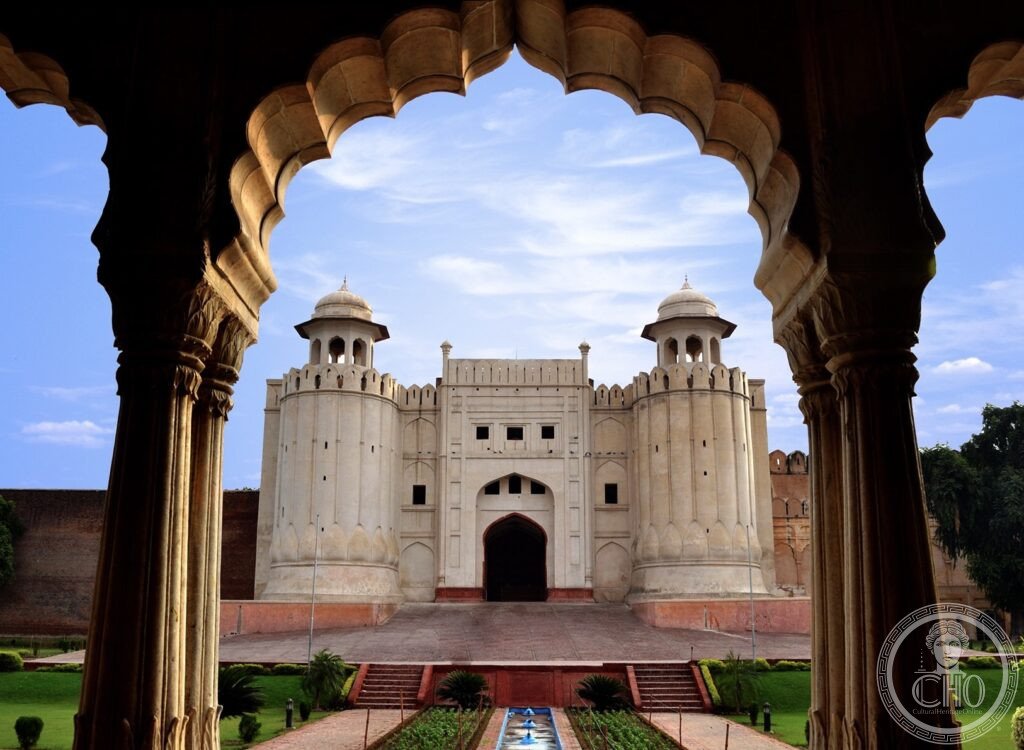
The principal surviving monument of Mughal imperial power in Pakistan — a walled citadel on the western edge of Lahore’s old city, rebuilt and extended by the great Mughal emperors Akbar, Jahangir, Shah Jahan, and Aurangzeb (1556–1707), whose principal surviving interior (the Naulakha Pavilion, white marble with polychrome pietra dura inlay) was built for the same emperor who commissioned the Taj Mahal, and whose Picture Wall (the exterior of the Jahangiri Quadrangle, the first use of glazed-tile pictorial decoration on Mughal palace walls) is the most important tile ensemble in South Asia.
At a glance
Lahore Fort (Urdu: لاہور قلعہ, Lahōr Qal’a; also known as Shahi Qila, “Royal Fort”) is a citadel in the north-west corner of the old city of Lahore, Punjab, Pakistan. The fort was the principal residence and administrative centre of the Mughal Empire during its period in Lahore (which served as the Mughal capital for much of the 16th and 17th centuries); the surviving structures date primarily from the reigns of Akbar (r. 1556–1605), Jahangir (r. 1605–1627), Shah Jahan (r. 1628–1658), and Aurangzeb (r. 1658–1707). The Shalimar Gardens (5 km east of the fort) were laid out by Shah Jahan in 1641–42 as a chahar bagh (quartered garden of paradise); both the fort and the gardens were inscribed by UNESCO in 1981.
Key facts
- The Picture Wall (1624–1631): the northern exterior wall of the Jahangiri Quadrangle — a 400-metre expanse of glazed-tile pictorial panels on the exterior of the palace wall (facing the street, not the courtyard); the panels depict scenes of court life, hunting, elephant fights, acrobats, horses, and decorative arabesques in yellow, blue, turquoise, and white on a red brick ground; this was the first time Mughal palace architecture used pictorial tile decoration on an exterior wall (all earlier Mughal tile work was geometric or calligraphic, and interior); the technique was adapted from the Safavid Persian tradition but the pictorial programme is distinctly Mughal.
- Naulakha Pavilion (c. 1631–1633): a small audience hall built by Shah Jahan (the same emperor who commissioned the Taj Mahal and the Red Fort of Delhi); named ‘Nau Lakh’ (“nine lakhs” of rupees, the construction cost); entirely of white marble with polychrome pietra dura (inlaid precious and semi-precious stones in floral and geometric patterns); the curved Bengal-roof form (unusual in Mughal architecture) and the elaborate jali (stone screen) windows with intricate geometric pierced patterns are the most technically refined elements; the same craftsmen who worked on the Taj Mahal are believed to have worked here.
- Alamgiri Gate (1673): the main western entrance to the fort, built by Aurangzeb (Emperor Alamgir); two massive semicircular bastions with octagonal towers flank the entrance; the gate faces the Badshahi Mosque (1673, also by Aurangzeb), the second-largest mosque in the world at the time of its construction; the alignment of the gate and the mosque (directly opposite each other across the Hazuri Bagh garden) was deliberate — the largest mosque in the Mughal Empire facing the palace gate.
- Shalimar Gardens (1641–42): 5 km east of the fort, the Shalimar Gardens are the best surviving example of a chahar bagh (quartered garden of paradise) from the Shah Jahan period; three terraced levels of gardens are connected by a central water channel and cascades; the third (uppermost) terrace has a large pavilion and fountains; the garden covers 16 hectares; the layout follows the Persian-influenced tradition of the garden as a representation of paradise (the word ‘paradise’ derives from the Old Persian ‘pairidaeza,’ a walled garden).
- Heritage: UNESCO World Heritage Site, Fort and Shalimar Gardens in Lahore, inscribed 1981.
- GPS: 31.5884° N, 74.3155° E.
History
A fort has stood on the site of Lahore Fort since at least the 11th century (the earliest references date from the reign of Sultan Mahmud of Ghazni, who sacked Lahore in 1021 AD); the current structure is almost entirely Mughal, built in stages over 150 years. Emperor Akbar began the systematic rebuilding of the fort in fired brick (1566), replacing the earlier mudbrick structures; Akbar’s walls and towers form the outer perimeter. Jahangir added the Jahangiri Quadrangle (1617) and the Picture Wall; Shah Jahan added the Diwan-i-Am (public audience hall), the Shish Mahal (“Palace of Mirrors”, with mirror-mosaic vaulting), and the Naulakha Pavilion; Aurangzeb added the Alamgiri Gate (1673) and the Moti Masjid (Pearl Mosque).
After the collapse of Mughal power in the 18th century, the fort was occupied successively by the Afghan Durrani dynasty (who damaged many of the interior decorations), the Sikh Empire of Maharaja Ranjit Singh (who used the fort as a royal residence and added the Sikh-era Hazuri Bagh pavilion in the outer garden), and the British East India Company (which used the fort as a military barracks from 1849, causing further damage and some demolitions). Pakistan’s Archaeology Department has managed the fort since independence in 1947; conservation work (including restoration of the Picture Wall and the Naulakha Pavilion) has been ongoing since the 1970s.
What you see
The fort is entered through the Alamgiri Gate (west side), which opens onto the Hazuri Bagh (a garden with a white marble pavilion built by Ranjit Singh in 1818 from marble plundered from Mughal tombs in Lahore). Turning left from the gate brings you to the Picture Wall — the 400-metre exterior tile panel sequence, best seen in morning light from the street side. The interior is organised around several courtyards; the essential route covers the Diwan-i-Am, the Shish Mahal (Palace of Mirrors — the interior is encrusted with mirror-glass mosaic pieces set in plaster, creating a flickering light effect when candle-lit), the Naulakha Pavilion (the quietest and most refined space in the fort), and the view from the upper terrace toward the Badshahi Mosque.
The Shalimar Gardens (a separate visit, 5 km east by car or rickshaw) require a full hour for unhurried walking through the three terraced levels. The lowest terrace (the ‘ordinary garden’) is open to the public daily; the middle and upper terraces contain the pavilions and the main water features. The gardens are at their best in spring (March–April, when the flowering trees and rose beds are in bloom) and early autumn (September–October); the summer heat (May–September, 38–45°C) makes the stone surfaces uncomfortable.
Practical information
- Admission: Lahore Fort PKR 500 (approximately €1.60) for foreign visitors; Shalimar Gardens PKR 200; both sites are open daily from 8:30 am to 5:30 pm (last entry 5 pm); the fort is a UNESCO site but the conservation state is variable — some sections are closed for ongoing restoration; guided tours are available from the entrance and are recommended for the Picture Wall and the interior rooms.
- Getting there: Allama Iqbal International Airport (LHE) in Lahore has direct flights from Dubai, Abu Dhabi, Doha, Kuala Lumpur, Toronto (with a stop), and London (seasonal); from the airport, the fort is approximately 30 km by road (40–60 minutes by Uber/Careem, ~PKR 800–1200, €2.50–4); the fort is at the northern edge of Lahore’s old city (Walled City of Lahore), adjacent to the Delhi Gate; the old city is best explored on foot from the fort.
- Walled City of Lahore: the fort is the north anchor of the Walled City of Lahore (a separate UNESCO Tentative List site); the food street at Gawalmandi, the Wazir Khan Mosque (1635, the most elaborately tile-decorated mosque in Pakistan), and the Delhi Gate are all within walking distance; the Lahore Museum (1894, originally visited by Kipling’s ‘Kim’) is 2 km south on Mall Road.
Getting there
Allama Iqbal International Airport (LHE) is 30 km from the fort. Uber/Careem from the airport (~40–60 min). The fort is at the north edge of the Walled City of Lahore, walkable from Delhi Gate. GPS: 31.5884, 74.3155.
Nearby
- Badshahi Mosque — the largest mosque in the world at the time of its construction (1673, Aurangzeb), directly opposite the Alamgiri Gate of the fort across the Hazuri Bagh garden; the prayer hall (capacity 100,000, 1.3 million for special occasions using the courtyard) is still one of the largest in the world; the red sandstone and white marble construction is the final masterpiece of Mughal imperial architecture; still in active use for Friday prayers.
- Wazir Khan Mosque (1635) — within the Walled City, 1 km south-east of the fort; the most elaborately decorated mosque in Pakistan, with the entire interior (courtyard walls, interior vaults, minaret shafts) covered in kashi kari (glazed tile mosaic) in floral and geometric patterns; the colour palette (deep blue, yellow, green, and white on red brick) is among the most beautiful in Mughal religious architecture; a major conservation programme (Aga Khan Trust for Culture + Walled City of Lahore Authority, begun 2009) is restoring the tile work.
- Lahore Museum — on Mall Road (The Mall), 2 km south of the fort; founded 1894, the Lahore Museum is the best museum in Pakistan, with collections covering Indus Valley Civilisation artefacts (3000–1500 BC), Gandharan Buddhist sculpture (1st–5th century AD), Mughal miniature painting, arms and armour, and Islamic calligraphy; Rudyard Kipling’s father Lockwood Kipling was curator 1875–1894; the museum appears in the opening pages of Kipling’s Kim (1901).
Sources
- Wikipedia, Lahore Fort; Shalimar Gardens, Lahore, accessed June 2026.
- UNESCO, Fort and Shalimar Gardens in Lahore, WHS reference 171, inscribed 1981.
- Catherine Asher, Architecture of Mughal India, Cambridge University Press, 1992 — the standard art-historical analysis of the fort buildings.
- Ebba Koch, Mughal Art and Imperial Ideology, Oxford University Press, 2001.
Find it on the map
See this place and what’s around it →📷 Become a Cultural Heritage Online photographer
Share your photos of places: they stay published under your name as the author. The more they're seen, the more you get noticed — and soon a contest will reward the most appreciated photos.
Log in or sign up free to add a photo