

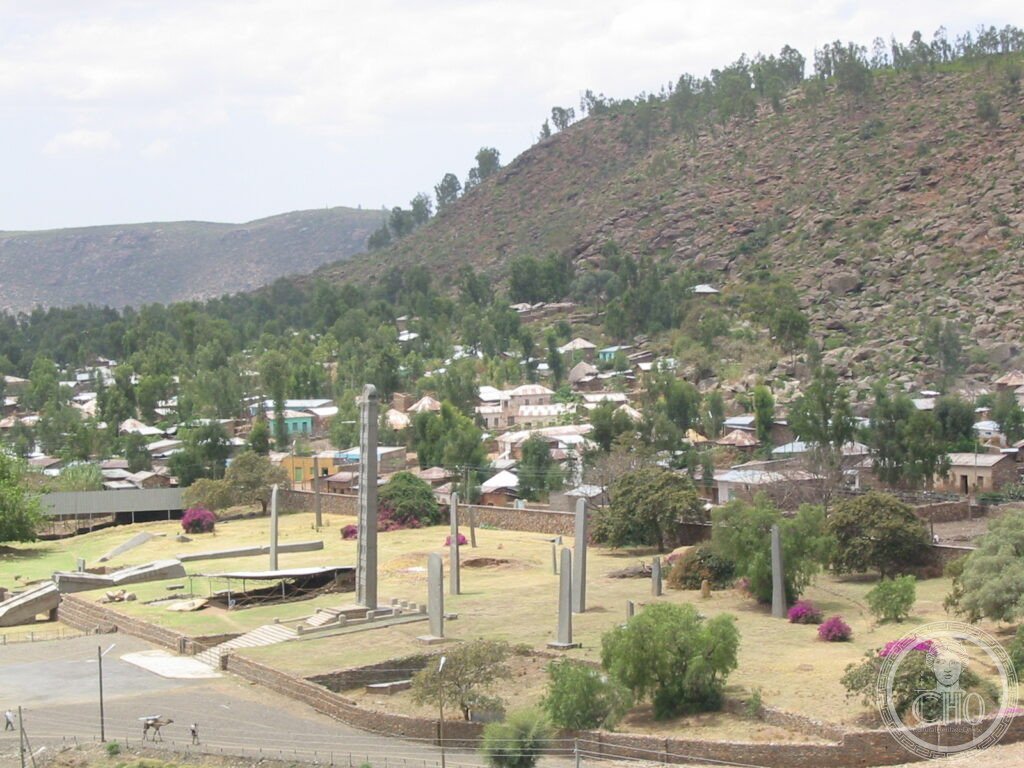
The ruins of the most powerful state in sub-Saharan Africa before the Mali Empire — the Aksumite Empire (1st–7th century AD) that controlled trade between the Roman Empire and India, whose kings minted their own gold coinage with the first Christian symbol on any currency, and whose greatest monument is a field of carved granite obelisks (stelae), the tallest of which reaches 33 metres — the largest single block of stone ever successfully erected by an ancient civilisation and the one now lying fallen where it toppled approximately 1,500 years ago.
At a glance
Aksum (also spelled Axum; Amharic: አክሱም, Aksum; Tigrinya: ኣኽሱም) is a town of approximately 65,000 inhabitants in the Tigray Region of northern Ethiopia, near the Eritrean border. It was the capital of the Aksumite Empire, the dominant power in the Red Sea and Horn of Africa from approximately the 1st to the 7th century AD — contemporaneous with the Roman Empire, with which it traded extensively (the Periplus of the Erythraean Sea, a 1st-century Greek maritime trading guide, describes Aksum as a major commercial hub). The town is most famous for its field of granite obelisks (stelae) — carved, decorated, multi-storey towers representing royal tomb markers, the tallest of which (the Great Stele) was 33 metres tall before it fell. UNESCO inscribed the Aksum archaeological complex in 1980, as one of the first sub-Saharan African inscriptions.
Key facts
- The Stelae: the Northern Stelae Park contains several dozen obelisks of different heights, and three of them matter most. (1) The Great Stele (Stele 1) is the largest single block of stone ever erected by an ancient civilisation, 33 metres tall and weighing approximately 520 tonnes; it fell in ancient times and now lies broken in several pieces where it collapsed, having never been raised successfully or having stood only briefly. (2) The Rome Stele (Stele 2, the Obelisk of Axum) is 24 metres tall; it was taken to Rome as war loot by the Italian Fascist army in 1937 and re-erected in front of the Italian Ministry for African and Colonial Affairs, then returned to Ethiopia in 2008 after decades of diplomatic negotiations and re-erected in the Stelae Park. (3) The King Ezana Stele (Stele 3) is 21 metres tall, the tallest still-standing stele in the park, decorated with false-door and false-window carvings that mimic Aksumite palace architecture
- The Obelisk of Aksum and its return from Rome: Mussolini’s forces looted the 24-metre obelisk (Stele 2) from Aksum in 1937 as a war trophy, part of the Italian conquest of Ethiopia (1935–36); it was re-erected outside the Italian Ministry for African and Colonial Affairs (now the Ministry for Economic Development) in Rome, where it stood for 68 years; the Italian government agreed to return it in 2007; the stele was dismantled, transported, and re-erected in Aksum in 2008 — the largest repatriation of African cultural property from Europe to date
- Aksumite Christianity: the Aksumite king Ezana converted to Christianity in c. 340 AD (making the Aksumite Empire one of the first states in the world to adopt Christianity as its official religion, before the Roman Empire); the coinage of Ezana is the first in history to carry the Christian cross; the Ethiopian Orthodox Church traces its origins to the Aksumite period, claiming the Ark of the Covenant is kept in the Chapel of the Tablet adjacent to the Cathedral of Mary of Zion in Aksum (the claim is taken seriously by the Ethiopian Orthodox Church and has never been independently verified)
- The Cathedral of St Mary of Zion: the holiest site in the Ethiopian Orthodox Church, adjacent to the Stelae Park; the current cathedral (1965, built by Emperor Haile Selassie to replace a 17th-century church that was itself built on the ruins of the original 4th-century Aksumite cathedral) is closed to women; the adjacent Chapel of the Tablet (a small building accessed only by the Guardian Monk) is said to contain the Ark of the Covenant
- The Tomb of the False Door (Enda Yesus): one of the royal tombs of Aksum (c. 3rd–7th century), accessible via underground rock-cut chambers; the carved granite false door (a decorative portal to the tomb) is a characteristic Aksumite motif also found on the stelae
- Heritage: UNESCO World Heritage Site, Aksum, inscribed 1980
- GPS: 14.1289° N, 38.7183° E
History
The Aksumite Empire emerged from the pre-Aksumite chiefdoms of the Horn of Africa in the 1st century AD; the earliest Aksumite inscriptions and coins date from approximately 150–250 AD. At its height (3rd–6th centuries), Aksum controlled the Red Sea trade route between the Roman Empire and India — the port of Adulis (on the Eritrean coast, 250 km north-east of Aksum) was the principal point of transfer, from which Aksumite merchants traded gold, ivory, slaves, and spices against Roman luxury goods and Indian textiles. The Aksumite Empire controlled the western Arabian Peninsula (modern Yemen and Saudi Arabia) from the late 3rd to the early 6th century AD, including the famous Himyarite Kingdom.
King Ezana (r. c. 320–360 AD) was the most important Aksumite ruler: he conquered the Kingdom of Kush (Meroe, modern Sudan) in 350 AD, ending the last Kushite state; he converted to Christianity in c. 340 AD under the influence of Syrian traders; and he issued the first coins in history carrying the Christian cross. The Aksumite Empire declined from the 7th century onwards, as the Arab conquests closed the Red Sea trade routes and an environmental crisis (possibly related to overgrazing and soil erosion) reduced agricultural productivity; the capital moved southward to Lalibela and eventually Gondar. Aksum retained its religious significance as the seat of the Patriarch of the Ethiopian Orthodox Church and the claimed repository of the Ark of the Covenant.
What you see
The Northern Stelae Park is the central monument zone; the standing and fallen stelae are arranged in a rough row, with the tallest (the Great Stele, fallen) at the north end and the King Ezana Stele (standing, 21 m) approximately in the middle. The Rome Stele (returned 2008, now re-erected) is south of the King Ezana Stele. The carvings on the stelae — false windows, false doors, and horizontal beam decorations in the Aksumite style — replicate the facades of the multi-storey royal palaces that stood in Aksum in the same period; the overall effect is of a street of palace facades compressed into stone towers.
The Cathedral of St Mary of Zion complex (a 5-minute walk from the Stelae Park) encompasses the old cathedral (17th century, now a museum), the new Haile Selassie cathedral (1965, open to visitors, including women), and the Chapel of the Tablet (not accessible, guarded by a single monk). The Aksumite palace ruins (Ta’akha Maryam Palace, 4th–7th century) and the Royal Tombs (Mausoleum and Tomb of Kaleb and Gebre Meskel, accessible underground) are within the UNESCO monument zone and require a guide for orientation.
Practical information
- Getting there: Aksum Airport (AXU) has daily flights from Addis Ababa (Ethiopian Airlines, 1.5 hours); the airport is 2 km from the town centre; from Addis Ababa by road and bus (approximately 1,000 km, 18–20 hours — not recommended for tourist travel due to road conditions and distance); from Lalibela by charter flight (30 minutes) or road (8–10 hours on a difficult mountain road; worth combining as part of a Tigray/historical Ethiopia circuit)
- Security note: the Tigray region experienced a civil conflict (the Tigray War, 2020–2022) that caused extensive damage to the region, including some damage to UNESCO heritage sites (the Monastery of Debre Damo was reported damaged); as of 2024, a peace agreement was in place and the region has been reopening to tourism; visitors should check current security conditions with the Ethiopian government and their embassy before travel
- Guides: a local guide is strongly recommended — the underground tombs require accompaniment, the town layout is confusing, and the context of the stelae (their relationship to the royal tombs below them) is not legible without explanation; licensed guides are available at the Stelae Park entrance
Getting there
Aksum Airport (AXU) is 2 km from the Stelae Park; daily flights from Addis Ababa (Ethiopian Airlines, 1.5h). Part of the UNESCO Ethiopia heritage circuit (Lalibela 8–10h by road, or 30min by charter flight; Gondar 4h by road). GPS: 14.1289, 38.7183.
Nearby
- Lalibela — the 11th-century monolithic rock-hewn churches of King Lalibela (250 km south-east of Aksum by road), carved from a single granite escarpment into 11 interconnected underground churches with intact liturgical use; the most impressive underground religious complex in the world; UNESCO WHS 1978; Ethiopian Orthodox Christmas (Genna, January 7th) and Easter (Fasika) pilgrimages are the most atmospheric times to visit
- Monasteries of Tigray — dozens of ancient Ethiopian Orthodox monasteries clinging to cliff faces throughout the Tigray Region, many accessible only by climbing rock faces with minimal equipment; Debre Damo (6th century, accessible only by climbing a leather rope up a 15-metre cliff face) and Abuna Yemata Guh (carved into a cliff at 2,500 metres, accessed by a vertiginous ledge walk) are the most extraordinary; many contain intact medieval frescoes and manuscripts
- Yeha — 55 km north-east of Aksum, the Great Temple of Yeha (c. 700 BC) is the oldest standing building in sub-Saharan Africa — a pre-Aksumite South Arabian-style temple of dry-stone ashlar masonry, still standing 2,700 years after construction; the temple is under the guardianship of the Ethiopian Orthodox Church (as the ruins of a church built within the temple walls in the medieval period)
Sources
- Wikipedia, Aksum; Stelae of Axum, accessed June 2026
- UNESCO, Aksum, WHS reference 15, inscribed 1980
- David Phillipson, Ancient Ethiopia: Aksum, Its Antecedents and Successors, British Museum Press, 1998 — the standard archaeological survey
- Stuart Munro-Hay, Aksum: An African Civilisation of Late Antiquity, Edinburgh University Press, 1991
Find it on the map
See this place and what’s around it →📷 Become a Cultural Heritage Online photographer
Share your photos of places: they stay published under your name as the author. The more they're seen, the more you get noticed — and soon a contest will reward the most appreciated photos.
Log in or sign up free to add a photo