
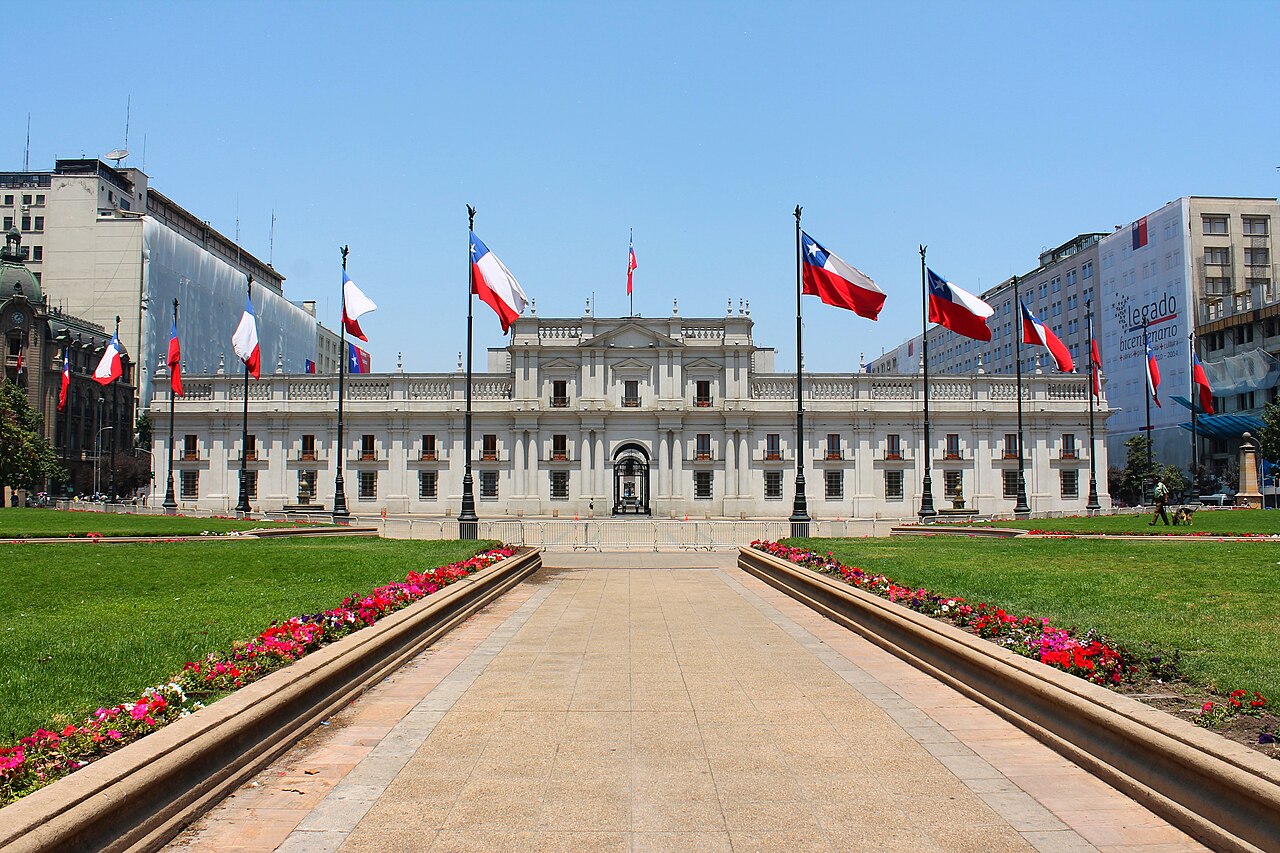
Built as the Royal Mint of colonial Chile and converted into the presidential palace in the nineteenth century, La Moneda is the most historically resonant building in South America – the site of the 1973 coup that ended Salvador Allende’s presidency and changed the course of Latin American history.
At a glance
- Type
- Presidential palace / government building
- Period
- 1784-1805
- Style
- Neoclassical
- Location
- Plaza de la Constitucion, Santiago Centro, Chile
- Coordinates
- -33.4425, -70.6545
- Architect
- Joaquin Toesca
Overview
La Moneda occupies an entire city block in central Santiago and serves as the seat of the President of Chile and the executive branch of government. Built between 1784 and 1805 by Italian-Chilean architect Joaquin Toesca as the Royal Mint of the Spanish colonial government, the building became the presidential palace in 1846 when the original mint function was relocated. Its long colonnaded Neoclassical facades of pale gray stone define four sides of an urban block; inside, two large ceremonial courtyards open to the sky. The building draws over one million visitors annually and hosts the Changing of the Guard ceremony on alternate days. A vast underground cultural center, the Centro Cultural Metropolitano, was excavated beneath the adjacent plaza in the 2000s.
History
Construction began in 1784 under the direction of Joaquin Toesca, an Italian architect trained in Rome who had been brought to Chile by the Spanish Crown. The building was completed in 1805 and served as the mint of colonial and early republican Chile, producing silver and gold coinage. In 1846 President Manuel Bulnes moved the executive offices of government into La Moneda, and since then it has been the seat of every Chilean president. On September 11, 1973, La Moneda became the site of the defining event in twentieth-century Chilean history: the military coup led by General Augusto Pinochet against the democratically elected socialist President Salvador Allende. Chilean Air Force jets bombarded the palace; Allende died inside. The palace was subsequently restored and a below-ground cultural center beneath the adjacent Plaza de la Constitucion was added between 2006 and 2010.
Architecture and Design
Toesca designed La Moneda in the austere Neoclassical style of late-eighteenth-century colonial Spain. The building is organized around two rectangular interior courtyards: the Patio de los Naranjos and the Patio de los Canelos. The four exterior facades are composed of a continuous colonnaded gallery at ground level and a regular rhythm of windows above, all in pale volcanic stone. The main entrance on the Plaza de la Constitucion is marked by a Doric portico. The interior contains state rooms including the Salon de Honor and the Salon Toesca used for official receptions.
Cultural significance
La Moneda carries the deepest political symbolism of any building in Latin America. The bombed and burning palace of September 11, 1973 became one of the most published news photographs of the twentieth century. For Chileans, La Moneda represents both the fragility and the resilience of democratic institutions. Toesca’s work established the canonical Neoclassical vocabulary for public building in Chile and influenced civic architecture across the Pacific coast of South America well into the nineteenth century.
Visiting today
The interior courtyards of La Moneda are open to the public free of charge during weekday business hours via the Morande 80 entrance on Calle Morande. Guided tours of the state rooms are available by advance reservation. The Changing of the Guard ceremony takes place every other day at 10:00 AM in the Plaza de la Constitucion. The adjacent Centro Cultural La Moneda hosts rotating exhibitions with free admission.
Getting there
Metro Line 1 stops at La Moneda station, directly adjacent to the building. Metro Line 2 stops at Moneda station one block south. From Santiago International Airport, the Centropuerto bus runs to the city center in approximately 45-60 minutes.
Sources and resources
Find it on the map
See this place and what’s around it →Record researched and written by Luigi De Marchi for Cultural Heritage Online, 2026.
📷 Become a Cultural Heritage Online photographer
Share your photos of places: they stay published under your name as the author. The more they're seen, the more you get noticed — and soon a contest will reward the most appreciated photos.
Log in or sign up free to add a photoIs this page about you?
This page is read by travellers and heritage enthusiasts who find it on Google. Tell us how you are connected to this place and we will take it from there.