
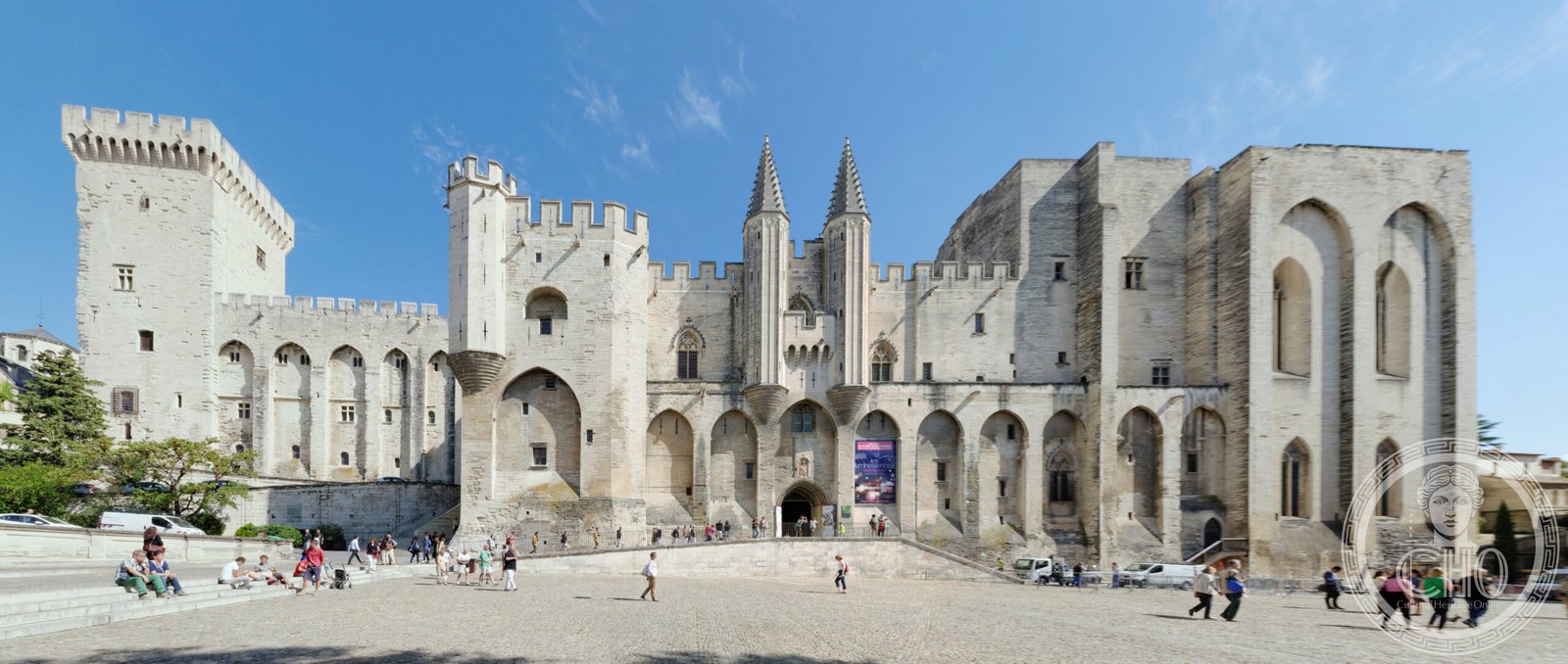
Built against the ramparts of the Palais des Papes by a cardinal of the Avignon papacy, this former livrée is now the most historically layered hotel in Provence.
At a glance
La Mirande stands at 4 place de l’Amirande, pressed against the south wall of the Palais des Papes in the heart of the Avignon intra muros. Its origins lie in the early 14th century, when the cardinal’s palace — or livrée — was raised for Cardinal de Pellegrue, nephew of Pope Clement V. The classical façade visible today was added in the late 17th century and is attributed to architect Pierre Mignard. After two centuries in the hands of a single Avignon family, the building was converted into a five-star boutique hotel in 1990, retaining its 18th-century interiors, stone floors, and antique furnishings.
Key facts
- Built: 14th century (cardinal’s palace); late 17th-century façade attributed to Pierre Mignard
- Style: Gothic origins; Classical façade; 18th-century interior
- Status: Five-star luxury boutique hotel (27 rooms)
- Address: 4 place de l’Amirande, 84000 Avignon, France
- GPS: 43.95033, 4.807915 — Open in Google Maps
- UNESCO/Listed: Within the UNESCO-listed Historic Centre of Avignon buffer zone; Palais des Papes directly adjacent is World Heritage Site
History
When Pope Clement V transferred the papal court to Avignon in 1309, his entourage of cardinals required accommodation befitting their rank. His nephew, Cardinal de Pellegrue, secured a prime site immediately adjacent to the rising Palais des Papes and erected a livrée — the term used for a cardinal’s palace in Avignon — whose four stone tower levels still form the core of the building. The site was damaged during a siege in 1410 but not destroyed.
In 1653 the property was acquired by Claude de Vervins. By the late 17th century Pierre de Vervins, marquis de Bédouin, commissioned a thorough remodelling, adding the classical stone façade attributed to architect Pierre Mignard — whose father and uncle had served as painters to Louis XIV’s court. The Pamard family, prominent in Avignon medicine and civic life, took ownership in 1796 following the Revolution and held the building for nearly two centuries. In 1966 the house served as a filming location for Jacques Rivette’s film La Religieuse, with Anna Karina.
In 1987 the Stein family purchased La Mirande and undertook a meticulous restoration with interior designer François-Joseph Graf and architect Gilles Grégoire, converting it into a hotel. The property opened in 1990 and has since become one of the reference points for grand-maison hospitality in Provence.
What you see
The street façade on place de l’Amirande is composed and restrained — a late 17th-century classical elevation in pale Provençal stone, with symmetrical windows and discreet ironwork. The medieval tower volumes are visible from the courtyard side, where the mass of the Palais des Papes rises directly overhead, making the scale relationship between the two buildings immediately legible.
Inside, the principal rooms preserve 18th-century proportions: high ceilings with original beams, stone floors, and fireplace surrounds. The furnishings — antique pieces, old master paintings, medieval tapestries — were selected as part of the 1987–90 restoration to reflect the building’s layered chronology rather than impose a single period. The garden, tucked between the hotel and the papal ramparts, is planted in the formal southern French manner and remains one of the quietest corners in Avignon.
Practical information
- Hotel guests only for rooms; the restaurant is open to non-residents (booking essential)
- Cooking school operated in the medieval kitchens; open to non-guests
- Best season: late spring (May–June) and early autumn (September–October) for garden and mild temperatures
- Estimated stay: the hotel is best appreciated over two nights minimum
Getting there
La Mirande is a five-minute walk from Avignon Centre (TGV) station, which receives direct TGV trains from Paris-Gare de Lyon in 2 hours 40 minutes. From Marseille-Provence Airport, the journey by shuttle or taxi takes approximately one hour. The hotel stands inside the medieval walls, steps from the main entrance to the Palais des Papes on place du Palais.
Nearby
- Palais des Papes — the largest Gothic palace in the world and a UNESCO World Heritage Site, directly adjacent; guided tours daily.
- Musée du Petit Palais — medieval and early Renaissance paintings (including Italian primitives) in the former archbishops’ palace on place du Palais.
- Pont Saint-Bénézet — the famous 12th-century bridge immortalised in the nursery rhyme, a ten-minute walk north along the ramparts.
- Villeneuve-lès-Avignon — the French royal counterpart to the papal city, across the Rhône, with its own fort and charterhouse.
Sources
Find it on the map
See this place and what’s around it →📷 Become a Cultural Heritage Online photographer
Share your photos of places: they stay published under your name as the author. The more they're seen, the more you get noticed — and soon a contest will reward the most appreciated photos.
Log in or sign up free to add a photoIs this page about you?
This page is read by travellers and heritage enthusiasts who find it on Google. Tell us how you are connected to this place and we will take it from there.