
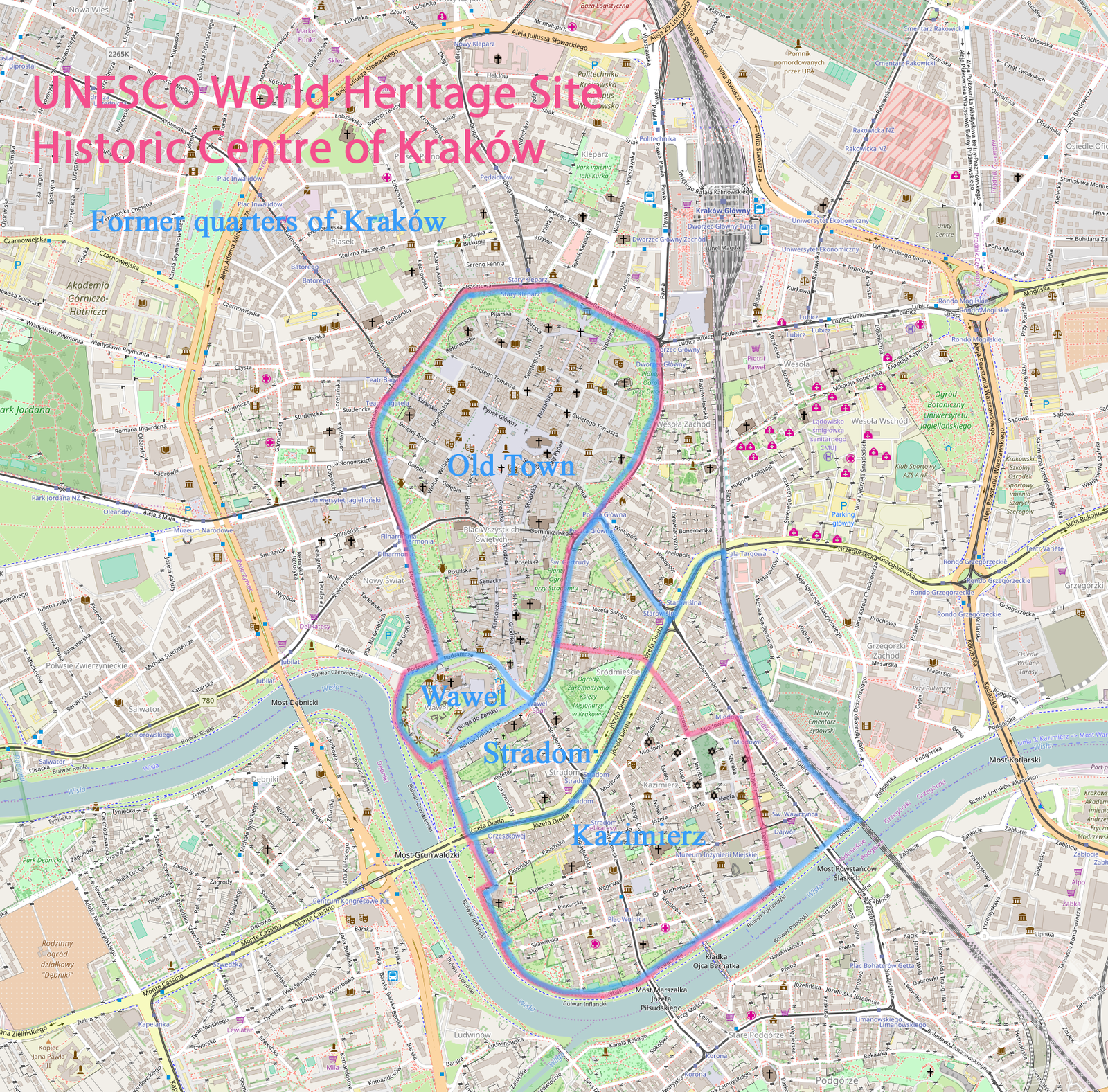
The heart of Poland’s medieval capital, Kraków Old Town remains one of Europe’s most complete medieval urban centres, its Renaissance and Gothic treasures encircled by the verdant Planty Park where defensive walls once stood.
At a glance
Stare Miasto, as locals call it, occupies the historic core of Kraków within a ring of parkland. The district centres on the Main Market Square (Rynek Główny)—the largest medieval town square in Europe—and the Renaissance cloth hall Sukiennice. Medieval Kraków was defended by 3 kilometres of walls punctuated by 46 towers and seven main gates, erected over two centuries and dismantled in the 19th century to create Planty Park.
History
The current street plan dates to 1257, laid out after Tatar invasions devastated the city in 1241, 1259, and 1287. Kraków served as Poland’s political centre from 1038 until 1596, when King Sigismund III Vasa moved his court to Warsaw. The Royal Road, the coronation route of Polish kings, traverses the Old Town from the Florian Gate through the Main Square to Wawel Castle on the Vistula. During the 19th century, civic planners demolished the medieval fortifications and transformed the surrounding moat into a green belt, creating the modern Planty Park that embraces the district today.
What you see
St. Mary’s Basilica (Kościół Mariacki) and the Church of St. Wojciech command attention, the latter Poland’s oldest church. The cloth hall Sukiennice, a Renaissance masterpiece at the square’s heart, once housed merchants and now contains shops, restaurants, and the National Gallery of Art on its upper floor. The Town Hall Tower (Wieża ratuszowa) flanks the plaza. Kamienice—the characteristic tenement houses and noble residences—define the streetscape. Medieval gateways, including the Barbican (Barbakan) built in 1499, mark the boundary between old and new Kraków.
Cultural significance
Kraków Old Town was among the first sites inscribed on UNESCO’s original World Heritage List, recognised as a masterwork of medieval town planning and a living testament to Polish dynastic ambition. The district served as Poland’s political and cultural nexus for over five centuries. It stands as an official National Historic Monument (Pomnik historii), designated in 1994, and represents the pinnacle of Central European medieval urbanism.
Key facts
- Location: Kraków, Poland (50.06209°N, 19.93688°E)
- UNESCO World Heritage: Yes—Historic Centre of Kraków (inscribed in the original 1978 list)
- Medieval street plan: Established 1257
- Former fortifications: 3 km of walls with 46 towers and 7 main gates (mostly demolished 19th century)
- National Historic Monument: Designated 16 September 1994
Practical information & getting there
The Old Town is the heart of Kraków’s tourism district and readily accessible from the main railway station (Kraków Główny) by tram or on foot. The Planty Park forms a continuous walking loop around the medieval quarter. Most major monuments and the Main Market Square are easily reached on foot. For current visiting hours and admission fees to individual churches, galleries and museums, consult local tourism offices.
Sources & resources
Find it on the map
See this place and what’s around it →
Historical events at this place (1)
📷 Become a Cultural Heritage Online photographer
Share your photos of places: they stay published under your name as the author. The more they're seen, the more you get noticed — and soon a contest will reward the most appreciated photos.
Log in or sign up free to add a photo