

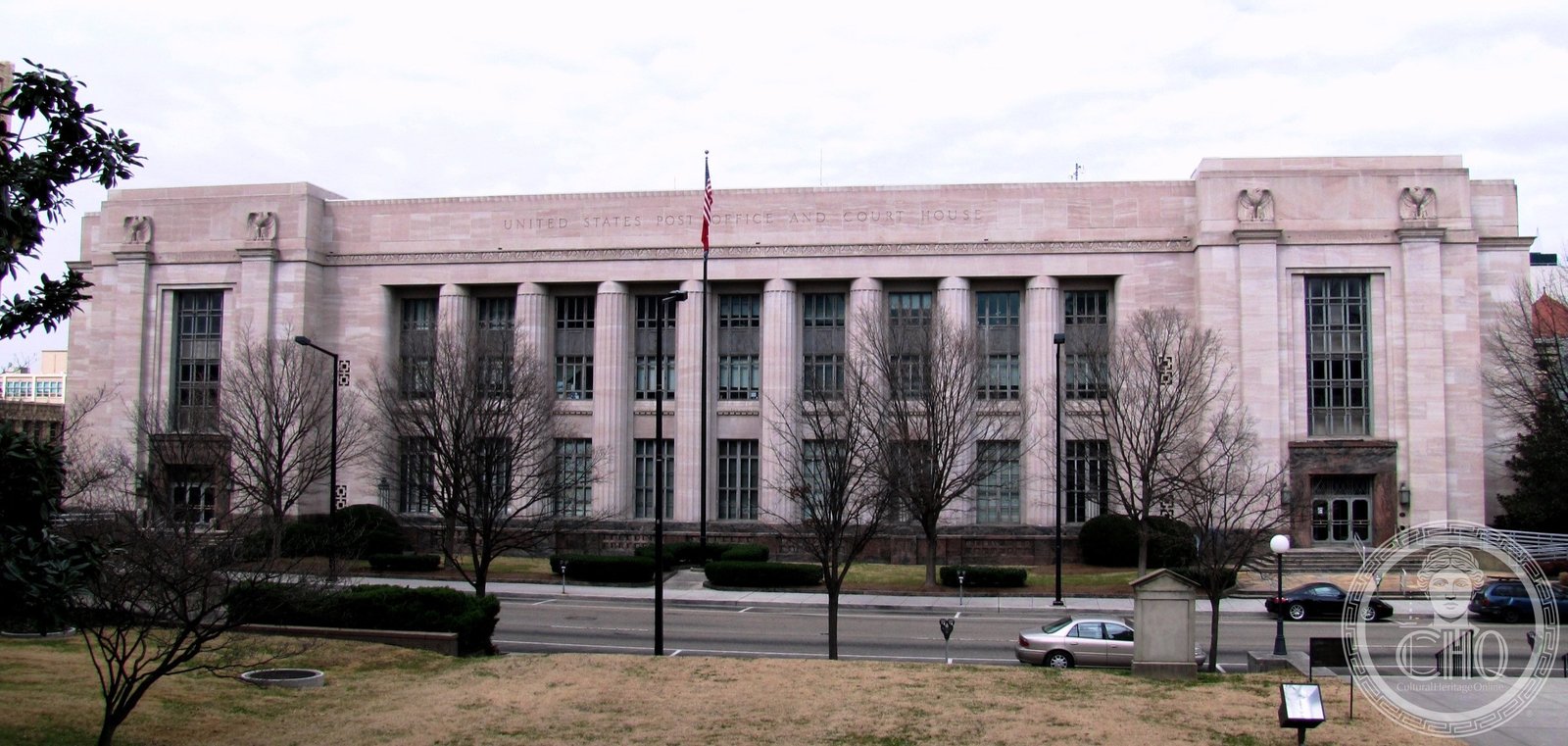
Built from six varieties of Tennessee marble, this 1934 federal courthouse and post office is the finest example of Art Deco Moderne government architecture in East Tennessee—a PWA-era monument where Albert Milani’s carved eagles stand guard over aluminum-grilled windows and a lobby of polished pink stone.
At a glance
Formally titled the United States Post Office and Courthouse but universally known as the Knoxville Post Office, this building at 501 Main Street opened in March 1934 after two years of construction. Designed by the local firm Baumann and Baumann—whose principals trained in the Beaux-Arts tradition under Paul Cret at the University of Pennsylvania—it combines classical composition with restrained Art Deco ornament in the manner advocated by the Treasury Department for federal architecture during the New Deal. Six types of Tennessee marble clad the exterior and main interiors, making this one of the most material-rich federal buildings in the region. It was added to the National Register of Historic Places in 1984 and continues to function as a branch post office and state court building.
Key facts
- Completed: February 1934; postal service opened March 11, 1934
- Architects: Baumann and Baumann (Albert Baumann Sr. and Jr.)
- Style: Art Deco / Moderne
- Materials: Six types of Tennessee marble (primarily “pink”); aluminum casement windows; cork wood courtroom floor
- NRHP listed: May 31, 1984 (ref. 84003567)
- Address: 501 Main St., Knoxville, TN 37902
- GPS: 35.96083°N, 83.91889°W
History
Knoxville’s first federal building, the Old Customs House on Market Street (1874), was expanded in 1910 but had become inadequate for a growing city by the following decade. Senator Kenneth McKellar and Congressman J. Will Taylor secured congressional appropriations in the late 1920s for a new facility. The project was awarded to Baumann and Baumann, a prominent local firm that had recently completed the Andrew Johnson Hotel on Gay Street. Albert Baumann Jr. (1897–1952) had studied architecture at the University of Pennsylvania under Beaux-Arts champion Paul Cret, and the building’s design reflects a Treasury Department model likely influenced by Cret’s approach to monumental civic architecture.
Construction commenced in December 1932, with the A.W. Kushe Company of Detroit as contractor. The building was completed in February 1934 and formally dedicated on February 15 of that year in a ceremony attended by Congressman Taylor and Mayor John O’Connor. Knoxville’s new post office and federal courthouse occupied the full city block bounded by Main Street, Locust Street, Walnut Street, and Cumberland Avenue. After a 1964 renovation lowered the ceiling in one section, federal courts shifted to the Howard Baker Jr. Federal Courthouse nearby in the 1990s. The building now houses a USPS branch and the Tennessee State Criminal Court of Appeals. Author Cormac McCarthy referenced it twice in his 1979 novel Suttree.
What you see
The building occupies a full city block, measuring 250 by 138 feet with 123,000 square feet of gross space. Its exterior is clad primarily in Tennessee “pink” marble—a warm, locally quarried stone used in monumental buildings across the United States—with Moderne-style cylindrical molding along the roofline and aluminum casement windows set in recessed bays. Corners are diagonally cut to create entrance vestibules. Four eagle statues, carved by Candoro Marble Works sculptor Albert Milani (1892–1972), occupy niches flanking the main entries and remain among the finest examples of Art Deco sculptural ornament in the city. Art Deco light fixtures top the red marble retaining wall of the sunken courtyard at the front of the building.
The interior public areas are particularly rich. A marble floor and marble, aluminum, and bronze paneling define the first floor. Grillwork carries floral motifs; aluminum spandrels on the upper floors bear floral and zigzag patterns; the original plaster ceiling was decorated with aluminum floral and zigzag moldings before being concealed by a tiled ceiling in 1964. The courtroom floor, one of the building’s most distinctive details, is laid in cork wood. Together, these surfaces represent one of the most complete Art Deco civic interiors surviving in East Tennessee.
Practical information
- Postal services: The first-floor USPS branch is open during regular business hours (Monday–Friday)
- Public access: The main lobby and first floor are accessible to the public during USPS operating hours; upper-floor courts are open during session days
- Exterior: The Main Street facade is fully visible from the sidewalk at all times
- Allow: 20–30 minutes for a thorough exterior walk and lobby visit
- Best time: Morning light brings out the pink and rose tones of the Tennessee marble on the facade
Getting there
The building is located at 501 Main Street in downtown Knoxville, one block south of Gay Street and within easy walking distance of Market Square. Knoxville’s McGhee Tyson Airport (TYS) is approximately 15 miles south; the airport is connected to downtown by taxi and rideshare. The closest bus routes run along Gay Street. Metered street parking and public garages are available in the surrounding blocks of downtown Knoxville.
Nearby
- Tennessee Theatre (1928) — three blocks north on South Gay Street; Spanish-Moorish movie palace designed by Chicago architects Graven & Mayger
- Market Square — two blocks north; Knoxville’s historic public square surrounded by 19th- and early 20th-century commercial buildings
- Museum of Appalachia — 20 miles north in Norris; extensive collection of Appalachian folk artifacts in an outdoor village setting
Sources
- National Register of Historic Places nomination: Knoxville Post Office, ref. 84003567 (May 31, 1984); nominator Philip Thomason
- Wikipedia: “United States Post Office and Courthouse (Knoxville, Tennessee)” — https://en.wikipedia.org/wiki/United_States_Post_Office_and_Courthouse_(Knoxville,_Tennessee)
- Knoxville-Knox County Metropolitan Planning Commission, “The Future of Knoxville’s Past” (2006)
Find it on the map
See this place and what’s around it →Record researched and written by Luigi De Marchi for Cultural Heritage Online, 2026.
📷 Become a Cultural Heritage Online photographer
Share your photos of places: they stay published under your name as the author. The more they're seen, the more you get noticed — and soon a contest will reward the most appreciated photos.
Log in or sign up free to add a photoIs this page about you?
This page is read by travellers and heritage enthusiasts who find it on Google. Tell us how you are connected to this place and we will take it from there.