

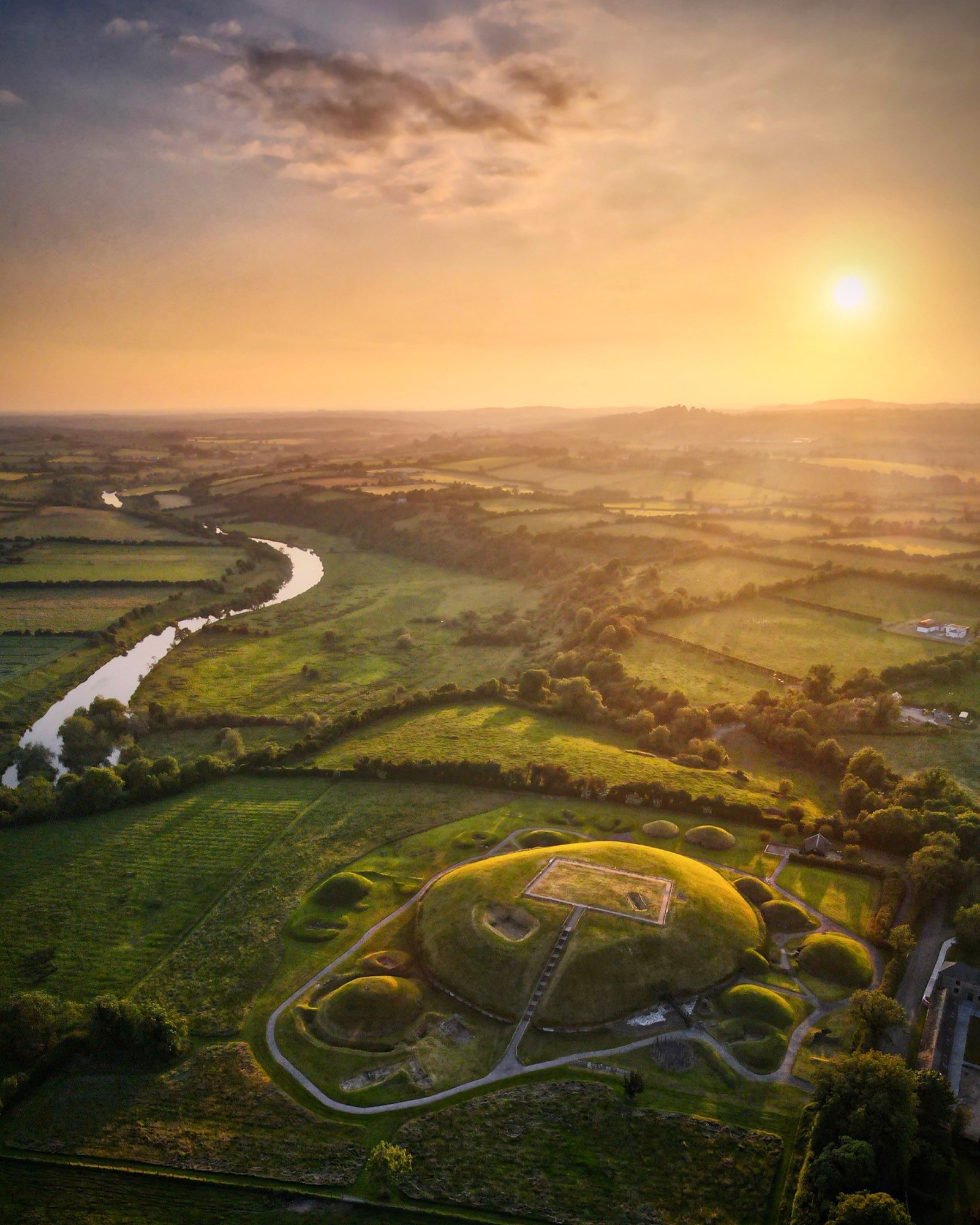
One kilometre west of Newgrange, the great mound of Knowth contains approximately one-third of all megalithic rock art known on earth — over 350 decorated surfaces of spirals, lozenges, and abstract forms — along with two full passage tombs pointing east and west. For five thousand years after its Neolithic construction, it never stopped being used.
At a Glance
Knowth is the largest mound in the Brú na Bóinne complex (UNESCO World Heritage Site, 1993), standing approximately 95 metres in diameter and 11 metres high, slightly larger than the more famous Newgrange located 1 km east. It contains two separate passage tombs — their passages extending approximately 40 metres each from opposite sides of the mound, the longest megalithic passages in Ireland — and is surrounded by 18 smaller satellite mounds in a pattern repeated nowhere else in the Neolithic world. Its most extraordinary distinction: approximately one-third of all megalithic rock art known anywhere on earth is concentrated at this single site.
Key Facts
- Period: c. 3200–2800 BC (Neolithic); in continuous use for approximately 5,000 years.
- UNESCO WHS: 1993 (Brú na Bóinne — Archaeological Ensemble).
- Passage tombs: Two, oriented east–west; the eastern passage aligns with equinox sunrise.
- Megalithic art: ~350 decorated surfaces; approximately one-third of all megalithic rock art on earth.
- Satellite mounds: 18 smaller mounds surrounding the great mound.
- Passages: ~40 metres each (longest in Ireland); not currently open to public entry.
- Access: Guided tour from Brú na Bóinne visitor centre only; book in advance.
Five Thousand Years of Use
Knowth was built in approximately 3200–2800 BC by Neolithic farming communities who had settled the fertile Boyne Valley. The eastern passage is aligned with the equinox sunrise (unlike Newgrange, which is aligned with the winter solstice), suggesting the complex served ceremonial purposes at multiple points in the year. The scale of the construction — the main mound alone required an estimated 200,000 tonnes of material — implies a level of social organisation, surplus production, and planning comparable to contemporary achievements in ancient Egypt.
What makes Knowth extraordinary in the archaeological record is the continuity of its use. After its Neolithic construction, the mound was used as a Bronze Age burial site, as a ritual location in the Iron Age, and then, perhaps most remarkably, as a seat of political power in early medieval Ireland: the Hill of Knowth is mentioned in the Irish Annals as the residence of the Kings of Brega, a territorial kingdom. A Norman motte-and-bailey fortress was subsequently constructed on its summit; medieval habitation continued at the site until the 14th century. No other megalithic monument in Ireland has such a complete biography of reuse.
The Art
Knowth’s true distinction is its concentration of megalithic art. Approximately 250 kerbstones and passage walls are decorated with spirals, lozenges, arcs, serpentine lines, chevrons, and abstract patterns — totalling approximately 350 individual decorated surfaces. This represents approximately one-third of all megalithic rock art known in the entire world. The art style is abstract and non-representational; no definitive interpretation of the symbolic system has been established, and scholars debate whether the motifs are astronomical, ritual, social, or purely aesthetic in function.
The two passages extend approximately 40 metres from opposite sides of the mound — the western passage reaches to within a few metres of the eastern passage’s end, though they do not connect. The eastern passage aligns with the equinox sunrise, admitting light deep into the chamber in March and September. Unlike Newgrange, the Knowth passages are not currently open to visitor access for conservation reasons, though excavation and conservation work by George Eogan (1962–2000) produced the definitive record of the site.
Practical Information
Knowth can only be visited as part of a guided tour departing from the Brú na Bóinne visitor centre, shared with Newgrange (located on the south bank of the Boyne, off the R132 near Donore, Co. Meath). Tours are timed and ticketed; advance booking is strongly recommended, especially in summer and at equinox dates. The visitor centre houses permanent exhibitions on Neolithic life, megalithic art, and the construction techniques of the Boyne Valley complex. The exterior of the Knowth mound and its kerbstones can be walked around and viewed on the guided tour; the passages themselves are not open to entry. OPW (Office of Public Works) manages the site.
Getting There
- By car: From Dublin, N1/M1 north to Drogheda, then R132 west to Donore; visitor centre is signposted (c. 50 km, 1 hour).
- By bus: Bus Éireann service from Dublin Busaras to Drogheda; local taxi or bike hire from Drogheda to visitor centre (c. 12 km).
- Tours from Dublin: Multiple day-trip operators serve the Brú na Bóinne complex.
- Note: Tickets for Knowth and Newgrange sell out; book online at OPW heritage sites well in advance.
Nearby
- Newgrange — 1 km east: Ireland’s most celebrated megalithic monument, with its famous winter solstice sunrise alignment into the burial chamber; already in the CHO database (ID 15437).
- Dowth — 2 km east: the third great mound of Brú na Bóinne, less visited than Newgrange and Knowth, with its own decorated kerbstones and passage tomb (not open to visitors).
- Battle of the Boyne site — 5 km south: where William III defeated James II in 1690; OPW heritage site with visitor centre.
- Hill of Tara — 20 km southwest: seat of the High Kings of Ireland; Iron Age and early medieval earthworks with panoramic views of Meath.
Sources & Resources
- Wikipedia: Knowth.
- UNESCO World Heritage: Brú na Bóinne.
- George Eogan, Knowth and the Passage-Tombs of Ireland (Thames & Hudson, 1986).
- George Eogan & Helen Roche, Excavations at Knowth 2 (Royal Irish Academy, 1997).
- OPW Heritage Ireland: Brú na Bóinne.
Find it on the map
See this place and what’s around it →📷 Become a Cultural Heritage Online photographer
Share your photos of places: they stay published under your name as the author. The more they're seen, the more you get noticed — and soon a contest will reward the most appreciated photos.
Log in or sign up free to add a photo