

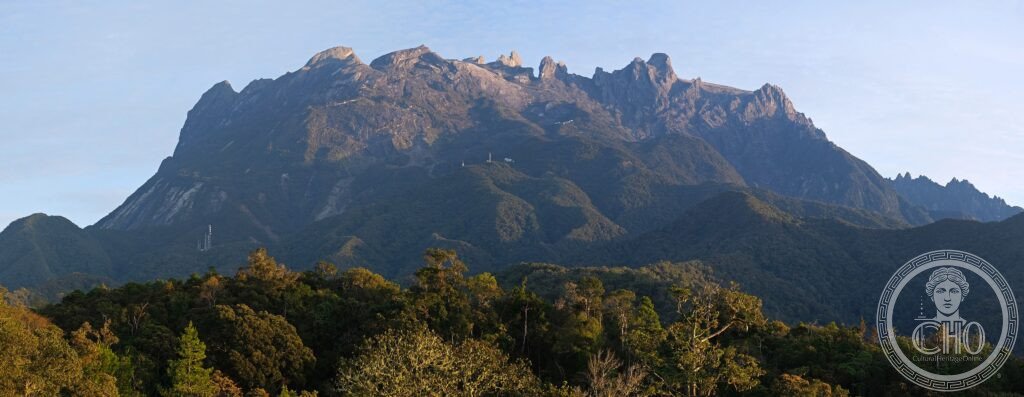
The highest mountain in Malaysia and one of the most biodiverse parks in Southeast Asia. Kinabalu Park in Sabah, Malaysian Borneo, protects the 4,095-metre summit of Mount Kinabalu (sacred to the Kadazan-Dusun people and the most popular high-altitude summit trekking destination in Southeast Asia) and a surrounding forest that contains one of the richest plant communities on Earth, including the world’s largest pitcher plant.
At a glance
Kinabalu Park (75,370 hectares; established 1964; UNESCO WHS 2000) is located in the Crocker Range, Sabah, approximately 90 km east of the state capital Kota Kinabalu (accessible by road in 2h). The park protects the granite massif of Mount Kinabalu (4,095 metres; the summit via ferrata route consists of approximately 8.5 km of trail from park HQ at 1,558 metres to the summit, with an elevation gain of approximately 2,537 metres). The park is divided into altitude zones, each with distinct flora: lowland dipterocarp rainforest (below 1,000 m; the Rafflesia zone; Rafflesia arnoldii — the world’s largest individual flower — blooms sporadically in this zone; sightings are not guaranteed). Montane forest (1,000–2,800 m; the most accessible zone; the main trail passes through this zone; the pitcher plant zone — approximately 16 species of Nepenthes pitcher plants including the world’s largest, Nepenthes rajah, found only in Kinabalu and one or two nearby sites). Sub-alpine vegetation (2,800–3,700 m; ultramafic scrub and alpine meadows). And the summit granite plateau (3,700–4,095 m; bare rock scoured by glaciers in the Pleistocene; the via ferrata summit route traverses this zone in darkness for the pre-dawn summit attempt).
Key facts
- The summit climb: the most popular multi-day mountain trek in Southeast Asia. The standard summit route is the Via Timpohon: 8.5 km one way, permits required, only 135 climbers allowed per day, 2 days and 1 night, with an overnight at the Laban Rata Guesthouse at 3,270 m. Day 1 is the hike from Timpohon Gate, 1,866 m, to Laban Rata, 3,270 m: approximately 6 km in 4–6h, on a well-maintained trail with steps and handrails on the steepest sections, of which the final kilometre is the hardest. Day 2 is the summit attempt, 2h 45 min from Laban Rata via the granite rope section; climbers leave at 2–3am to reach the top at approximately 5–6am for the sunrise. The rope section begins at approximately 3,700 m, where the trail leaves the forest and crosses bare granite slabs with ropes fixed in the rock: exposed in wet weather, technically easy in dry conditions. On the summit plateau the main features are Low’s Peak, 4,095 m, St John’s Peak, and the Donkey’s Ears, two pinnacles slightly lower at approximately 4,040 m and the most distinctive shape on the Kinabalu skyline. The sunrise view over the South China Sea, the Sulu Sea and the forests of Sabah and Sarawak is one of the most spectacular summit panoramas in Asia; the descent returns to Timpohon Gate the same day via Laban Rata. The 2015 earthquake, 5.9 Mw in June 2015, caused a rockslide on the summit section that killed 18 climbers, and led to significant changes in the permit and safety systems.
- The biodiversity of Kinabalu: one of the most species-rich places per unit area on Earth. The Kinabalu Park has been described as “a treasure house of plants and animals without parallel anywhere in the world” (the park brochure is not entirely wrong). The numbers: approximately 5,000–6,000 plant species (half the species of all of Europe in a single park; the largest number of plant species in any park in Borneo). 326 bird species (37 Bornean endemics; the Bornean Bristlehead, considered the most charismatic bird in Borneo; the Bornean Mountain Whistler; the Kinabalu Serpent Eagle; the Black-and-crimson Oriole). 42 species of freshwater fish (the highest density of freshwater fish species per km of stream in any park in Southeast Asia). 100 mammal species (including the Bornean Pygmy Elephant, the Proboscis Monkey, and the Clouded Leopard, all of which range into the park lowlands). The Nepenthes pitcher plants: 16 species in the park (the world’s largest pitcher plant, Nepenthes rajah, growing only above 1,500 m on Kinabalu and a few adjacent mountains; the pitcher of a mature plant can hold up to 3.5 litres of fluid and has been observed to drown and digest not only insects but also small vertebrates — frogs, lizards, even small rats — that fall in).
- The Rafflesia and the Bornean flora: the world’s largest flower is sometimes visible in the park lowlands. Rafflesia arnoldii (named after the 19th-century British naturalists Stamford Raffles and Thomas Arnold who first documented it in Sumatra in 1818) is a holoparasitic plant (it has no leaves, roots, or visible stem — the entire plant consists of filaments growing inside the root tissue of the Tetrastigma vine host; only the flower emerges from the host root) that produces the world’s largest individual flower (approximately 1 metre in diameter; 7–10 kg in weight; deep red with white spots; the smell is often described as rotting flesh — this attracts flies which pollinate the flower). The flower lasts only 5–7 days before turning black and collapsing. Sightings in Kinabalu Park and the surrounding forests require local intelligence about which plants are currently in bloom (the park visitor centre maintains a bloom sighting board; local guides in the forest around Poring Hot Springs, just outside the main park boundary, are the most reliable source of Rafflesia sightings).
- Heritage: UNESCO World Heritage Site, Kinabalu Park, inscribed 2000.
- GPS: 6.0750° N, 116.5500° E.
History
Kinabalu is a sacred mountain for the Kadazan-Dusun people of Sabah (the summit is believed to be the resting place of the spirits of the dead; an annual ceremony — the Manatak ceremony — is conducted to appease the mountain spirits). The first European ascent was by Hugh Low of the British colonial administration in 1851 (the main summit Low’s Peak is named after him). The botanical survey by Odoardo Beccari in 1865 first documented the extraordinary plant diversity. The national park was established in 1964, one of the first in Malaysia. UNESCO WHS 2000. The June 5, 2015 earthquake (magnitude 5.9; the strongest earthquake in Sabah in recorded history) triggered a rockslide on the summit route that killed 18 climbers (13 school students and 5 teachers from Singapore and Malaysia). New permit systems and safety protocols were implemented.
What you see
The park headquarters area (1,558 m; the visitor centre with natural history exhibits; the Mountain Garden with labelled specimen plants including several Nepenthes pitcher plant species; the starting point of the summit trail). The Mesilau Trail (an alternative summit approach starting 3 km from park HQ; passes through old-growth montane forest with excellent birding; longer but more scenic than the main trail). The Poring Hot Springs (43 km east of park HQ; part of the park; natural hot sulphur springs with developed bathing pools; the canopy walkway at 41 metres; the best site for Rafflesia sightings in the area; the butterfly garden with Bornean endemic butterfly species).
Practical information
- Summit permits: summit permits (required for all climbers attempting above Laban Rata, i.e., the summit section) must be booked well in advance: 135 climbers per day maximum. Book through the Sutera Sanctuary Lodges system (the park concessionaire) or through a licensed Sabah tour operator. The permit includes compulsory accommodation at Laban Rata Guesthouse (3,270 m; dormitory or private rooms; advance booking recommended; dinner, breakfast, and a packed lunch are included in the accommodation package; prices approximately MYR 400–600/person for the 2-day package including permit and accommodation). A compulsory local guide is required (included in the permit package; 1 guide per 5 climbers).
- Getting there: from Kota Kinabalu (2h by road; 90 km on the Tuaran Highway; regular mini-bus services from Kota Kinabalu Central Market depart 7am–8am daily; car rental and private driver also available from Kota Kinabalu). Kota Kinabalu International Airport (BKI; direct flights from Kuala Lumpur — 2h 30 min; from Singapore — 2h 30 min; from Hong Kong, Taipei, and Seoul with AirAsia X; MH and AirAsia domestic connections from all Malaysian cities).
- Best time: the summit is accessible year-round but the dry season (March–September) has the best summit conditions. Rainfall is heaviest October–January. The summit is visible and clear most mornings year-round (cloud builds around the summit by mid-morning and can obscure it by noon). The 2015 earthquake did not permanently damage the summit route (it reopened after 3 months). The Kinabalu Ultra-Trail marathon (the most famous mountain running race in Southeast Asia; held in October; the summit route and the Mesilau loop are the race course) is a major annual event that affects park access for 2 days.
Getting there
From Kota Kinabalu: 2h by road (90 km). Direct flights BKI from Kuala Lumpur (2h 30 min), Singapore (2h 30 min). GPS: 6.0750, 116.5500.
Nearby
- Sepilok Orangutan Rehabilitation Centre. 300 km east of Kinabalu Park (4h by road to Sandakan, then 25 km; or 45 min flight from Kota Kinabalu to Sandakan Airport). The world’s most famous orangutan sanctuary. The Sepilok Orangutan Rehabilitation Centre (established 1964; near Sandakan; open to the public; the feeding platform at 10am and 3pm draws wild and semi-wild orangutans from the surrounding Kabili-Sepilok Forest Reserve; up to 20 orangutans may appear at once; the centre also rehabilitates baby orangutans rescued from logging sites and oil palm plantations — the “Nursery Programme” allows visitors to observe infant orangutans learning forest skills; the Bornean Sun Bear Conservation Centre is immediately adjacent to Sepilok — the sun bear is the world’s smallest bear species and occurs only in Borneo and Sumatra; 44 bears are in care at the centre).
- Kinabatangan River and the Bilit rainforest. 350 km south-east of Kinabalu Park (accessible via Sandakan; 3h from Sandakan Airport by road to Sukau or Bilit). The best place in the world to see the proboscis monkey. The lower Kinabatangan River (approximately 130 km from Sukau to the coast; a UNESCO proposed WHS; the most important corridor of lowland forest remaining in Sabah; the widest stretch of the river between Sukau and the coast has a forest-lined bank that hosts proboscis monkey (approximately 2,000 individuals in the lower Kinabatangan corridor; reliably seen from river boats at dawn and dusk), pygmy elephant (approximately 400 in the Kinabatangan corridor — the most accessible wild elephant population in Borneo), orang-utan, Bornean gibbon, Irrawaddy dolphin in the lower tidal section, saltwater crocodile (Crocodylus porosus; the world’s largest reptile; adults up to 6 metres), and the Buffy Fish Owl and Storm’s Stork).
- Turtle Islands Park (Selingan Island). 40 km north of Sandakan (1h 30 min by speedboat from Sandakan jetty). The only place in the world where you can reliably witness sea turtle nesting and hatchery release any night of the year. The Turtle Islands Park (three coral islands — Selingan, Bakkungan Kecil, and Gulisaan — approximately 40 km north of Sandakan; declared a park in 1977) is the most important nesting site for the Green Sea Turtle (Chelonia mydas) in Southeast Asia. Female green turtles nest on Selingan every night of the year (except in the strongest storms). Visitors arrive in the afternoon, are assigned to a ranger group, and are woken in the night to watch a turtle nesting in real time (the process of digging the nest chamber, laying approximately 120 eggs, and covering the nest takes 2–3 hours). They then observe the release of hatchlings from the hatchery (eggs are moved to the hatchery immediately after nesting to prevent predation; hatchlings are released on the beach under supervision).
Sources
- Wikipedia, Kinabalu Park. Mount Kinabalu. Nepenthes rajah. Rafflesia arnoldii, accessed June 2026.
- UNESCO, Kinabalu Park, WHS reference 1012, inscribed 2000.
- A. Lamb, Orchids of Sabah and Sarawak, Natural History Publications Borneo, 1997.
Find it on the map
See this place and what’s around it →
📷 Become a Cultural Heritage Online photographer
Share your photos of places: they stay published under your name as the author. The more they're seen, the more you get noticed — and soon a contest will reward the most appreciated photos.
Log in or sign up free to add a photo