
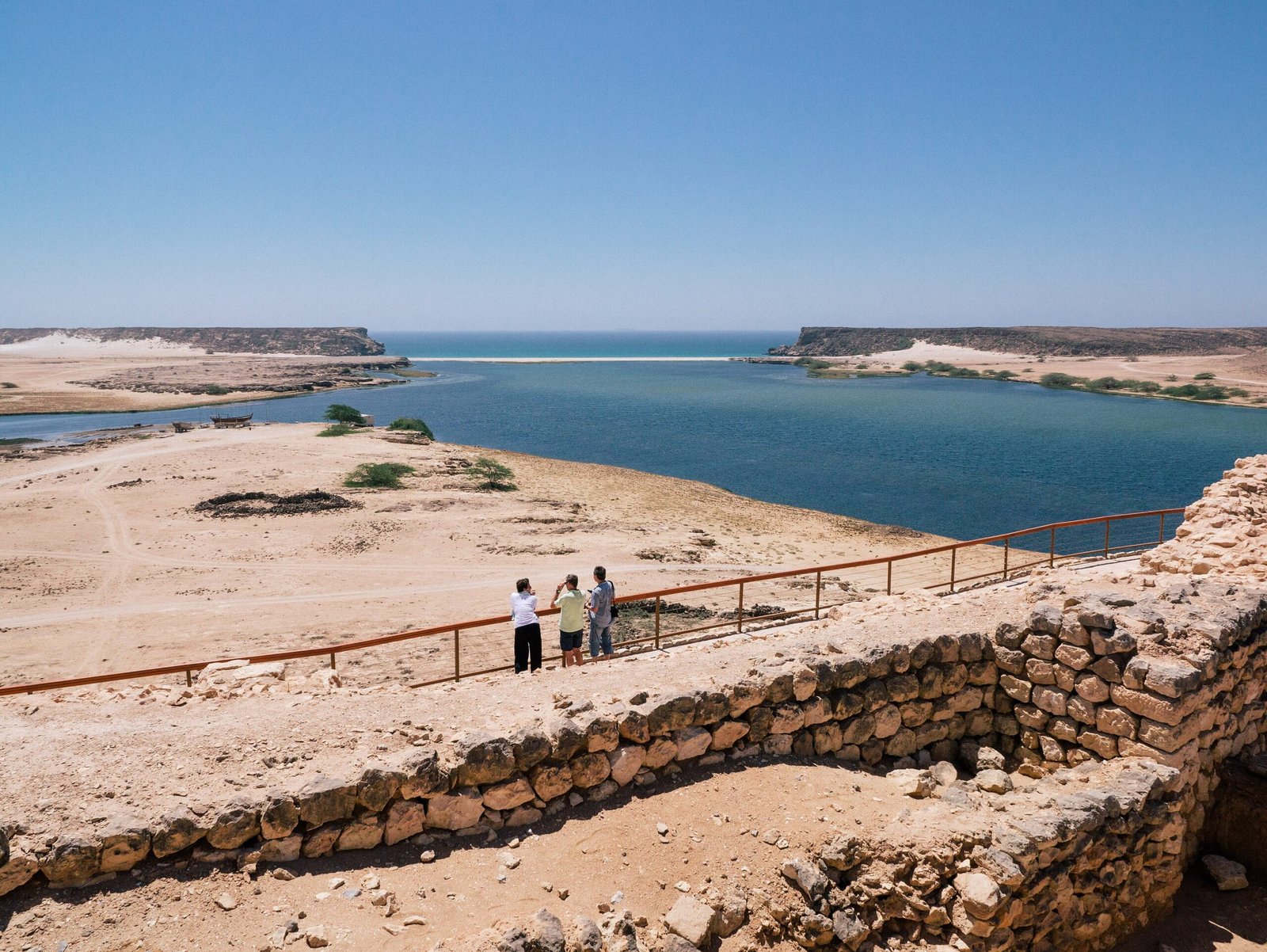
The ancient South Arabian port city that was the principal maritime gateway of the frankincense trade — where the incense of Dhofar was loaded onto ships bound for Rome, India, and the ancient world.
At a glance
On a strategic promontory at the mouth of Khor Rori creek where it meets the Arabian Sea, approximately 40 km east of Salalah in the Dhofar region of southern Oman, the ancient city of Sumhuram was the principal maritime entrepot of the frankincense trade that connected the incense-producing hills of Dhofar to the Mediterranean world. Founded by the South Arabian Hadrami kingdom around the 1st century BC, the city operated as a seasonal port where the world’s finest frankincense — harvested from the Boswellia sacra trees of the Dhofar hills — was loaded onto ships and transported west to Qana and then north to Palmyra and Mediterranean markets, or east directly to India. Part of the UNESCO World Heritage Site “Land of Frankincense” since 2000, Sumhuram has been excavated since 1997 by an Italian Archaeological Mission to Oman.
Key facts
- UNESCO inscription: 2000 — Land of Frankincense (serial site, component Khor Rori)
- Period: c. 1st century BC – 6th century AD (Hadrami South Arabian kingdom, later Himyarite and early Islamic)
- Size: Approximately 100 x 50 metres within stone walls
- Key features: Temple to moon deity Sin, domestic structures, workshops, harbour with wharf and anchorage basin
- Excavations: Italian Archaeological Mission to Oman (University of Pisa), ongoing since 1997
- Trade commodity: Boswellia sacra frankincense — Roman sources estimate 3,000 tonnes moved through Arabian routes annually at peak
- Lagoon: The adjacent tidal khor (creek/lagoon) still shelters small fishing boats today, as it did 2,000 years ago
History
Sumhuram was founded approximately in the 1st century BC by the South Arabian Hadrami kingdom — a successor state of the ancient kingdom of Qataban in present-day Yemen — specifically as a port to control and facilitate the export of frankincense from the Dhofar hills. The location was strategically chosen: the promontory above Khor Rori offered a defensible elevated position, while the protected lagoon below provided a natural harbour where ocean-going vessels could anchor safely. At its peak during the 1st–3rd centuries AD, Sumhuram was a node in a trade network of continental scale: frankincense harvested from the Boswellia sacra groves of the Dhofar hills was transported to the port, loaded onto ships, and dispatched west along the Arabian coast to the Hadrami entrepot of Qana (near present-day Bir Ali in Yemen), where it joined the overland caravan routes to Palmyra, Alexandria, and Rome. Roman texts record the enormous value of Arabian incense: Pliny the Elder complained that Arabia drained Roman gold through the spice and incense trade, and modern estimates suggest that at peak the frankincense trade generated revenues comparable to major Roman provincial taxes.
After the decline of the Hadrami kingdom, Sumhuram passed successively under the control of the Himyarite kingdom (which unified most of southern Arabia in the 3rd–4th centuries AD), the Aksumite Ethiopian empire (which briefly occupied much of southern Arabia in the 6th century AD), and eventually the early Islamic polity in the 7th century AD. The site was gradually abandoned, probably during the 6th–7th centuries, as shifting political and commercial conditions redirected trade routes. The lagoon silted partially, reducing its utility as a deep-water harbour. The site remained largely undisturbed — and virtually unknown outside Oman — until Italian archaeologists began systematic excavations in 1997, revealing the remarkable state of preservation of the stone architecture and the rich corpus of inscriptions in the Hadrami script.
The 1997 excavations by the Italian Archaeological Mission to Oman (MAOI, directed initially by Alessandro de Maigret and subsequently by Alessandra Avanzini of the University of Pisa) have uncovered the city plan in considerable detail: a temple to the South Arabian moon deity Sin (the principal deity of the Hadrami kingdom), a series of domestic and storage structures, evidence of metalworking and craft production, and a substantial corpus of inscriptions in the South Arabian Hadrami script documenting dedications, royal decrees, and mercantile transactions. The inscriptions have been fundamental in establishing the political history of the site and its connections to the wider network of South Arabian kingdoms.
What you see
The archaeological site of Sumhuram occupies a rectangular promontory approximately 100 metres long by 50 metres wide, enclosed within stone walls that are preserved in places to several metres in height. The most prominent surviving structure is the temple complex in the northern part of the site, with its monumental entrance gateway and interior courtyard — the best-preserved South Arabian temple outside Yemen. The domestic quarters show a characteristic South Arabian urban plan of rectangular rooms arranged around courtyards, with well-preserved stone doorframes, thresholds, and wall bases. The harbour area at the base of the promontory, facing the lagoon, preserves traces of a stone quay or wharf structure and evidence of the anchorage basin. The adjacent Khor Rori lagoon is a living landscape: its mangrove-fringed shores and calm waters attract migratory birds and retain the character of the ancient anchorage.
The wider UNESCO serial site “Land of Frankincense” encompasses four components in the Dhofar region: Wadi Dawkah (the living frankincense grove where Boswellia sacra trees are still harvested), the caravan oasis of Shisr/Ubar (identified by some scholars as the legendary lost city of Ubar), Khor Rori/Sumhuram, and Al-Balid (the medieval successor city near Salalah). Together these four sites trace the complete frankincense supply chain from grove to port. Visiting Khor Rori in the context of the broader serial site gives full comprehension of what the ancient trade looked like — from the tapping of trees in the hills to the loading of ships on the Arabian Sea.
Practical information
- Location: Approximately 40 km east of Salalah, Dhofar, Oman. GPS: 17.0378 N, 54.4406 E
- Opening hours: Generally accessible; the Oman government manages the UNESCO site with an on-site visitor centre (verify current hours with Oman Tourism)
- Best season: October–March (avoid the June–September khareef monsoon season, though the misty khareef dramatically transforms the Dhofar landscape)
- Combined visit: The full Land of Frankincense UNESCO tour covers four sites and is best done over 1–2 full days based in Salalah
- Entry: Nominal fee; site museum with finds from the Italian excavations
Getting there
Salalah International Airport (SLL) has direct connections from Muscat (Oman Air, 1h15m) and several Gulf hubs. From Salalah city, Khor Rori is approximately 40 km east via Route 47 (the coastal road towards Mirbat); the turning for the site is signposted. A hire car is the most practical option for visiting the Land of Frankincense serial sites. Organised heritage tours from Salalah hotels include the UNESCO sites as a standard itinerary.
Nearby
- Wadi Dawkah — The living frankincense grove, component of the same UNESCO WHS, approximately 50 km north of Salalah; the trees are still tapped for resin today
- Al-Balid Archaeological Park — The medieval Islamic city of Zafar (Dhofar capital, 12th–16th centuries) near Salalah, also UNESCO-inscribed; the site museum houses the best collection of Land of Frankincense artefacts
- Mirbat — A historic fishing and frankincense town 70 km east of Salalah, with a Portuguese fort and one of the finest beaches on the Arabian Sea
- Shisr / Ubar — The desert caravan oasis and possible lost city of Ubar discovered in 1992, approximately 170 km north of Salalah
Sources
- Avanzini, A. (ed.), A Port in Arabia between Rome and the Indian Ocean (3rd C. BC – 5th C. AD). Khor Rori Report 2, L’Erma di Bretschneider, Rome, 2008
- UNESCO World Heritage List: Land of Frankincense — Site 1010
- de Maigret, A., Arabia Felix: An Exploration of the Archaeological History of Yemen, Stacey International, London, 2002
- Ministry of Heritage and Tourism, Sultanate of Oman: ICOMOS Evaluation Report (2000)
- Wikipedia: Khor Rori
Find it on the map
See this place and what’s around it →📷 Become a Cultural Heritage Online photographer
Share your photos of places: they stay published under your name as the author. The more they're seen, the more you get noticed — and soon a contest will reward the most appreciated photos.
Log in or sign up free to add a photo