
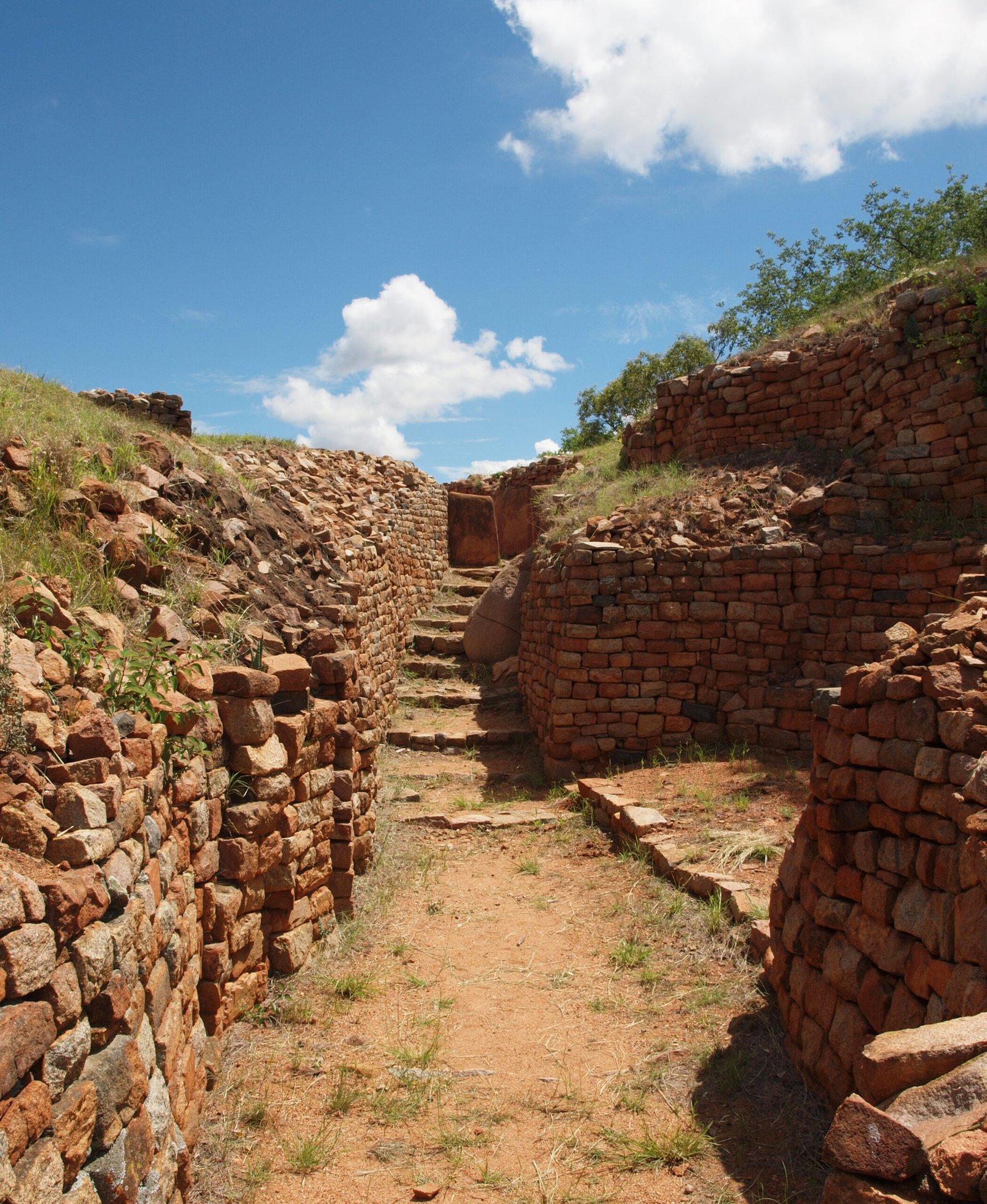
The capital of the Rozvi Empire after the fall of Great Zimbabwe — a UNESCO World Heritage Site whose extraordinary checker-pattern dry-stone terracing represents the technical and aesthetic apex of sub-Saharan Zimbabwe Tradition architecture.
At a glance
Approximately 22 km west of Bulawayo in western Zimbabwe, the ruins of Khami served as the capital of the Rozvi (Butua) state from approximately 1450 AD until the site’s destruction by the Ndebele warrior state in 1683. Inscribed as a UNESCO World Heritage Site in 1986, Khami is the finest example of the later phase of the Zimbabwe Tradition — the distinctive dry-stone architecture tradition of southern Africa — and documents the Rozvi state’s integration into the Indian Ocean trading world through finds of Portuguese porcelain, Chinese Ming ceramics, and glass trade beads.
Key facts
- UNESCO designation: World Heritage Site 1986 (Criteria iii, iv)
- Period: c. 1450–1683 AD (Rozvi/Butua Empire)
- Architectural tradition: Zimbabwe Tradition dry-stone construction
- Signature features: checker-pattern and herringbone decorative stonework on platform facings
- Main platform height: Precipice Platform approximately 20 metres
- Trade finds: Portuguese porcelain, Chinese Ming Dynasty ceramics, Indian Ocean glass beads
- Destroyed: 1683, by the Ndebele (Matabele) conquest
History
When the great stone enclosure city of Great Zimbabwe was abandoned around 1450 AD — most likely because the surrounding land could no longer support the concentration of population and cattle that the kingdom required — the ruling Rozvi (also called Butua) elite relocated westward and established a new capital at Khami, in territory with access to richer grazing lands and the gold and ivory trade routes running to the Mozambican coast. Over the following two centuries, Khami grew into the largest and most architecturally sophisticated of the successor states of the Zimbabwe Tradition.
The Rozvi state became one of the most important intermediaries in the Indian Ocean trade network linking the interior of southern Africa with the Portuguese colonial ports of Sofala and Tete on the Mozambican coast. Portuguese traders visited Khami and brought European ceramics, glass beads, and cloth in exchange for gold, ivory, and cattle. The Chinese Ming porcelain found in the ruins arrived via this same Indian Ocean network, testifying to the global reach of Khami’s commercial connections in the 16th and 17th centuries.
In 1683 a Nguni (Ndebele) military force destroyed Khami, killing the Rozvi king and dispersing the population. The site was abandoned and the architecture fell into ruin. European awareness of the ruins dates to the 1890s; the first systematic archaeological investigations were carried out by Neville Jones in the 1930s, and UNESCO inscribed the site in 1986 as part of a serial nomination that also includes Great Zimbabwe and Khami’s satellite sites.
What you see
Unlike the single massive enclosure of Great Zimbabwe, the Khami complex is organised as a series of royal platform enclosures (daga platforms) spread across a hillside and a peninsula overlooking the Khami River. Each platform is faced with dry-stone walls built without mortar in the “checker pattern” — alternating courses of dark and light stone creating a geometric decorative effect — or in the “herringbone pattern,” where courses of stones are laid at alternating diagonal angles. These decorative stonework traditions are the technical and aesthetic apex of the Zimbabwe Tradition and are not found at Great Zimbabwe itself, which predates them.
The hilltop Precipice Platform — the royal enclosure, approximately 20 metres high — commands panoramic views of the Khami valley. At its summit the foundations of the royal dhaka (clay-walled) palace are still visible, along with stone-lined passageways running through the platform walls. A small site museum displays the Portuguese, Chinese, and Indian Ocean trade goods recovered from the royal precincts, contextualising Khami’s place in a global commercial world of the 16th–17th centuries.
Practical information
- Location: 22 km west of Bulawayo city centre on the Khami Road
- Opening: daily 08:00–17:00; entry approximately USD 5–10 (foreign visitors)
- Site museum: on-site; small display of trade ceramics and local finds
- Facilities: basic; bring water and sun protection
- Combined visit: pair with Natural History Museum of Zimbabwe in Bulawayo (one of the best natural history museums in Africa)
- Best time: April–September (dry season, cooler temperatures)
Getting there
Khami is located 22 km west of Bulawayo, Zimbabwe’s second city, and is most easily reached by private vehicle or hired taxi from Bulawayo city centre (approximately 30 minutes). Bulawayo is served by Joshua Mqabuko Nkomo International Airport, with direct flights from Johannesburg (South Africa), Harare (Zimbabwe), and several other regional cities. No reliable public transport serves the ruins directly; taxi hire from Bulawayo for a half-day return is the standard approach for independent visitors.
Nearby
- Natural History Museum of Zimbabwe — in Bulawayo city centre; one of Africa’s finest natural history collections, with exceptional Zimbabwe Tradition archaeology displays
- Matobo National Park — 35 km south of Bulawayo; UNESCO World Heritage Site (2003) with ancient San rock paintings, balancing granite boulders, and the grave of Cecil Rhodes
- Cyrene Mission — 25 km south; 1940s mission church with remarkable African Christian murals by students of Cyrene Mission School
Sources
- UNESCO World Heritage Centre, Khami Ruins National Monument (whc.unesco.org, accessed 2026)
- Huffman, T.N., Snakes and Crocodiles: Power and Symbolism in Ancient Zimbabwe (Witwatersrand University Press, 1996)
- Garlake, P.S., Great Zimbabwe (Thames and Hudson, 1973)
- National Museums and Monuments of Zimbabwe, Khami site records
- Wikipedia, “Khami” (accessed 2026)
Find it on the map
See this place and what’s around it →📷 Become a Cultural Heritage Online photographer
Share your photos of places: they stay published under your name as the author. The more they're seen, the more you get noticed — and soon a contest will reward the most appreciated photos.
Log in or sign up free to add a photo