
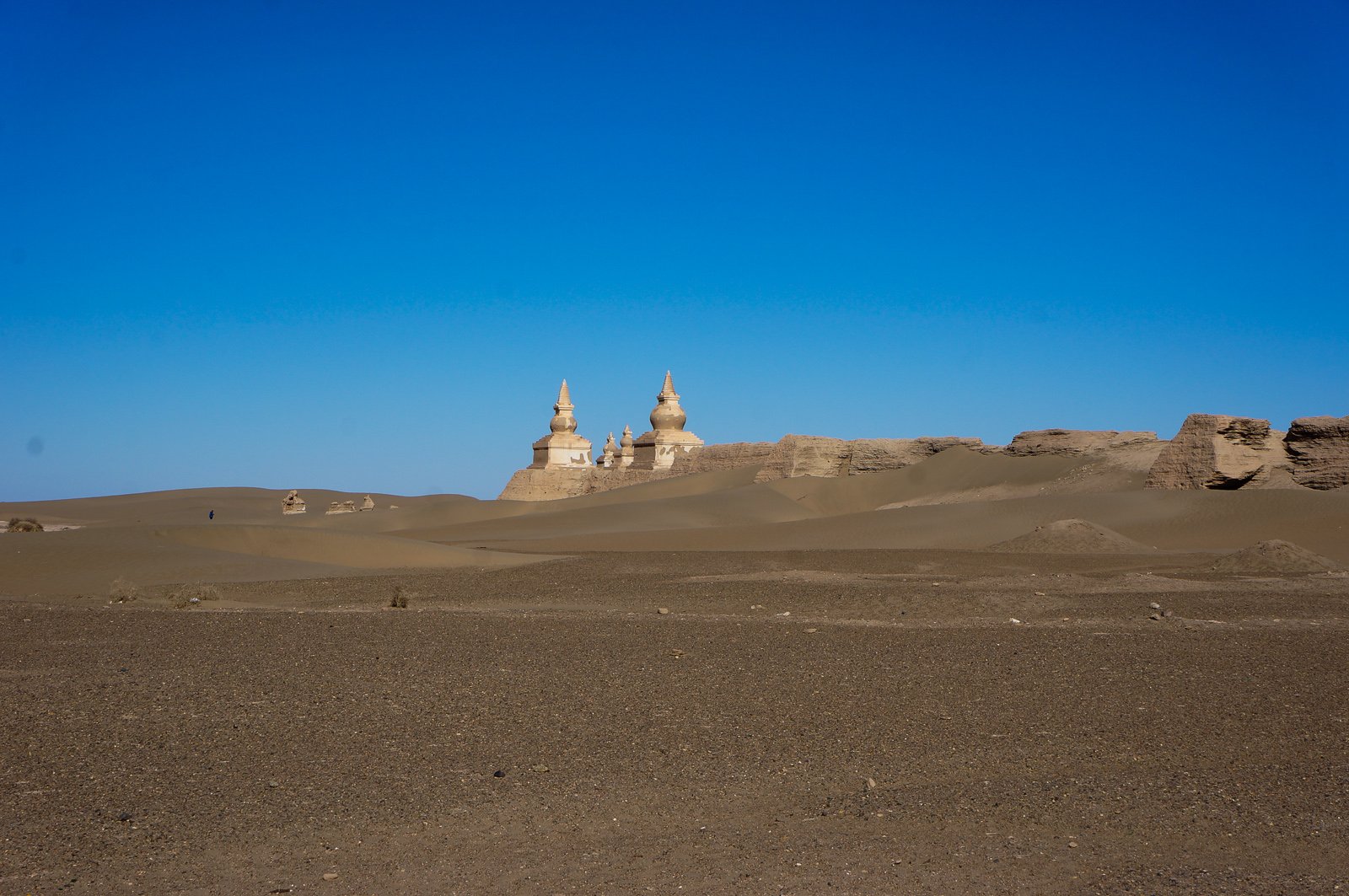
Khara-Khoto — Mongolian for “Black City” — is one of the most dramatically preserved ghost towns on the Silk Road: a walled city in the Gobi Desert of Inner Mongolia whose towers still stand 12 metres high, abandoned after a Ming Dynasty siege in 1372, then stripped of thousands of manuscripts, paintings, and Buddhist artefacts by Tsarist Russian explorer Pyotr Kozlov in 1908. Almost everything Kozlov found is now in the Hermitage in Saint Petersburg.
At a glance
Founded by the Western Xia (Xi Xia) dynasty around 1032 AD at the edge of the Hexi Corridor where the Silk Road split into multiple branches, Khara-Khoto was for three centuries a prosperous trading post, Buddhist pilgrimage centre, and administrative capital of the Mongolian borderlands. After its destruction in 1372, the desert preserved everything inside: manuscripts written in the undeciphered Tangut script, Buddhist paintings, printed books, ceramic vessels, coins, and statues. The site today is a UNESCO World Heritage Tentative List entry and one of the most dramatic and least-visited archaeological ruins in China.
Key facts
- Founded: c. 1032 AD by the Western Xia (Xi Xia) dynasty
- Destroyed: 1372 AD by Ming Dynasty general Feng Sheng; population fled or killed, irrigation channels cut
- Walls: rectangular enclosure 390 m × 300 m; towers still standing approximately 12 metres high
- Kozlov expeditions: 1908 and 1909, removed approximately 2,000 manuscripts + 300 paintings + thousands of Buddhist items for Tsar Nicholas II; all in the State Hermitage Museum, Saint Petersburg
- The Tangut script: the city’s manuscripts were in Tangut, the language of the Western Xia — undeciphered until the 1970s; the Khara-Khoto texts remain the largest Tangut corpus in existence
- UNESCO status: on the World Heritage Tentative List
- Access: requires a 4WD journey of approximately 35 km across desert from Ejin Banner (Dalain Hob)
History
The Western Xia (Xi Xia) dynasty — a Tangut-speaking Buddhist kingdom that controlled the Hexi Corridor from 1038 to 1227 AD — founded Khara-Khoto around 1032 as an administrative and trading outpost at the northern end of their territory, where the Silk Road fanned out toward the Mongolian steppe. The city sat at the confluence of the Ejin and Terihin rivers (now dry), whose water sustained both the city’s inhabitants and the irrigated fields around it.
After Genghis Khan destroyed the Western Xia in 1227, Khara-Khoto passed to Mongol rule and was integrated into the Yuan Dynasty (the Mongolian empire’s Chinese successor). Marco Polo visited the area in the 1270s, though it is uncertain whether he visited the city itself; he refers to it as “Etzina.” Under the Mongols the city remained a functioning urban centre and an important node in the overland trade network, its Buddhist monasteries attracting monks from Tibet, Mongolia, and China.
In 1372, the newly established Ming Dynasty sent general Feng Sheng with a large army to eliminate remaining Mongol-aligned strongholds in the north. Khara-Khoto was besieged and captured. According to local legend, the Mongol commander dug a passage through the wall and attempted to escape with his family and gold, but was caught and executed. Feng Sheng’s forces demolished the irrigation infrastructure, and without water the city became uninhabitable. The desert moved in and covered the ruins in sand, and Khara-Khoto passed from history into legend — known only to local Mongolian nomads who called it “cursed” and avoided it.
In 1908, Russian explorer Pyotr Kozlov, travelling under a commission from Tsar Nicholas II to survey the Mongolian borderlands, reached the ruins of Khara-Khoto with his expedition. What Kozlov found was astonishing: because the extreme dryness of the Gobi Desert had perfectly preserved organic materials, the city’s contents were essentially intact after 535 years of abandonment. He excavated approximately 2,000 manuscripts in Tangut and Chinese, 300 Buddhist thangka paintings, printed books (among the oldest printed texts known), ceramic objects, and coins. A second expedition in 1909 recovered thousands more items, including a large stupa filled with 42 complete Buddhist statuettes and hundreds of individual devotional items.
All of these objects were transported to Saint Petersburg and are now in the State Hermitage Museum and the Institute of Oriental Manuscripts. The Tangut manuscripts from Khara-Khoto remain the largest corpus of Tangut-language texts in existence and were central to the eventual decipherment of the Tangut script in the 1970s by Soviet and later Chinese linguists. The removal of the collection is a persistent point of scholarly and diplomatic contention between China and Russia.
What you see
The ruins are dramatic. The rectangular mudbrick walls — 390 m × 300 m — still stand in most sections, with round corner towers rising approximately 12 metres above the desert floor. The main city gate on the west wall is partially preserved. Inside the walls, the foundations of streets, residential blocks, and administrative buildings are visible as low mounds beneath the sand. The most striking surviving structure is a large stupa (the Great Pagoda) in the northwest corner, its brick-and-mudbrick construction still reaching approximately 10 metres in height, surrounded by the stumps of smaller votive stupas.
Outside the southern wall, additional smaller stupas and what appear to be shrine platforms extend across the desert. The 1908 Kozlov stupa, the structure from which the largest cache of objects was removed, can still be identified.
Practical information
- Location: Ejin Banner (Ejina Qi), Alxa League, Inner Mongolia Autonomous Region, China
- Access: The site is approximately 35 km northwest of the town of Ejin Banner (Dalain Hob) across desert terrain; a 4WD vehicle is essential outside of dry conditions
- Entry: Nominal entry fee; the site is managed by the local government as a tourist attraction with a basic visitor point
- Best season: Spring (April–May) and autumn (September–October); summer temperatures exceed 40°C; spring can bring sandstorms
- Finds in museums: State Hermitage Museum, Saint Petersburg (primary collection); Institute of Oriental Manuscripts, Saint Petersburg; Inner Mongolia Museum, Hohhot (some objects)
Getting there
Ejin Banner is the nearest town, reachable by air from Hohhot (capital of Inner Mongolia, 1,100 km east) via the Ejin Banner Taolai Airport, or by train and road from Zhangye (Gansu Province, 400 km southeast via the Hexi Corridor). From Ejin Banner, hire a 4WD with a local driver at the town’s hotels or the tourist office; the desert track to the site takes approximately 45–60 minutes each way. There is no public transport to the site. GPS coordinates are essential; the track is not always clearly marked.
Nearby
- Juyan Wetlands (Ejin Oasis) — 20 km east, a remarkable desert oasis with ancient Euphrates poplar trees turning golden in October — one of Inner Mongolia’s most photographed landscapes
- Dunhuang and Mogao Caves — 450 km southwest, the supreme Buddhist cave complex of the Silk Road, with 492 painted caves spanning 1,000 years of art
- Jiayuguan Fort — 400 km southeast, the westernmost major fort of the Great Wall, marking the ancient boundary of the Chinese world
Sources
- Kozlov, Pyotr K. — Mongolia and Amdo and the Dead City of Khara-Khoto, 1923 (trans. from Russian)
- Dunnell, Ruth W. — The Great State of White and High: Buddhism and State Formation in Eleventh-Century Xia, University of Hawaii Press, 1996
- State Hermitage Museum — Khara-Khoto collection catalogue
- Wikipedia — Khara-Khoto
Find it on the map
See this place and what’s around it →📷 Become a Cultural Heritage Online photographer
Share your photos of places: they stay published under your name as the author. The more they're seen, the more you get noticed — and soon a contest will reward the most appreciated photos.
Log in or sign up free to add a photo