
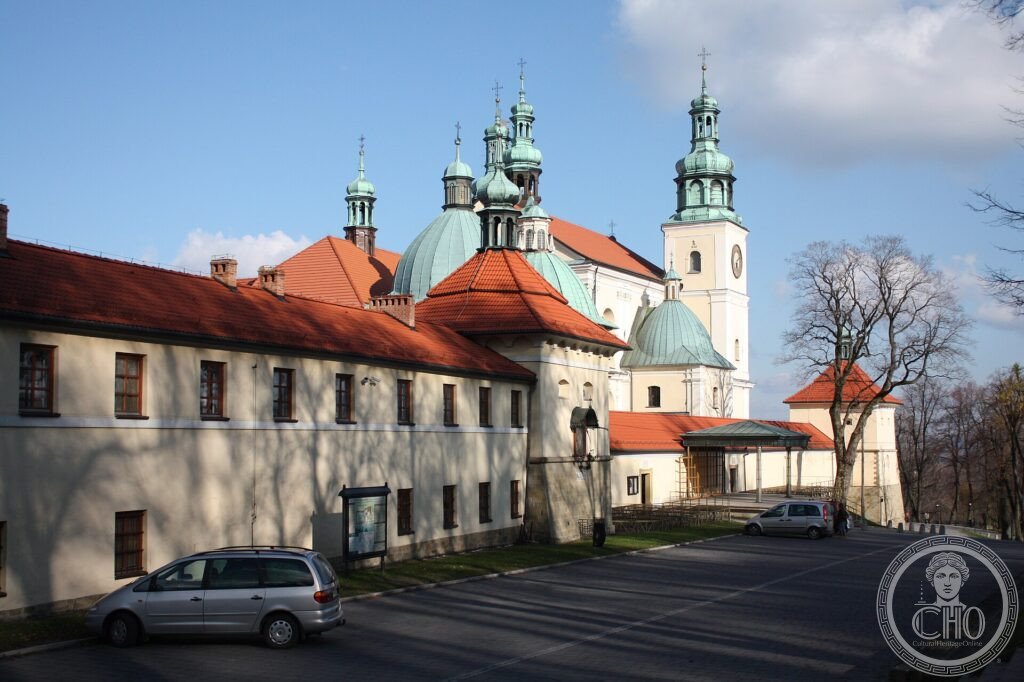
In the early seventeenth century a Polish nobleman turned the hills around his castle into a symbolic Jerusalem: a monastery and dozens of chapels retracing the Passion of Christ, set within the landscape. It remains one of Poland’s great pilgrimage sites, dear to John Paul II.
At a glance
Kalwaria Zebrzydowska is a Counter-Reformation pilgrimage landscape laid out in the early 17th century, where architecture and nature are combined to recreate the holy places of Jerusalem. The nobleman Mikołaj Zebrzydowski founded a Bernardine monastery and, in the surrounding hills, a series of Mannerist chapels marking the stations of the Passion of Christ and the life of the Virgin. Still a major pilgrimage centre, especially associated with Pope John Paul II, it was inscribed by UNESCO in 1999.
Key facts
- UNESCO: World Heritage since 1999
- Founded: from 1600 by the nobleman Mikołaj Zebrzydowski
- A symbolic Jerusalem: chapels in the hills recreate the holy places
- Mannerist: the chapels are designed in an inventive Mannerist style
- Bernardine monastery: the basilica and friary at the heart of the site
- John Paul II: a pilgrimage place dear to the Polish-born pope
History
In 1600 Mikołaj Zebrzydowski, voivode of Kraków, founded a Bernardine monastery on a hill near his castle, inspired by accounts of Jerusalem. Around it, over the following decades, he and his successors laid out a “Calvary”: dozens of chapels and shrines set among the wooded hills and valleys to correspond to the sites of Christ’s Passion and the life of the Virgin, so that pilgrims could walk the holy story through the landscape.
The chapels were designed in a rich Mannerist style, some by the Flemish architect Paul Baudarth. The sanctuary became one of the most important pilgrimage destinations in Poland, drawing great crowds for its Passion plays in Holy Week, a tradition that continues.
What you see
The Baroque-fronted basilica and monastery crown the central hill, their towers visible across the valley. From there the pilgrimage paths lead out to the scattered chapels — small Mannerist structures, some shaped symbolically — among woods and meadows, the whole landscape arranged as a devotional journey.
During Holy Week the paths fill with pilgrims following the Passion plays from chapel to chapel.
Practical information
- Sanctuary: the basilica and monastery are open to visitors and pilgrims
- Chapels: reached on foot along the pilgrimage paths in the hills
- Time needed: half a day; longer to walk the full circuit
- Holy Week: the Passion plays draw very large crowds
Getting there
Kalwaria Zebrzydowska is in Lesser Poland, about 35 km south-west of Kraków. It is reached by road, bus or train from Kraków. GPS: 49.866° N, 19.676° E.
Nearby
- Kraków — the UNESCO old town and royal capital, to the north-east
- Wadowice — the birthplace of Pope John Paul II, nearby
- Auschwitz-Birkenau — the memorial and museum, to the north
Sources
- UNESCO World Heritage Centre — “Kalwaria Zebrzydowska: the Mannerist Architectural and Park Landscape Complex and Pilgrimage Park” (ref. 905)
- Sanktuarium Kalwaria Zebrzydowska — official sanctuary site
- Encyclopaedia Britannica — Kalwaria Zebrzydowska
Find it on the map
See this place and what’s around it →📷 Become a Cultural Heritage Online photographer
Share your photos of places: they stay published under your name as the author. The more they're seen, the more you get noticed — and soon a contest will reward the most appreciated photos.
Log in or sign up free to add a photoIs this page about you?
This page is read by travellers and heritage enthusiasts who find it on Google. Tell us how you are connected to this place and we will take it from there.