
The medieval capital of the Goryeo Dynasty — the Korean kingdom that gave Korea its name — where the first metal moveable type was invented and the world’s most complete Buddhist canon was carved. The only UNESCO World Heritage Site on North Korean territory, inscribed in 2013.
At a glance
In the southwestern region of North Korea, approximately 50 km north of the Demilitarised Zone, the historic city of Kaesong preserves the remains of the capital of the Goryeo Dynasty (918–1392 AD) — the Korean kingdom from whose name “Korea” derives. The UNESCO inscription, granted in 2013, covers 12 historic sites including palace ruins, a Confucian academy, and royal tombs. It is the only UNESCO World Heritage Site on North Korean territory.
Key facts
- Period: Capital of the Goryeo Dynasty, 918–1392 AD (475 years)
- Founded: 919 AD by dynasty founder Wang Geon (Taejo)
- Name: “Goryeo” is the origin of the Western name “Korea”
- UNESCO WHS: Inscribed 2013 — the only World Heritage Site in North Korea
- 12 inscribed sites: Manwoldae palace ruins, Koryo Museum (Sungkyunkwan, 992 AD), tomb of Wang Geon, royal tombs
- Key achievements: First metal moveable type (c. 200 years before Gutenberg); Tripitaka Koreana (81,258 wooden printing blocks, 1237–1248)
- Access: Organised tours only through the North Korean travel system
History
In 918 AD, Wang Geon founded the Goryeo Dynasty and in 919 established its capital at Kaesong (then called Gaegyeong or Songdo). The Goryeo period was one of the most remarkable in Korean history. Under successive kings, Korean civilisation achieved extraordinary advances: celadon ceramics of unmatched quality; the invention of the world’s first metal moveable type, approximately 200 years before Gutenberg’s press in Germany; and the compilation of the Tripitaka Koreana — the most complete and textually accurate Buddhist canon ever produced — carved between 1237 and 1248 onto 81,258 wooden printing blocks that survive intact at Haeinsa Temple in South Korea.
Kaesong survived the devastating Mongol invasions of the 13th century, which resulted in a period of Mongol suzerainty over the peninsula. In 1392, the Joseon Dynasty replaced the Goryeo and moved the capital south to what is now Seoul. After the Korean War (1950–1953), Kaesong found itself in North Korean territory just north of the DMZ. The Kaesong Industrial Complex, a joint North-South economic zone, operated 2004–2016. Today Kaesong is a North Korean city of approximately 350,000 people.
The UNESCO inscription in 2013 was the result of a nomination submitted jointly by North and South Korea — one of the few instances of inter-Korean cooperation in the heritage field. Joint excavations at Manwoldae palace by North and South Korean archaeological teams took place between 2007 and 2015 before being suspended following the closure of the industrial zone.
What you see
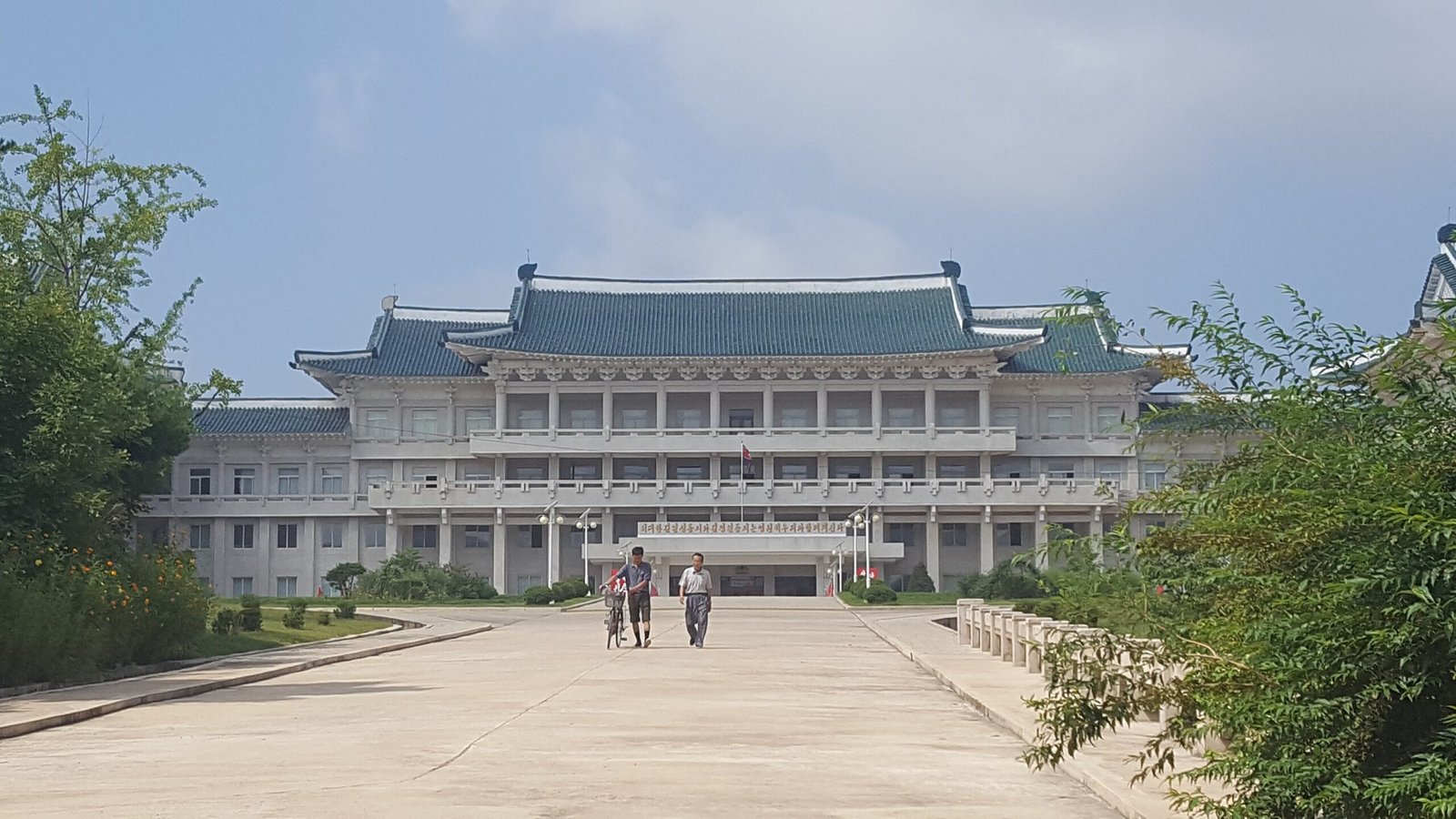
The most accessible inscribed monument is the Koryo Museum, housed in the buildings of the Sungkyunkwan Confucian academy founded in 992 AD. The museum preserves a collection of Goryeo celadon ceramics, Buddhist statuary, and historical artefacts providing direct evidence of the dynasty’s cultural output. The academy buildings themselves — timber-frame constructions of the Korean neo-Confucian tradition — are among the best-preserved medieval structures on the Korean peninsula.
Manwoldae, the ruins of the Goryeo royal palace on the slopes of Songak Mountain, covers a vast area beneath accumulated soil and vegetation. Partial excavations by the joint North–South Korean teams have revealed the extensive stone platform foundations of the palace complex. The tomb of Wang Geon, marked by a reconstructed memorial hall, lies northeast of the city. Several royal Goryeo tombs are also among the inscribed sites.
Practical information
- Access: Organised tours through authorised North Korea travel agencies only; no independent travel permitted
- Eligibility: Most nationalities eligible; US, South Korean, and Israeli citizens face restrictions (subject to change)
- Tour operators: Koryo Tours (Beijing), Young Pioneer Tours, and other licensed operators offer Kaesong day trips or overnight itineraries
- Photography: Permitted at most tourist sites; local guide restrictions apply at sensitive locations
- Currency: Foreign visitors typically use euros or Chinese yuan at designated tourist facilities
Getting there
All visits to Kaesong take place within organised North Korea tour itineraries, typically departing from Pyongyang (approximately 170 km north). Kaesong is reachable from the North Korean capital by road (approximately 2 hours) or by train. The only international entry point for most visitors is Pyongyang Sunan International Airport, with flights from Beijing and a limited number of other Asian cities.
Nearby
- Korean Demilitarised Zone (DMZ) — runs approximately 50 km south of Kaesong; the Panmunjom truce village is accessible from both sides on organised tours
- Pyongyang — the North Korean capital, approximately 170 km north, the hub of all international tourism in the DPRK
- Songak Mountain — the forested mountain immediately behind the city that provides the dramatic backdrop to the Manwoldae palace ruins
Sources
- UNESCO World Heritage List, “Historic Monuments and Sites in Kaesong,” inscribed 2013. whc.unesco.org
- Duncan, John B. The Origins of the Chosŏn Dynasty. Seattle: University of Washington Press, 2000.
- Lee, Ki-baik. A New History of Korea. Cambridge: Harvard University Press, 1984.
- Koryo Tours. Kaesong travel documentation. koryogroup.com
- Wikipedia, “Kaesong.” en.wikipedia.org/wiki/Kaesong
Find it on the map
See this place and what’s around it →📷 Become a Cultural Heritage Online photographer
Share your photos of places: they stay published under your name as the author. The more they're seen, the more you get noticed — and soon a contest will reward the most appreciated photos.
Log in or sign up free to add a photo