

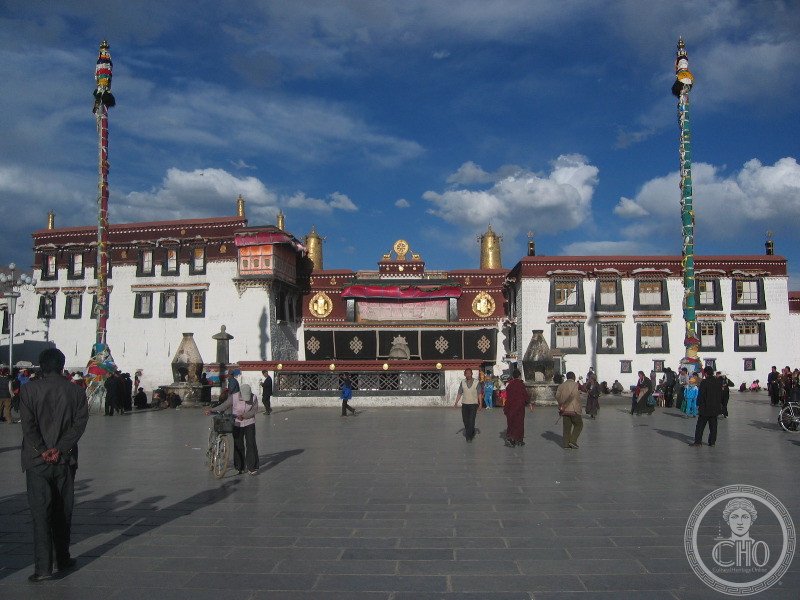
The spiritual heart of Lhasa, Jokhang is a revered Tibetan Buddhist temple founded in the 7th century to enshrine a sacred statue brought by a Nepalese queen. Today it remains one of Tibet’s most important pilgrimage sites.
At a glance
Jokhang stands in Barkhor Square as a temple complex combining Tibetan Buddhist architecture with elements reflecting its cosmopolitan origins. The site encompasses a main temple, surrounding monastery buildings, and residential quarters for monks of the Gelug school. It functions simultaneously as a sacred pilgrimage destination and a living religious community.
History
King Songsten Gampo founded the Jokhang around 640 CE to house the Jowo Mikyo Dorje, a statue of Akshobhya Buddha brought to Tibet by his Nepalese wife, Queen Bhrikuti. His Tang Chinese consort, Wencheng, later contributed the Jowo Shakyamuni sculpture, now the temple’s primary sacred image.
Nepalese and Indian artisans shaped the original design and construction, establishing cosmopolitan artistic traditions. By the 14th century, the temple had become associated with the Vajrasana pilgrimage tradition of India. Following the 1792 Gorkha invasion, the Qianlong Emperor restricted Nepalese access, transforming Jokhang into an exclusively Tibetan sacred space.
During the 1966 Cultural Revolution, Red Guards attacked the temple and halted worship for a decade. Restoration work proceeded from 1972 to 1980. The Jokhang achieved UNESCO World Heritage status in 2000 as part of the Potala Palace inscribed site.
What you see
The temple reflects a synthesis of Tibetan, Nepalese, and Chinese architectural influences. Golden roofs gleam above the main sanctuary, where the Jowo Shakyamuni statue sits as the object of devoted pilgrimage. Circumambulatory paths allow visitors to walk around the structure in the Tibetan Buddhist tradition of clockwise devotion.
Interior spaces feature elaborate altar arrangements, hanging thangka paintings, and ornate wooden columns. The complex includes monastic quarters, courtyards, and subsidiary chapels devoted to protective deities and Gelug school teachers.
Cultural significance
Jokhang occupies an unparalleled place in Tibetan Buddhist devotion as the ultimate pilgrimage destination. The presence of the Jowo Shakyamuni—considered an emanation of Buddha’s enlightened form—draws thousands of pilgrims annually, many prostrating themselves repeatedly along the approach routes.
The temple embodies Tibet’s historical connections to Nepal and China, preserved in its syncretic artistic heritage. As a monastic institution, it continues to train monks in Gelug doctrine and practice, maintaining continuity with centuries-old religious traditions.
Key facts
- Founded: c. 640 CE by King Songsten Gampo
- Location: Barkhor Square, Lhasa, China
- Coordinates: 29.65° N, 91.05° E
- Primary sacred image: Jowo Shakyamuni statue
- Religious tradition: Tibetan Buddhism, Gelug school
- UNESCO World Heritage Site: 2000 (extension of Potala Palace)
Practical information & getting there
Jokhang is centrally located in Lhasa, accessible by foot or local transport. Entry is subject to Chinese restrictions; visitors should verify current access policies before traveling. Respectful dress and behavior are essential in this active place of worship. Photography policies vary within the temple complex.
Sources & resources
Find it on the map
See this place and what’s around it →📷 Become a Cultural Heritage Online photographer
Share your photos of places: they stay published under your name as the author. The more they're seen, the more you get noticed — and soon a contest will reward the most appreciated photos.
Log in or sign up free to add a photoIs this page about you?
This page is read by travellers and heritage enthusiasts who find it on Google. Tell us how you are connected to this place and we will take it from there.