
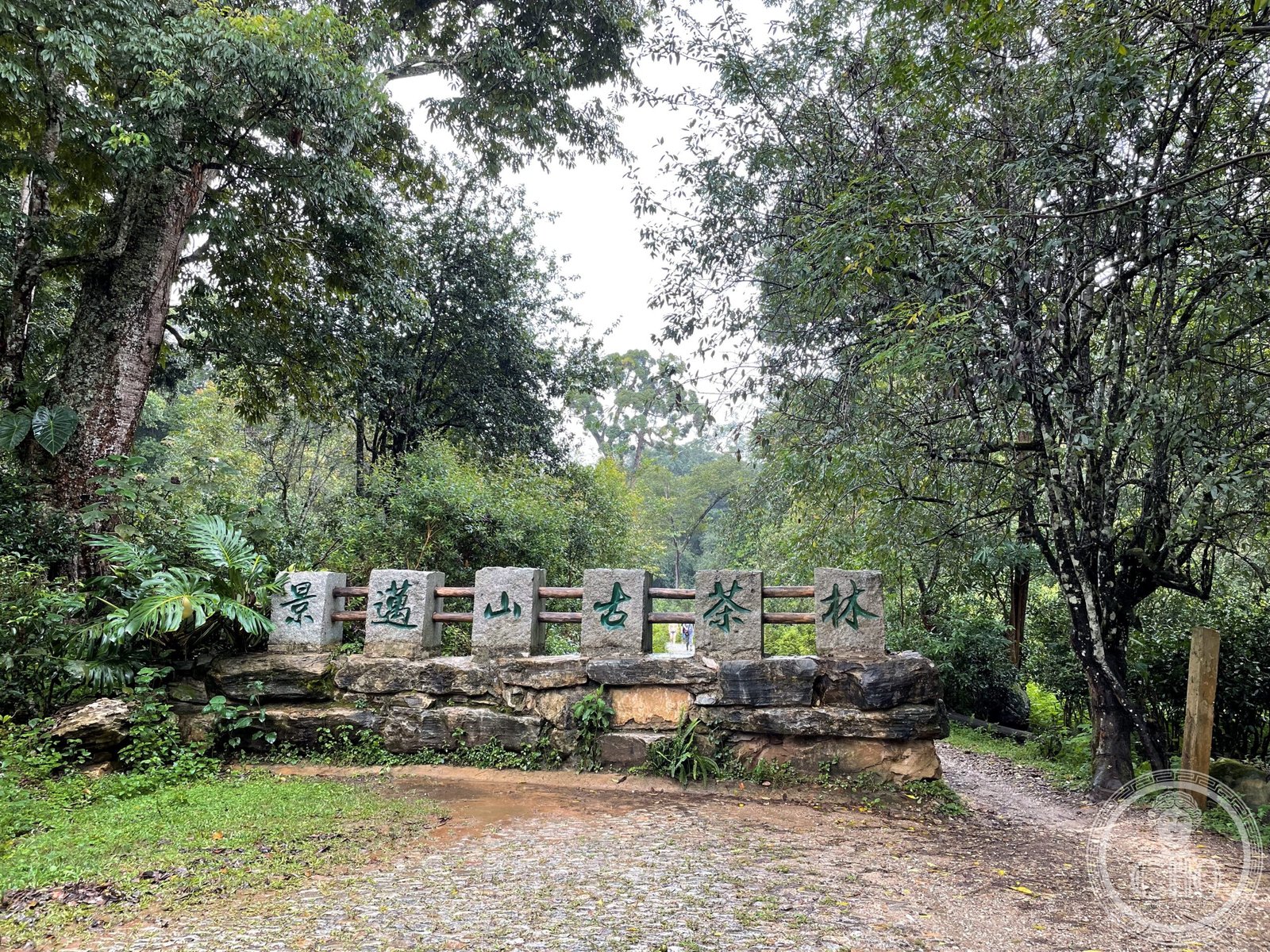
A Living Tea Landscape
Jingmai Mountain in southern Yunnan is home to the world’s largest and best-preserved ancient tea plantation — a mosaic of old-growth tea trees, shade forest, and traditional villages that has been continuously cultivated for over a thousand years. Here tea is not a monoculture: it grows beneath a canopy of forest trees in an agroforestry system refined across generations of Blang and Dai farmers.
Ancient Cultivation Practices
The tea trees on Jingmai are not bred cultivars but ancient specimens, some over 500 years old, with gnarled trunks and broad canopies. Cultivated under a forest shade-farming philosophy that predates modern agronomy by centuries, these trees produce the pu-erh tea prized across East Asia. The system is fully organic: no fertilisers, no irrigation, no monoculture.
The Blang and Dai Communities
Five traditional villages of the Blang and Dai ethnic minorities sit within the tea forests, their wooden architecture, religious shrines, and agricultural festivals intimately integrated with the landscape. The Blang consider themselves the original cultivators of this forest, tracing their tea-farming ancestry back more than a millennium through oral tradition and ritual practice.
Biodiversity and Forest Ecology
The interplanting of tea with native forest trees creates a microhabitat of remarkable biodiversity. Wild orchids, mosses, and insects thrive in the shade layers; the forest canopy moderates temperature and humidity in ways that monoculture plantations cannot replicate. This living ecosystem is inseparable from the cultural practices that sustain it.
UNESCO Recognition
Inscribed in 2023 under criteria iii and v, the Cultural Landscape of Old Tea Forests of Jingmai Mountain was recognised as an outstanding example of a traditional land-use system that represents the interaction between human communities and their natural environment, evolving over a millennium without losing its ecological integrity.
Visiting Jingmai
The mountain is accessible from Pu’er City (formerly Simao) in southern Yunnan, a 3–4 hour drive on mountain roads. Visitor facilities are modest: homestays in the traditional villages offer the most authentic experience, including participation in tea-picking and pu-erh cake pressing. The area is best visited in spring (March–April) during the first flush harvest.
Getting There
Pu’er has a small airport with connections to Kunming (the Yunnan capital, 1 hr flight). From Kunming, high-speed rail also reaches the region. The mountain road from Pu’er to Jingmai takes approximately 3 hours by car.
Wider Yunnan UNESCO Context
Yunnan is one of China’s most biodiverse and culturally rich provinces. Nearby UNESCO sites include the Three Parallel Rivers (ref 1083) and the Chengjiang Fossil Site (ref 1388). The Jingmai landscape completes a picture of Yunnan as a zone of exceptional natural and cultural heritage.
Find it on the map
See this place and what’s around it →📷 Become a Cultural Heritage Online photographer
Share your photos of places: they stay published under your name as the author. The more they're seen, the more you get noticed — and soon a contest will reward the most appreciated photos.
Log in or sign up free to add a photo