
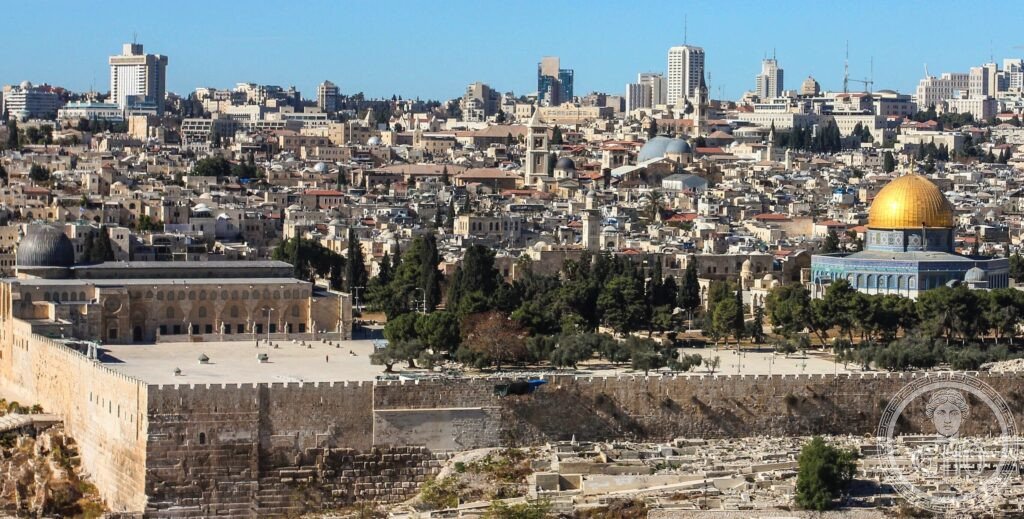
Within the stone lanes of the Old City, Jerusalem holds the holiest site of Judaism, a principal shrine of Christianity and the third holiest sanctuary of Islam almost side by side. The Temple Mount, the Western Wall and the Church of the Holy Sepulchre stand within a few hundred metres of one another, an unmatched concentration of sacred ground.
At a glance
The Old City of Jerusalem, inscribed as a UNESCO World Heritage Site in 1981 on a nomination submitted by Jordan, packs the Temple Mount, the Western Wall, the Church of the Holy Sepulchre and the Via Dolorosa into a single walled quarter. The Temple Mount, known in Hebrew as Har HaBayit and in Arabic as al-Haram al-Sharif, carries the Dome of the Rock and the Al-Aqsa Mosque on a platform expanded under Herod the Great. Below it, the Western Wall is the surviving retaining wall of that Herodian platform, not a wall of the Temple building itself, and remains the principal open-air prayer site of Judaism.
Key facts
- Old City: contains the Temple Mount, the Western Wall and the Church of the Holy Sepulchre within a compact walled area, inscribed as a UNESCO World Heritage Site in 1981 on a Jordanian nomination made without Israeli consent.
- Temple Mount / al-Haram al-Sharif: the site of the First and Second Temples in Jewish tradition and, in Islamic tradition, the location of the Prophet Muhammad’s Night Journey, marked by the Dome of the Rock.
- Dome of the Rock: built in 691 under the Umayyad Caliph Abd al-Malik, generally regarded as the oldest surviving Islamic building; its gold dome was renewed in 1962 and regilded in 1993 at the expense of King Hussein of Jordan.
- Al-Aqsa Mosque: built in 705 under Caliph al-Walid, the largest mosque on the Mount and the third holiest site in Islam after Mecca and Medina.
- Church of the Holy Sepulchre: founded in 335 by the Emperor Constantine, largely rebuilt by the Crusaders in the 11th and 12th centuries, and traditionally identified as the site of the crucifixion, burial and resurrection of Jesus.
History
Jerusalem’s sacred status begins with Solomon’s First Temple, destroyed in 586 BCE when Nebuchadnezzar II of Babylon took the city and exiled its population. Cyrus the Great of Persia allowed the exiles to return, and a Second Temple was built, later massively expanded by Herod the Great, whose platform became the largest sacred enclosure of the ancient world. In 70 CE Roman forces under Titus destroyed the Second Temple during the suppression of the Jewish revolt, and after the further Bar Kokhba revolt of 132–135 CE the emperor Hadrian rebuilt the city as Aelia Capitolina and barred Jews from entering.
Constantine built the Church of the Holy Sepulchre in 335, following his mother Helena’s identification of the site and her discovery of what was venerated as the True Cross. After Persian Sassanid conquest in 614, the city passed peacefully to Arab Muslim rule in 638, when Caliph Umar entered Jerusalem after its surrender by the Byzantine Patriarch Sophronius. Umar’s covenant guaranteed the safety of the city’s Christians, and he is said to have declined to pray inside the Church itself, for fear his act would be used as precedent to convert it into a mosque. The Dome of the Rock followed in 691 under Umayyad rule.
Jerusalem changed hands repeatedly in the centuries that followed: the First Crusade took the city with great violence in 1099, Saladin recaptured it peacefully in 1187, and Suleiman the Magnificent rebuilt the current city walls under Ottoman rule between 1537 and 1541. In the twentieth century, the 1947 UN Partition Plan, the 1948 war and the subsequent Jordanian annexation of East Jerusalem were followed by Israel’s capture of the Old City in the 1967 Six-Day War and its 1980 Basic Law declaring a reunified Jerusalem its capital. UNESCO inscribed the Old City as a World Heritage Site in 1981 on a nomination made by Jordan without Israeli agreement.
What you see
At the base of the Temple Mount, the Western Wall forms an open prayer plaza where worshippers gather before the ancient retaining stones, among them one massive single-cut block long identified as one of the largest in the platform’s construction. Above, the Temple Mount platform carries the Dome of the Rock, its octagonal walls faced with tilework and its dome sheathed in gold-plated copper, and the Al-Aqsa Mosque, a columned prayer hall that remains in active use.
Inside the Old City’s Christian quarter, the Church of the Holy Sepulchre is shared by six Christian denominations, Greek Orthodox, Roman Catholic, Armenian, Coptic, Ethiopian and Syriac, each responsible for separate sections of the building. At its centre stands the Edicule, the small shrine enclosing the traditional tomb of Jesus, whose 2016–2017 restoration by a team from the National Technical University of Athens exposed, for the first time in centuries, a Crusader-period marble slab and beneath it the original limestone burial bench cut into the rock of Golgotha. Nearby, the Via Dolorosa traces the traditional route of the Passion through fourteen stations. Elsewhere in the Old City stand the Tower of David, incorporating the base of one of Herod’s original fortress towers, and the small, quiet Armenian Quarter with its Crusader-period St James Cathedral.
Practical information
- Temple Mount access: Jewish religious law traditionally prohibits Jews from entering the platform, though some rabbinical authorities permit entry after ritual immersion; access rules for visitors change according to circumstances and should be checked with the relevant authorities before a visit.
- Church of the Holy Sepulchre: administered jointly by six Christian denominations, each governing separate areas of the building.
- Visiting arrangements: given the contested and highly sensitive status of these sites, opening times and access can change with little notice; current information is best confirmed through the official channels of the relevant custodians.
Getting there
The Old City lies within Jerusalem and is entered on foot through its historic gates; its principal sites, the Temple Mount, the Western Wall and the Church of the Holy Sepulchre, are all within walking distance of one another inside the walls.
Nearby
- Western Wall — at the foot of the Temple Mount, the main open prayer site of Judaism.
- Tower of David / Citadel — within the Old City walls, incorporating the surviving base of one of Herod’s fortress towers.
- Armenian Quarter — the smallest and quietest of the Old City’s quarters, home to the Crusader-period St James Cathedral.
- Via Dolorosa — the traditional route of the Passion, running through the Old City to the Church of the Holy Sepulchre.
Sources
- UNESCO
- National Technical University of Athens
Find it on the map
See this place and what’s around it →📷 Become a Cultural Heritage Online photographer
Share your photos of places: they stay published under your name as the author. The more they're seen, the more you get noticed — and soon a contest will reward the most appreciated photos.
Log in or sign up free to add a photo