
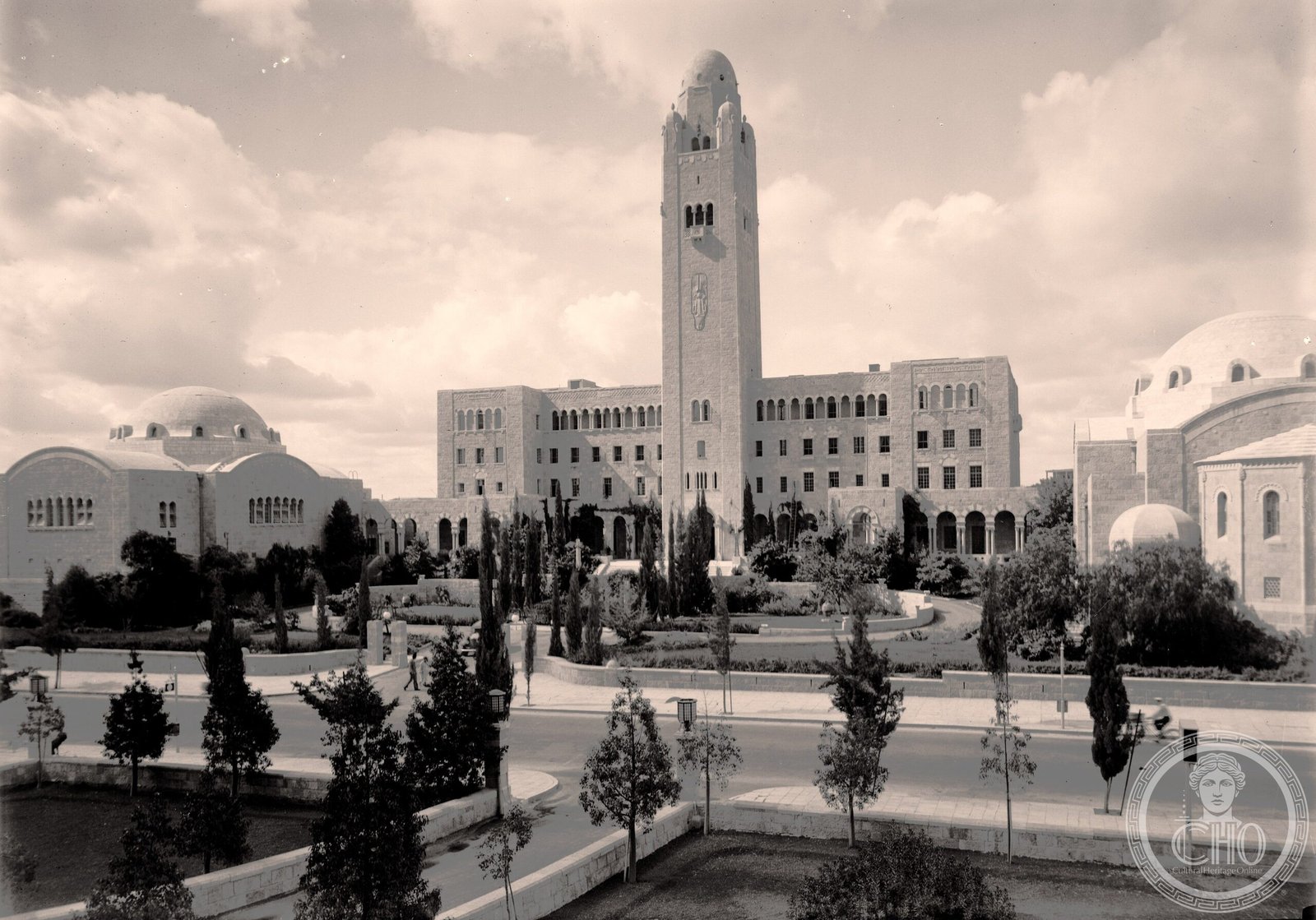
Standing opposite the King David Hotel on King David Street, the Jerusalem International YMCA is one of the most architecturally singular buildings in the Middle East. Its 45-metre central tower — flanked by two Byzantine domes and carved with Art Deco friezes — was designed by Arthur Loomis Harmon, one of the architects of the Empire State Building in New York. Harmon received the commission in 1926, the same year he was working on the Manhattan skyscraper, and he approached Jerusalem with the same ambition but a radically different vocabulary. The result is a building that draws simultaneously on Byzantine church architecture, Romanesque stone carving, and the geometric ornament of American Art Deco. At its 1933 inauguration, Field Marshal Lord Plumer declared it "a building that brings Christians, Jews, and Muslims together" — a vision that made it a rare neutral space during the turbulent British Mandate period. Today it operates as a hotel, sports facility, and community centre, open to visitors of all backgrounds.
At a glance
- Type
- YMCA / Hotel / Community centre
- Period
- 1926–1933
- Style
- Byzantine-Art Deco
- Location
- 26 King David Street, Jerusalem, Israel
- Coordinates
- 31.7778° N, 35.2138° E
- Architect(s)
- Arthur Loomis Harmon (Shreve, Lamb & Harmon)
Overview
The Jerusalem International YMCA combines a hotel, gymnasium, swimming pool, concert hall, and community spaces within a single complex organized around a landmark tower. The tower is the building's visual anchor: a square shaft rising through three setback stages to a lantern and observation deck, carved in local Jerusalem stone. Two flanking wings terminate in smaller domed rotundas, giving the building its characteristic three-arch silhouette from the street. The concert hall seats several hundred and retains its original acoustics and decorative programme, including carved stone and stained glass with interfaith iconography spanning Jewish, Christian, and Islamic motifs.
History
The project was initiated by the American YMCA movement, which sought to establish a permanent base in Jerusalem at a time of rising communal tensions under British Mandate rule. Harmon was selected following an international search, and his design was developed over several years before construction began in the early 1930s. The building was inaugurated in March 1933, just weeks before Hitler's rise to power reshaped the political context of the entire region. During the Mandate period, the YMCA hosted meetings and sporting events that brought Jewish, Arab, and British participants together — a function that became increasingly difficult after 1947. The building survived the 1948 War of Independence and has operated continuously since. It was designated a protected heritage structure by the Jerusalem municipality.
Architecture & Design
Harmon worked within the strict requirement that all Jerusalem buildings be clad in local limestone — a regulation that paradoxically strengthened his design by rooting it in the city's material tradition. The tower articulates three diminishing stages, each with arched loggias and carved stone balustrades. The ornamental programme is deliberately pluralist: menorah motifs appear alongside Byzantine crosses and Islamic geometric patterns in the carved stone. The main hall features a coffered ceiling and windows with leaded glass depicting flora native to the Holy Land. The overall massing — a vertical tower flanked by horizontal wings with domed ends — echoes both Byzantine church typology and the stepped ziggurat forms of contemporary American skyscrapers, achieving a synthesis that is wholly Jerusalem in character.
Cultural significance
Few buildings in the 20th century were designed so explicitly to embody interfaith coexistence, and fewer still have maintained that aspiration across nearly a century of political upheaval. The YMCA's role as a neutral meeting ground during the British Mandate gave it a symbolic importance that outlasted the period. Its tower observation deck, offering panoramic views of the Old City, has been a destination for visitors from every background. The building also has significance within the history of American architecture: Harmon's simultaneous work on the Empire State Building and the Jerusalem YMCA represents an extraordinary breadth of ambition, and the Jerusalem commission shows how far the Art Deco idiom could be stretched to absorb local context without losing coherence.
Visiting today
The Jerusalem International YMCA operates as a working hotel (Three Arches Hotel) and community facility. Non-guests can visit the lobby, concert hall, and gardens during opening hours. The tower observation deck is accessible for a small fee and offers some of the best views of the Jerusalem skyline and the Old City walls. The building hosts regular concerts, exhibitions, and sporting events. The adjacent King David Hotel and the Israel Museum are within easy reach for a half-day cultural itinerary.
Getting there
The Jerusalem International YMCA is located at 26 King David Street in central West Jerusalem. Bus lines 4 and 18 stop nearby on King David Street. The building is a 15-minute walk from Jerusalem's Central Bus Station and a 10-minute taxi ride from the Jerusalem Light Rail network. Parking is available on adjacent streets. The Old City walls and Jaffa Gate are approximately 1.5 km to the east on foot.
Sources & resources
Find it on the map
See this place and what’s around it →Record researched and written by Luigi De Marchi for Cultural Heritage Online, 2026.
📷 Become a Cultural Heritage Online photographer
Share your photos of places: they stay published under your name as the author. The more they're seen, the more you get noticed — and soon a contest will reward the most appreciated photos.
Log in or sign up free to add a photoIs this page about you?
This page is read by travellers and heritage enthusiasts who find it on Google. Tell us how you are connected to this place and we will take it from there.