
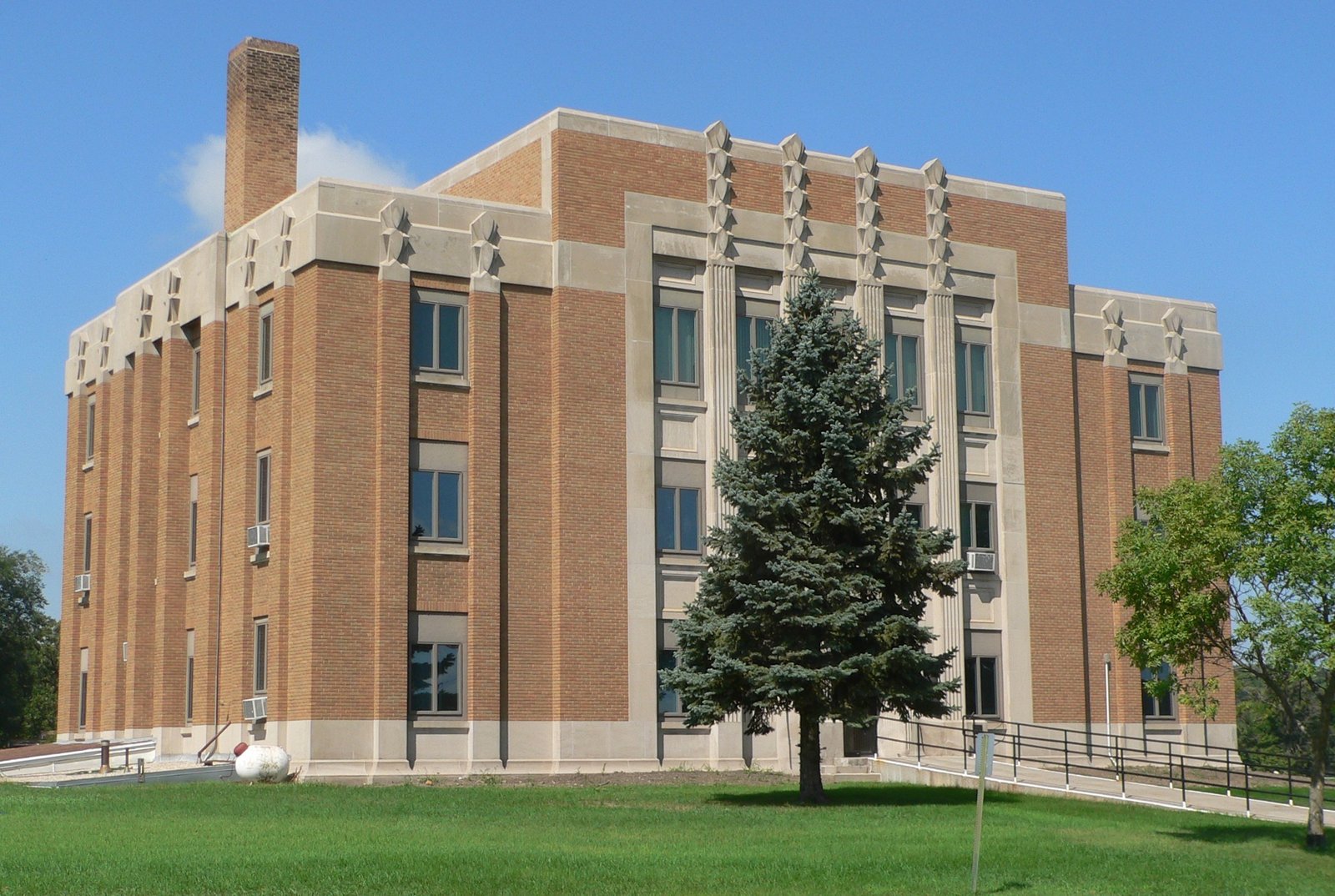
Perkins & McWayne’s 1930 Art Deco courthouse in Wessington Springs is the civic anchor of Jerauld County in the James River valley of central South Dakota—a three-story brick-clad concrete building whose Depression-era geometric vocabulary brought the modern American institutional style to a county seat of fewer than 1,000 people on the open plains.
At a glance
The Jerauld County Courthouse at the junction of South Dakota Avenue and Burrett Street in Wessington Springs, South Dakota was designed by the firm of Perkins & McWayne and built in 1930 by the Majerus Co. The building is a three-story concrete structure clad with brick on a raised basement, occupying less than one acre at the center of the county seat. Listed on the National Register of Historic Places on February 10, 1993, it represents the Art Deco style as practiced in small-town South Dakota during the early years of the Depression: a building whose geometric ornament and brick-and-concrete construction communicate permanence and civic authority without the elaborateness of the great urban courthouses of the same period. The courthouse serves as the seat of Jerauld County government and continues to function as the county’s primary civic institution nearly a century after its construction.
Key facts
- Built: 1930
- Architects: Perkins & McWayne
- Contractor: Majerus Co.
- Style: Art Deco
- Address: Junction of South Dakota Ave. and Burrett St., Wessington Springs, SD 57382
- NRHP: ref. 92001860, listed 10 February 1993
- Structure: Three-story concrete clad with brick; raised basement; less than one acre
- Current use: Active Jerauld County courthouse
History
Wessington Springs, the county seat of Jerauld County, is one of the small agricultural market towns that the railroads planted across the James River valley of central South Dakota in the late nineteenth century. The county was organized in 1883, taking its name from Elisha W. Jerauld, a territorial legislator, and Wessington Springs developed as its commercial and governmental center in the years that followed the initial homestead settlement of the area. By 1930, when the courthouse was built, Wessington Springs had a population of several hundred, making it a substantial county seat by South Dakota standards but a tiny community by any national measure.
The decision to build a new courthouse in 1930—at the very beginning of the Depression, before the full extent of the economic collapse had become apparent—reflected the confidence that South Dakota’s agricultural communities still had in the early years of the decade. The Perkins & McWayne firm applied the Art Deco vocabulary that was sweeping American civic architecture in the late 1920s and early 1930s to a building whose scale was calibrated for a central South Dakota county seat: three stories of brick-and-concrete construction rising from a raised basement, with the geometric ornamental program of Art Deco providing the institutional character that a county courthouse required. The Majerus Co.’s construction was completed in 1930, and the building has served without interruption as Jerauld County’s seat of government since its opening.
The NRHP listing in 1993 placed the courthouse among South Dakota’s recognized architectural landmarks, as part of a broader recognition that the state’s Depression-era county courthouses were a significant and threatened category of American civic architecture.
What you see
The Jerauld County Courthouse presents its Art Deco character through the geometric organization of the brick facade, the proportions of the window openings, and the ornamental detail at the cornice and entry that identify the building’s stylistic affiliation without the elaborateness that larger budgets and bigger cities made possible. The three-story mass rising from the raised basement reads as an institutional presence at the scale of Wessington Springs’s modest downtown, and the brick cladding gives the facade the material warmth and durability that concrete alone would not provide.
The building’s setting on Courthouse Square in Wessington Springs is the characteristic South Dakota county-seat landscape: a civic building placed at the center of the town’s commercial grid, surrounded by the small commercial blocks and residential streets of a plains agricultural community whose scale has changed little since the early twentieth century. The courthouse’s Art Deco character is unusual in this context, where the Federal and Neoclassical civic buildings of the nineteenth and early twentieth centuries still set the dominant architectural tone.
Practical information
- Status: Active county courthouse; open during normal government office hours
- Exterior: Freely viewable from South Dakota Avenue and Burrett Street
- Photography: Exterior from public areas freely permitted
- Time needed: 10–15 minutes for exterior; the courthouse square is the center of Wessington Springs’ small historic downtown
Getting there
Wessington Springs is in Jerauld County in the James River valley of central South Dakota, accessible via US Route 281 and SD Route 34. The nearest airports are Huron Regional Airport (35 miles north) and Pierre Regional Airport (85 miles west). Wessington Springs is approximately 150 miles northwest of Sioux Falls and 80 miles southeast of Pierre, the state capital. The courthouse is at the junction of South Dakota Avenue and Burrett Street in the center of the small downtown.
Nearby
- Dakota Wesleyan University (1885) — liberal arts university in Mitchell, SD, 60 miles southeast; the Mitchell campus has historic buildings from multiple eras
- Corn Palace, Mitchell — the famous Moorish Revival exhibition hall decorated annually with murals made from corn and grains, 60 miles southeast
- Lake Byron — one of the larger lakes in the James River lake chain, 15 miles north of Wessington Springs
- Hughes County Courthouse (1935), Pierre — Art Deco state-capital courthouse 85 miles west — compare two generations of South Dakota Art Deco civic architecture
Sources
- Wikipedia, “Jerauld County Courthouse” — primary narrative source
- National Register of Historic Places, ref. 92001860 (10 February 1993)
- Wikimedia Commons, Jerauld_County_courthouse,_SD,_from_ESE_1.jpg (CC0)
Find it on the map
See this place and what’s around it →Record researched and written by Luigi De Marchi for Cultural Heritage Online, 2026.
📷 Become a Cultural Heritage Online photographer
Share your photos of places: they stay published under your name as the author. The more they're seen, the more you get noticed — and soon a contest will reward the most appreciated photos.
Log in or sign up free to add a photoIs this page about you?
This page is read by travellers and heritage enthusiasts who find it on Google. Tell us how you are connected to this place and we will take it from there.