
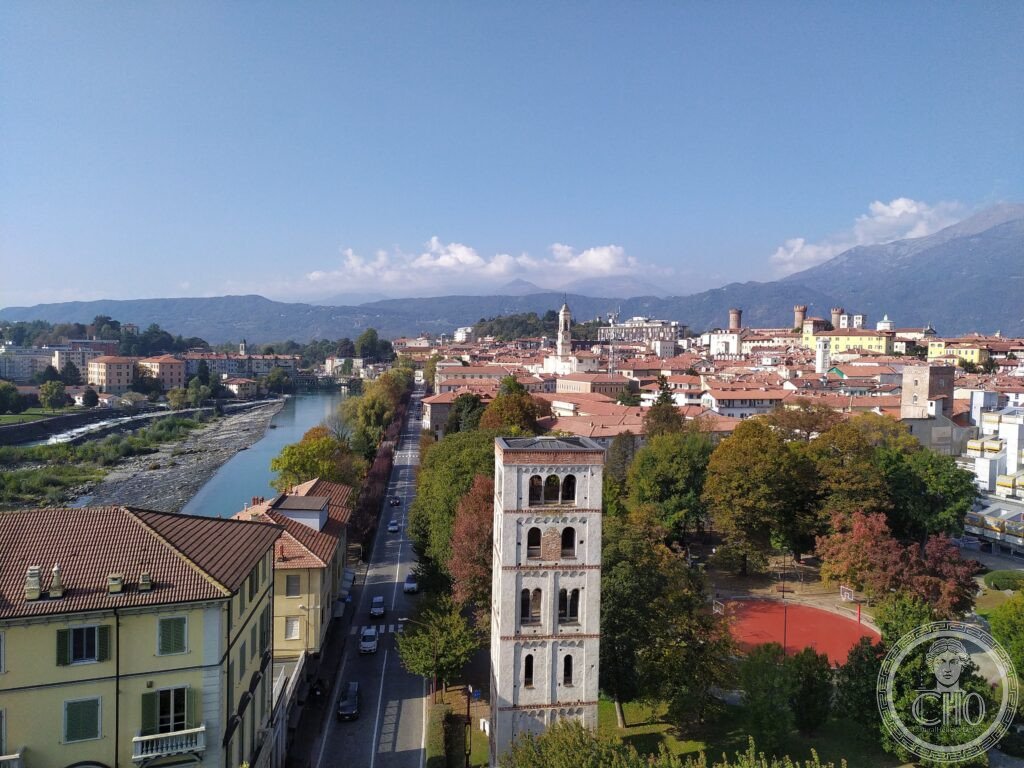
Ivrea, Città Industriale del XX Secolo
Ivrea (UNESCO 2018) is the only 20th-century industrial city inscribed as a World Heritage Site for its urban planning — a living archive of Adriano Olivetti’s vision of a humane industrial community built around the Olivetti typewriter and later computer factory, whose canteen, library, nursery, residential districts, and factory buildings by architects Luigi Figini, Gino Pollini, Ignazio Gardella, and Marco Zanuso make it the most complete surviving example of 20th-century paternalist industrial city-building in Europe.
At a glance
Ivrea (the most precisely Ivrea single Turin Piemonte Italy 45.4671 N 7.8739 E UNESCO WHS 2018 reference 1538: the Olivetti context: Camillo Olivetti (1868–1943 CE; the founder of Olivetti; an engineer who trained in the United States and studied at Stanford; he returned to Italy in 1908 and founded C. Olivetti & C. (the typewriter manufacturing company) in Ivrea; his 1908 typewriter M1 was the first Italian-manufactured typewriter; the company grew steadily through the 1920s–1930s producing typewriters and calculating machines); Adriano Olivetti (1901–1960 CE; the son of Camillo; the most important Italian industrialist-intellectual of the 20th century; he took control of the company in 1932 and transformed it from a manufacturing company into a cultural institution (the Olivetti company under Adriano published books, sponsored architecture, promoted design, funded social research, and built Ivrea into a model of the humane industrial community he wrote about in his philosophical works (the most important: “Società, stato, comunità” (1952 CE) and “Il cammino della speranza” (1958 CE))); the 23 buildings inscribed: the UNESCO inscription (2018; reference 1538) covers 23 individual buildings and complexes (the factory buildings: the main factory complex (Fabbrica 1, 1940 CE; Figini and Pollini); the Centro Servizi Sociali (Figini and Pollini, 1955–1959 CE; the social services building — the company canteen, nursery, library, health clinic, and cinema, all under one roof — the centerpiece of Adriano’s humane industrial vision); the residential districts: the Quartiere Castellamonte (Figini and Pollini 1940–1943 CE; 100 apartments for Olivetti workers, organized around shared green courtyards — the first application of CIAM (Congrès Internationaux d’Architecture Moderne) housing principles in an Italian industrial context)); the architects (6 different architects worked for Olivetti in Ivrea over 50 years; the most important: Luigi Figini (1903–1984 CE) and Gino Pollini (1903–1991 CE) (the duo responsible for the primary factory buildings and social services center); Ignazio Gardella (1905–1999 CE) (the canteen / restaurant building (Mensa Olivetti, 1953–1959 CE) — the most refined individual building in the complex; the structure: a single-story building with thin pre-cast concrete roof panels supported on slender steel columns (the most structurally elegant small building in postwar Italian architecture)); Marco Zanuso (1916–2001 CE) (the residential buildings of the 1950s–1960s; Zanuso was also the designer of several iconic Olivetti machines (the Olivetti Lexikon 80 portable typewriter, 1950 CE; the Elea 9003 mainframe computer (the first Italian fully transistorized computer; 1959 CE)))).
Key facts
- Adriano Olivetti and why the Ivrea industrial city was the most comprehensive attempt at utopian industrial city-planning in 20th-century Italy: Adriano Olivetti’s specific vision (his conceptual framework combined elements from three distinct traditions: (1) the Quaker factory town tradition (the English company towns — New Lanark (Owen), Bournville (Cadbury), Port Sunlight (Lever) — which Adriano had visited in the 1920s and which provided the housing + social services model); (2) the CIAM (Congrès Internationaux d’Architecture Moderne) rationalist planning tradition (Le Corbusier’s Athens Charter (1933); the separation of functions: living, working, recreation, circulation); (3) the Communitarian movement of the American sociologist Lewis Mumford (whose book “The Culture of Cities” (1938) Adriano had read and annotated — the idea that the industrial city should be organized not around the factory but around the community (the piazza, the library, the market, the garden))); the specific realization: Adriano built in Ivrea: 900 apartments for workers (rent subsidized to 10% of salary; this was before the Italian Republic’s social housing laws; no legal requirement existed); a factory canteen (free lunch for all workers); a library (the Libreria Olivetti: still open in Via Jervis, Ivrea; the most elegant bookshop in Piemonte; designed by Elio Ardissone (1959 CE) with Olivetti-standard precision furniture by Zanuso); a nursery for workers’ children (free); a sports complex and pool (subsidized access); a medical clinic (company doctor, dental, ophthalmology); a summer camp in the mountains (for workers’ children); Adriano’s own personal estate overlooking the town (Villa Olivetti; not in the UNESCO inscription; not open to the public); the thing that makes Ivrea different from Crespi d’Adda (UNESCO 1995, 40 km south): the scale and ambition is greater, but more importantly the ideology is different (Crespi was paternalist-hierarchical: the Crespi family at the top, the workers’ cottages at the bottom, the mausoleum visible from everywhere; Adriano’s Ivrea was explicitly egalitarian — the workers ate in the same canteen as the managers, the nursery was for all children regardless of the parent’s position in the company, and the housing design specifically avoided the visible hierarchy of different-sized apartments for different-grade employees)
- GPS: 45.4671° N, 7.8739° E
History
From the 1908 M1 typewriter to the Elea 9003 computer to 2018 UNESCO (the most precisely Ivrea single 1908 founding: the specific machine timeline (the Olivetti machine evolution in Ivrea, with the architects who designed the production buildings): 1908 M1 typewriter (Camillo Olivetti; the first Italian typewriter; 600 produced in the first year; the company had 40 employees); 1920s–1930s: Camillo and Adriano building a typewriter export company (the key export markets: the UK, France, Brazil (the single largest export market for Italian typewriters until the 1950s; the Brazilian office building in São Paulo (Rino Levi architect, 1947 CE) is one of the most important pieces of Brazilian modernist architecture)); 1940 Fabbrica 1 opens (Figini and Pollini; the first International Style industrial building in Italy; the steel-and-glass curtain wall was the specific innovation — Italian factories of the period were traditionally in masonry; the glass curtain wall introduced natural light to all factory floors without the energy consumption of electric lighting); 1959 Elea 9003 (the first Italian fully transistorized computer; designed by the Olivetti research team (the computer was designed by Marcello Colouring; the aesthetic design (the beige metal housing, the green data-output screens, the modular cabinet system) was by Ettore Sottsass (1917–2007 CE) — Sottsass’s first major commercial design and the work that established him as the leading Italian industrial designer of the second half of the 20th century)); 1960 CE death of Adriano Olivetti (Adriano died of a stroke on the Lausanne–Milan express train on 27 February 1960 CE; he was 59; his death ended the Olivetti cultural project (the subsequent management was primarily interested in manufacturing efficiency and international expansion; the social services programme was maintained but not expanded; the architectural commissions dried up)); 1964–1978 the Programma 101 personal computer (the first personal computer sold to the public (1965 CE; before the Apple I (1976); before the Altair (1975)); designed in Ivrea by Pier Giorgio Perotto (1930–2002 CE)); 2018 UNESCO inscription reference 1538.
What you see
The factory buildings, the Centro Servizi Sociali, the Mensa Olivetti, and the Libreria Olivetti (the most precisely Ivrea single visit (half day; the 23 inscribed buildings are distributed across the city; a guided tour is recommended to access the interiors)): 1) the factory complex (the main factory buildings on Via Jervis; visible from the outside (the Fabbrica 1 curtain wall and the red Fabbrica ICO building); the interior is partially accessible during guided tours (the Ecomuseo organizes tours: ecomuseoolivetti.it; book in advance; €12; the tour includes the Fabbrica ICO interior (the red brick factory of 1934–1942 CE; a horizontal factory building 400m long × 40m wide — the longest building in Ivrea at the time of construction))); 2) the Centro Servizi Sociali (Via Jervis; the Figini and Pollini social services complex; currently used by the municipality (the library is accessible; the canteen area is no longer a canteen)); 3) the Mensa Olivetti (the Gardella canteen; Via Jervis; partially visible from the street; the most refined building in the complex — the thin precast roof panels supported on 8 steel columns give the interior an unexpected lightness for a canteen designed to serve 2,000 people at a time)); 4) the Libreria Olivetti (Via Jervis 7; the bookshop; open Monday–Saturday; the 1959 CE interior by Ardissone with Zanuso furniture is largely intact; the best single surviving interior in the UNESCO complex); 5) the Quartiere Castellamonte (the workers’ housing district; 10-minute walk from the factory; the green courtyards between the housing blocks are publicly accessible; the specific detail to look for: the cantilevered balconies on the third and fourth floors (the specific structural innovation in the Figini-Pollini housing — the balconies project 2.5m with no visible support column below)).
Practical information
- Getting to Ivrea from Turin, accessing the 23 inscribed buildings, and combining with the Canavese pre-Alps landscape: transport from Turin: Trenitalia regional train from Torino Porta Susa to Ivrea (1h; €5; trains every 40 min; the train follows the Dora Baltea river valley from Turin into the Canavese); by car: SS26 from Turin direction Aosta (50 km; 50 min; the SS26 passes through the specific landscape (the Canavese morainic hills — the lake-dotted hills south of Ivrea are glacial moraines deposited by the last ice age; the specific landscape setting that Adriano Olivetti cited as one of the reasons to keep the factory in Ivrea rather than relocate to a flatter site with better logistics)); the Ecomuseo Olivetti (the organization managing access to the UNESCO complex; the self-guided visit requires the Ecomuseo guide (available free at the Ecomuseo office, Piazza Gioberti 1; the guide is a map with the 23 inscribed buildings numbered + opening hours for the accessible ones); the full guided tour (ecomuseoolivetti.it; book in advance; 2.5 hours; €12; includes interiors not otherwise accessible; the best single way to understand the complex); the Aosta Valley combination: from Ivrea, the Aosta Valley is 30 km north via the SS26; the first major site is the Roman Aosta (Augusta Praetoria; 24 BCE — the triumphal arch, the amphitheatre, the theatre, the Roman walls — all in the city center; 2 hours); further into the valley: Bard (the 19th-century fortress with Fiorenzo Galli art collection) and Fénis Castle (14th-century castle with the most elaborate interior fresco programme in the Aosta Valley)
Getting there
Trenitalia from Torino Porta Susa (1h, €5, every 40 min). Car: SS26 Turin→Ivrea 50 km. Ecomuseo Olivetti self-guided map (free, Piazza Gioberti 1) or guided tour €12 (ecomuseoolivetti.it). GPS: 45.4671, 7.8739.
Nearby
- Crespi d’Adda — 40 km south (UNESCO WHS 1995; 19th-century Crespi cotton company town; contrast with Ivrea: Crespi = paternalist hierarchy (mausoleum visible from everywhere); Ivrea = Adriano Olivetti’s egalitarian alternative)
- Aosta — 60 km north (UNESCO WHS 1000 BCE–1800 CE; Roman Augusta Praetoria (24 BCE): triumphal arch + theatre + amphitheatre + walls; the Valle d’Aosta prehistoric megalithic alignment at Saint-Martin-de-Corléans (3,200 BCE; the largest megalithic site in the Alps))
Gallery


Sources
- Wikipedia, Ivrea; Adriano Olivetti; Figini and Pollini; Mensa Olivetti; Elea 9003, accessed June 2026
- UNESCO, Ivrea, industrial city of the 20th century, WHS reference 1538, inscribed 2018
- Ochetto, Valerio. Adriano Olivetti: la biografia. Milano: Mondadori, 2013
Find it on the map
See this place and what’s around it →📷 Diventa un fotografo di Cultural Heritage Online
Condividi le tue foto dei luoghi: restano pubblicate con la tua firma come autore. Più vengono viste, più ti fai conoscere — e presto un concorso premierà le foto più apprezzate.
Accedi o registrati gratis per aggiungere una foto