
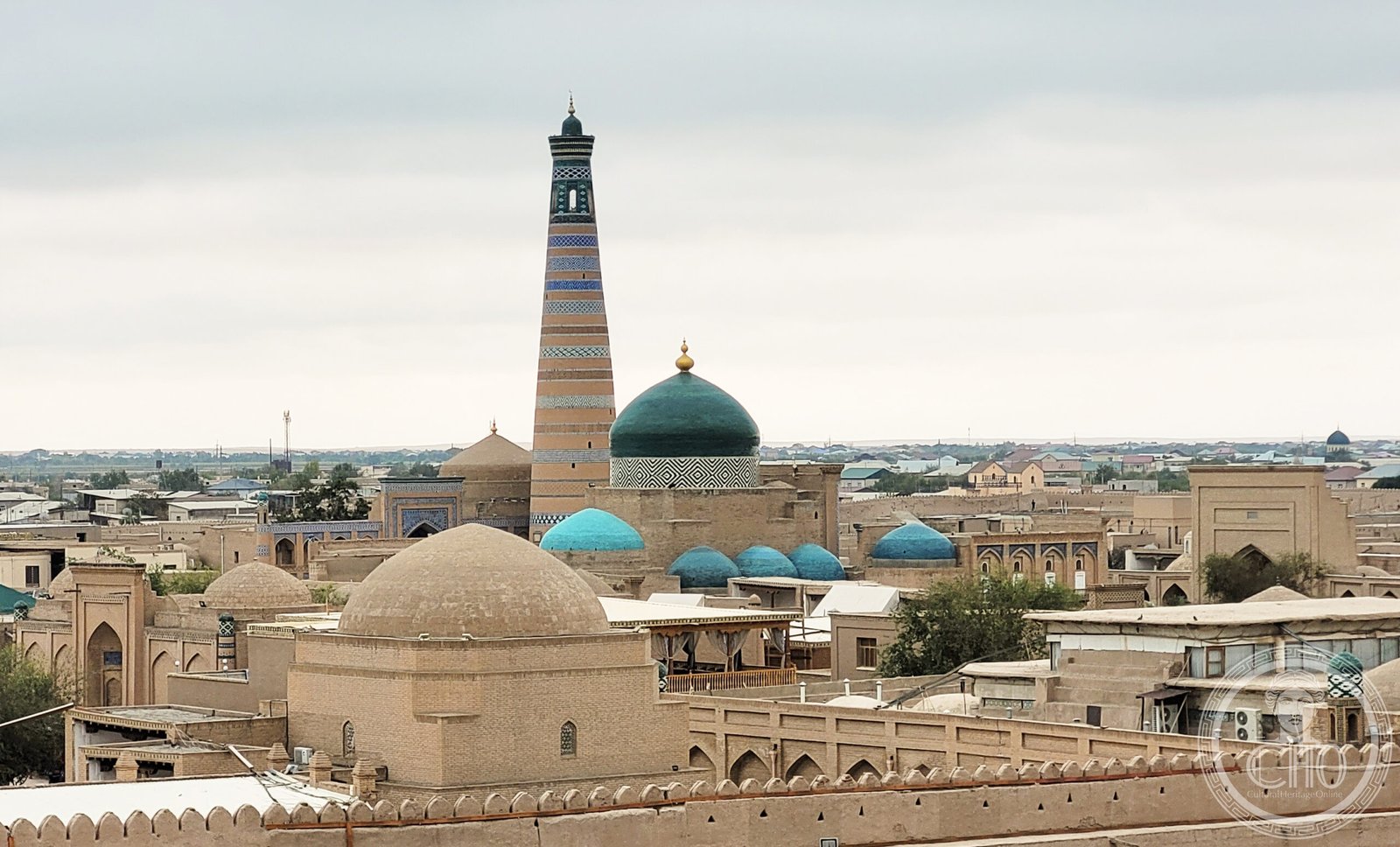
The walled inner city of Khiva is one of the best-preserved medieval Islamic cities in Central Asia — a 26-hectare urban enclosure of mud-brick palaces, madrasas, minarets and caravanserais, crowned by the unfinished Kalta-Minor minaret whose turquoise tilework has never been completed, and home to the Djuma Mosque with its extraordinary hypostyle hall of 218 carved wooden columns spanning eight centuries.
At a glance
Itchan Kala — meaning “inner fortress” — is the historic heart of Khiva, a Silk Road city in the arid Khorezm region of western Uzbekistan, south of the Aral Sea. Enclosed by 10-metre-high mud-brick walls 2,200 metres in circumference with four monumental gates, the walled precinct contains approximately 60 historically significant monuments — mosques, madrasas (Islamic colleges), minarets, mausoleums, the khans’ palaces, and caravanserais — most built between the 17th and 19th centuries under the Khanate of Khiva. UNESCO designated Itchan Kala a World Heritage Site in 1990, recognising it as an exceptional ensemble of Islamic urban architecture. Unlike many heritage sites, it remains a living city: people still live and work inside the walls.
History
Khiva’s origins are ancient — the oasis is associated with the legendary well dug by Shem, Noah’s son — but the architecture visitors see today dates overwhelmingly from the 17th to 19th centuries under the Khanate of Khiva, one of the three successor states of the Bukharan khanate. The city served as the capital of the Khanate from 1598 onward, when the Khan relocated the seat of power here from Urgench.
For centuries Khiva was a major hub of the Central Asian slave trade. Caravans brought captives — Persians, Russians and others seized in raids across the steppe — to its slave market, which operated openly until the Russian conquest of 1873. The city held up to 30,000 slaves at any given time in the early 19th century. This grim history sits alongside its architectural splendour.
The Russians under General Kaufmann occupied Khiva in 1873 with minimal resistance. The khan remained as a nominal ruler under Russian protectorate, and the physical fabric of the city survived largely intact. Soviet rule followed after 1920, and Khiva became part of the Uzbek SSR; crucially, Soviet authorities undertook extensive restoration of the monuments during the 1970s–80s, sometimes controversially, before Uzbekistan’s independence in 1991.
What you see
The Djuma Mosque (Friday Mosque) is among the oldest foundations in Khiva, with origins in the 10th century. It was entirely rebuilt in 1788–89, but its builders preserved the hypostyle hall with 218 carved wooden columns salvaged from earlier structures spanning 800 years — a deliberate act of architectural continuity. The columns bear different styles and ornamental programmes reflecting the centuries they were made; no two are identical.
The Kalta-Minor minaret (1851–55) is the most immediately striking monument: a massive tapering cylinder sheathed in turquoise and blue majolica tilework that was never completed. Muhammad Amin Khan began it with the ambition of building the tallest minaret in Central Asia — reportedly wanting it to be visible from Bukhara — but died in battle in 1855 before it reached full height. It stands today at approximately 29 metres, squat and broad at its base, a monument to ambition truncated.
The Tash-Khauli Palace (“Stone House”), built 1832–41, is the last and most elaborate of Khiva’s khans’ palaces. It contains a harem of three interconnected courtyards with 163 rooms, designed to house the khan’s wives and concubines. The tilework and carved plasterwork of the harem is the finest decorative programme in Khiva. The palace complex also includes official reception halls and a throne room.
The Muhammad Amin Khan Madrasa (1851–55) — built simultaneously with the Kalta-Minor — is the largest madrasa in Central Asia, with 125 cells for students. It now operates as a hotel. The Islam Khodja Madrasa and Minaret (1910) form the youngest ensemble inside the walls; the minaret at 44.8 metres is the tallest in Khiva, its distinctive banded brickwork making it a city landmark. The Pahlavon Mahmoud Mausoleum contains the tomb of Khiva’s patron saint, a 14th-century poet and wrestler; subsequent khans are buried in a dynastic necropolis around him.
Cultural significance
Itchan Kala represents the most coherent surviving example of pre-modern Central Asian Islamic urbanism. Where Bukhara and Samarkand have been more extensively rebuilt and modernised, Khiva’s walled inner city preserves its historic street pattern, building density, and architectural vocabulary largely intact — a consequence partly of its relative isolation after the Russian conquest. The reuse of ancient columns in the Djuma Mosque exemplifies how Central Asian builders engaged with the past as a material, not just a reference.
The site also illustrates the specific idiom of Khorezm Islamic architecture, which differs subtly from the more famous Timurid tradition of Samarkand: denser, more intimate in scale, with a preference for carved wooden decoration alongside the ubiquitous tilework. The unfinished Kalta-Minor stands as an accidental monument to the fragility of imperial ambition.
Key facts
- UNESCO WHS: Inscribed 1990 (one of the first three Soviet-era sites)
- Walls: 10 m high, 2,200 m circumference, 4 gates; mud-brick, continuously maintained
- Approximate monuments: 60 historically significant structures; 250 old residential houses
- Djuma Mosque: 218 carved wooden columns from different periods, oldest from the 10th century
- Kalta-Minor: Begun 1851, never completed; 29 m tall; would have exceeded 70 m if finished
- Tash-Khauli Palace: Built 1832–41; 163 rooms; harem with 3 courtyards
- Slave trade: Major slave market operated here until the Russian conquest, 1873
- Coordinates: 41.3786° N, 60.3628° E
Practical information
- Access: The walled city is easily walkable; the main entrance is through the West Gate (Ota Darvoza)
- Tickets: A single combined ticket covers the major monuments; individual tickets also available
- Best season: April–June and September–October; summers are extremely hot (>40 °C)
- Stay: Several hotels operate inside the walls including the converted Muhammad Amin Khan Madrasa
Getting there
Khiva has its own airport (Urgench Airport, 35 km east, with connections to Tashkent). Trains and buses connect Urgench to other Uzbek cities. From Urgench, shared taxis and minibuses cover the 35 km to Khiva in under an hour. The walled city is the centre of modern Khiva, easy to reach on foot from any central accommodation.
Nearby
- Dishon Kala — the outer city surrounding Itchan Kala, with its own palace (Nurullabay Palace, 1906–12) and markets
- Elliq Qala fortresses — ancient mud-brick fortress complexes scattered across the Khorezm steppe, some dating to the 4th–6th centuries CE, accessible by jeep tour
- Kunya-Urgench (Turkmenistan) — the ruins of medieval Urgench, 170 km north, with the tallest surviving minaret in Central Asia
Sources
Find it on the map
See this place and what’s around it →📷 Become a Cultural Heritage Online photographer
Share your photos of places: they stay published under your name as the author. The more they're seen, the more you get noticed — and soon a contest will reward the most appreciated photos.
Log in or sign up free to add a photo