

A small historic town on an island in the Volga River, pre-fabricated by Ivan the Terrible and assembled in 28 days as a military staging post for the conquest of Kazan in 1552 CE — and home to the only surviving contemporary portrait of the Tsar himself.
At a glance
Sviyazhsk occupies a small island (approximately 1 km long by 1 km wide) formed at the confluence of the Sviyaga and Volga rivers in the Republic of Tatarstan, Russia, some 30 kilometres west of Kazan. The town was founded in 1551 by Tsar Ivan IV “the Terrible” as a forward military base against the Khanate of Kazan. After Kazan fell in 1552, Sviyazhsk became a centre for the Christianization of the conquered Tatar territories. Inscribed as a UNESCO World Heritage Site in 2017 together with the Bolgar Archaeological Complex, the town is remarkable for the exceptional preservation of its 16th–18th century Russian Orthodox religious architecture and for frescoes containing the only authenticated contemporary likeness of Ivan the Terrible.
Key facts
- UNESCO inscription: 2017 (jointly with Bolgar Archaeological Complex)
- Founded: 1551 CE by Ivan IV “the Terrible”
- Location: Island, confluence of Sviyaga and Volga rivers, Republic of Tatarstan, Russia
- Distance from Kazan: approx. 30 km west
- Key monuments: Assumption Cathedral (1560 CE), Dormition Monastery, John the Baptist Convent
- Outstanding feature: Only surviving authenticated contemporary portrait of Ivan the Terrible
History
By the 1540s, the Tatar Khanate of Kazan had proved impregnable to Russian siege despite repeated campaigns. Its riverside fortress commanded the Volga River and could be resupplied from a vast hinterland. Ivan IV’s solution was logistically audacious: he ordered an entire prefabricated fortified town constructed in the forests near Uglich, roughly 1,000 kilometres upriver from Kazan. Walls, towers, churches, and living quarters were cut, shaped, and numbered for reassembly, then loaded onto rafts and floated down the Volga to the island of Sviazh at the mouth of the Sviyaga River. The entire structure was reassembled in 28 days in May 1551 — a feat of pre-industrial logistics with no precedent in Russian military history — creating an armed base close enough to Kazan to provide shelter and staging for Russian forces between campaigns.
Kazan fell to Ivan’s forces after a prolonged siege in October 1552, and Sviyazhsk rapidly transformed from a military camp into an ecclesiastical and administrative headquarters for the conversion of the newly incorporated Tatar territories to Russian Orthodoxy. The Assumption Monastery and John the Baptist Convent were established in the 1550s–1560s under the first Archbishop of Kazan and Sviyazhsk. The town continued to function as a religious and commercial centre through the 17th and 18th centuries but declined in the 19th century as railways bypassed the island. Following the construction of the Kuibyshev Reservoir in 1957, the surrounding lowlands were flooded and Sviyazhsk became a true island, its isolation inadvertently protecting the architectural ensemble from Soviet-era urban development.
What you see
The Assumption Cathedral (Uspensky Sobor), built 1556–1560 CE by order of Ivan IV to commemorate the conquest of Kazan, is the centrepiece of the monastic ensemble and the most important monument on the island. Its interior preserves a near-complete cycle of 16th-century frescoes covering the walls of both the main church and the monastic refectory. The refectory frescoes include a painted portrait of the living Tsar Ivan IV — an extraordinary breach of Orthodox iconographic convention, which traditionally confined representational art to saints and holy figures and excluded the likenesses of living secular rulers. These are the only surviving authenticated contemporary images of Ivan the Terrible, produced within his own lifetime with his own sanction.
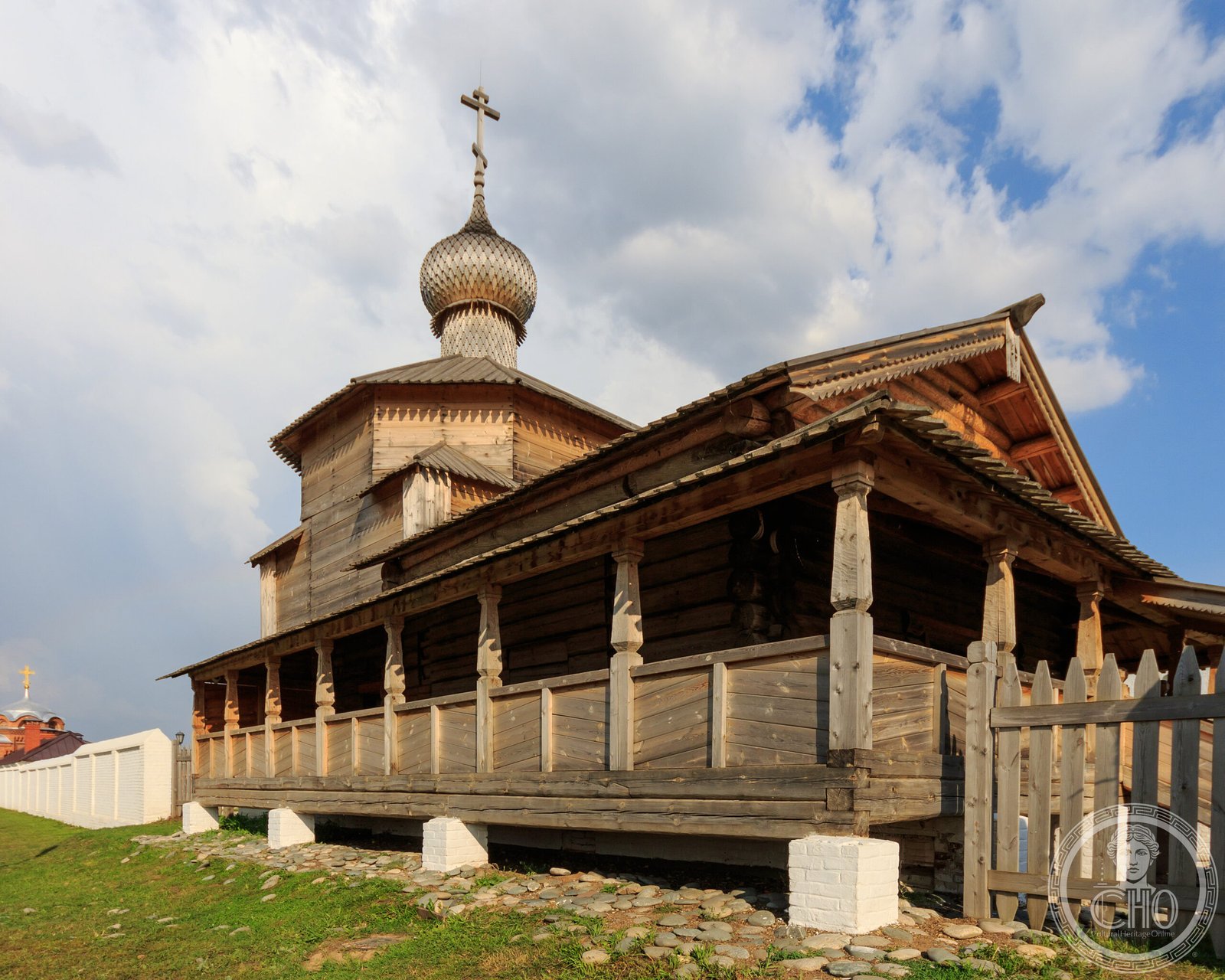
The John the Baptist Convent (Ioann-Predtechensky Convent), established c. 1553, contains the Trinity Church — one of the oldest surviving wooden churches in the Volga region, built in the 1550s — alongside later stone buildings. The Dormition Monastery complex, remnants of 16th-century civil infrastructure, timber-frame vernacular architecture, and a historic town plan largely unchanged since the 18th century complete the ensemble, offering an unusually complete picture of early provincial Russian religious urbanism at the moment of the empire’s eastward expansion.
Practical information
- Opening: Island open year-round; monastery and cathedral hours vary (typically 09:00–18:00 in summer).
- Admission: Island access free; fees for individual churches and the Sviyazhsk State Historical-Architectural and Art Museum-Reserve.
- Best time to visit: May–September; regular hydrofoil connections from Kazan in summer.
- Photography: Permitted in most areas; restrictions inside functioning churches during services.
Getting there
From Kazan: by seasonal high-speed hydrofoil from Kazan river station (approx. 1 hour), or by road via the Sviyazhsk causeway (completed 2013), approximately 50 km by road from central Kazan along the M7 highway west. Nearest major airport: Kazan International (KZN), approximately 40 km from the island.
Nearby
- Kazan Kremlin — UNESCO-listed fortress of the Tatar Khanate conquered by Ivan IV in 1552; approx. 30 km east.
- Bolgar Archaeological Complex — UNESCO WHS; ruins of the Volga Bulgaria capital and the site of the 922 CE conversion to Islam; approx. 180 km south on the Volga.
Sources
- UNESCO World Heritage List — Assumption Cathedral and Monastery of the town-island of Sviyazhsk (WHC ref. 1525)
- Encyclopaedia Britannica — “Sviyazhsk”
- Wikipedia — “Sviyazhsk” (en.wikipedia.org/wiki/Sviyazhsk)
Find it on the map
See this place and what’s around it →📷 Become a Cultural Heritage Online photographer
Share your photos of places: they stay published under your name as the author. The more they're seen, the more you get noticed — and soon a contest will reward the most appreciated photos.
Log in or sign up free to add a photo