
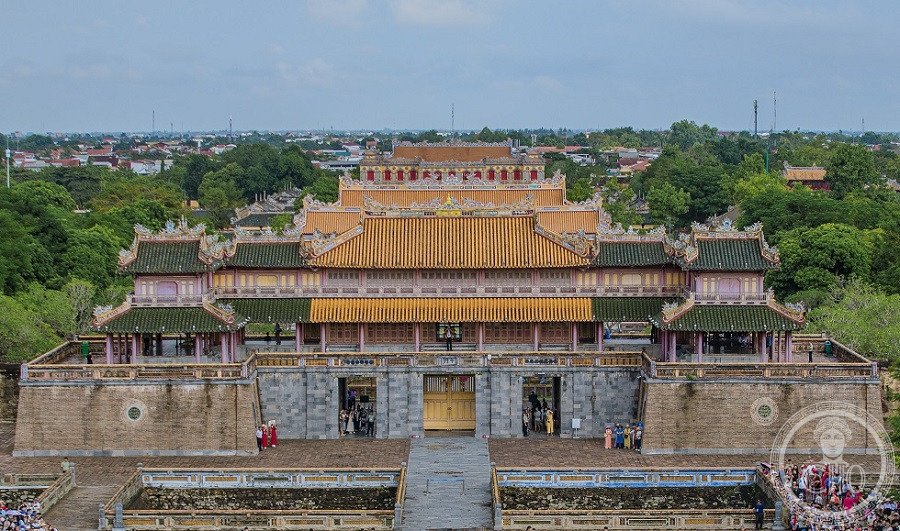
The royal enclosure of Vietnam’s last imperial capital, where emperors of the Nguyễn dynasty ruled from a walled citadel of palaces, gardens, and ceremonial spaces.
At a glance
The Imperial City—known in Vietnamese as Hoàng thành or Đại Nội—forms the sacred heart of Huế’s walled city. Within its fortifications stand the palaces of the imperial family, ancestral shrines, formal gardens, and administrative buildings where mandarins conducted statecraft. Construction began in 1804 under Emperor Gia Long and reached its present form by 1833.
History
Emperor Gia Long selected Huế as the new imperial capital and ordered the construction of the citadel in 1804, establishing it as the seat of Nguyễn power. The complex was remodeled and enlarged substantially in 1833, becoming a full expression of imperial ambition and Confucian order. During the French colonial period that followed, it functioned primarily as a ceremonial and residential space rather than a center of political authority.
The monarchy’s end in 1945 marked the beginning of decline. Wars ravaged the site through the succeeding decades, leaving structures damaged and the grounds neglected until restoration efforts began in earnest after the 1980s.
What you see
The Imperial City’s design reflects classical Vietnamese and Chinese principles of urban planning and symmetry. Within the walled perimeter stand interconnected palace compounds, ceremonial courtyards, and residential quarters arranged hierarchically around a central axis. Shrines honor the imperial ancestors, while ornamental gardens and water features provide spaces for reflection and leisure.
Cultural significance
As the physical embodiment of Nguyễn imperial authority, the Imperial City represents the final chapter of Vietnamese dynastic rule. It embodies the synthesis of Vietnamese, Chinese, and French architectural and cultural influences that defined the late imperial period. Today, it stands as a testament to courtly life, bureaucratic organization, and the artistry of a lost age.
Key facts
- Country: Vietnam
- City: Huế
- Coordinates: 16.47°N, 107.58°E
- UNESCO World Heritage Site (designated 1993, part of the Complex of Huế Monuments)
- Construction began: 1804
- Major remodeling and enlargement: 1833
Practical information & getting there
The Imperial City is located in central Huế. You can reach it on foot from Huế’s city center or by local transport. Restoration work continues; check current access conditions before visiting. A guide familiar with the Nguyễn dynasty enhances understanding of the palace layouts and historical context.
Sources & resources
Find it on the map
See this place and what’s around it →📷 Become a Cultural Heritage Online photographer
Share your photos of places: they stay published under your name as the author. The more they're seen, the more you get noticed — and soon a contest will reward the most appreciated photos.
Log in or sign up free to add a photoIs this page about you?
This page is read by travellers and heritage enthusiasts who find it on Google. Tell us how you are connected to this place and we will take it from there.