
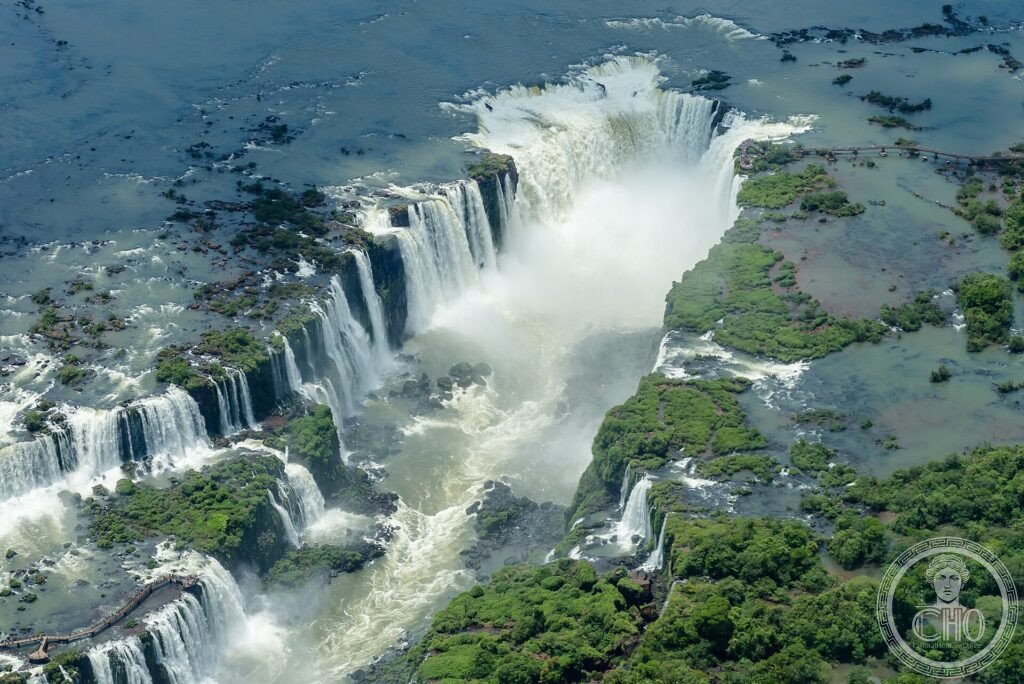
Where the river Iguaçu plunges into a chasm of hundreds of waterfalls, on the border between Brazil and Argentina, opens one of the grandest natural spectacles on the planet. Around the roar of the “Devil’s Throat” survives a remnant of Atlantic forest, kingdom of the jaguar and of thousands of species.
At a glance
Iguaçu National Park, in the Brazilian state of Paraná on the border with Argentina, protects one of the most spectacular waterfalls in the world: the Iguaçu Falls, where the river plunges over a 2.7 km horseshoe of cliffs in hundreds of cascades, the greatest of them the thunderous “Devil’s Throat”. Around the falls survives a precious remnant of the Atlantic Forest, home to the jaguar, tapir and thousands of species. Shared with Argentina’s Iguazú park, it was inscribed by UNESCO in 1986.
Key facts
- UNESCO: World Heritage since 1986 (Iguaçu National Park)
- The falls: hundreds of cascades over a 2.7 km horseshoe of cliffs
- Devil’s Throat: the largest and most powerful cataract
- Atlantic Forest: a remnant of the threatened subtropical forest
- Wildlife: jaguar, tapir, ocelot and abundant birds
- Shared site: adjoins Argentina’s Iguazú National Park
History
The falls have been known to the Guaraní people since long before Europeans arrived; a Spanish expedition recorded them in 1542. Their name comes from Guaraní words for “great water”. For centuries the surrounding forest remained wild and remote, until in the 20th century parks were created on both the Brazilian and Argentine sides to protect the falls and their setting.
The Brazilian Iguaçu National Park, one of the largest remnants of Atlantic Forest, was inscribed by UNESCO in 1986; the Argentine park had been listed in 1984. Together they safeguard the falls and a rare slice of a forest that once stretched along much of the Brazilian coast and is now largely gone.
What you see
On the Brazilian side a panoramic trail and walkways lead along the gorge, giving sweeping views of the chain of falls and a catwalk that reaches almost into the spray of the Devil’s Throat. Boats run beneath the cataracts, and coatis and butterflies throng the forest paths. The Argentine side offers closer, upper-level views.
The scale and roar of the falls, set in green forest, make Iguaçu one of the great natural sights of the Americas.
Practical information
- Park: entry ticket; shuttle buses and walkways; boat tours
- Time needed: a day (more to see both sides)
- Note: bring rain protection for the spray
- Two countries: Brazilian and Argentine sides each have their own park
Getting there
Iguaçu National Park is by the city of Foz do Iguaçu in western Paraná, Brazil, which has an airport. The falls are about 20 km from the city. GPS: 25.68° S, 54.44° W.
Nearby
- Foz do Iguaçu — the Brazilian gateway city
- Iguazú (Argentina) — the falls’ other side, also UNESCO-listed
- Itaipu Dam — the giant hydroelectric dam nearby
Sources
- UNESCO World Heritage Centre — “Iguaçu National Park” (ref. 355)
- ICMBio (Brazil) — official body
- Encyclopaedia Britannica — Iguaçu Falls
Find it on the map
See this place and what’s around it →📷 Become a Cultural Heritage Online photographer
Share your photos of places: they stay published under your name as the author. The more they're seen, the more you get noticed — and soon a contest will reward the most appreciated photos.
Log in or sign up free to add a photo