

At a glance
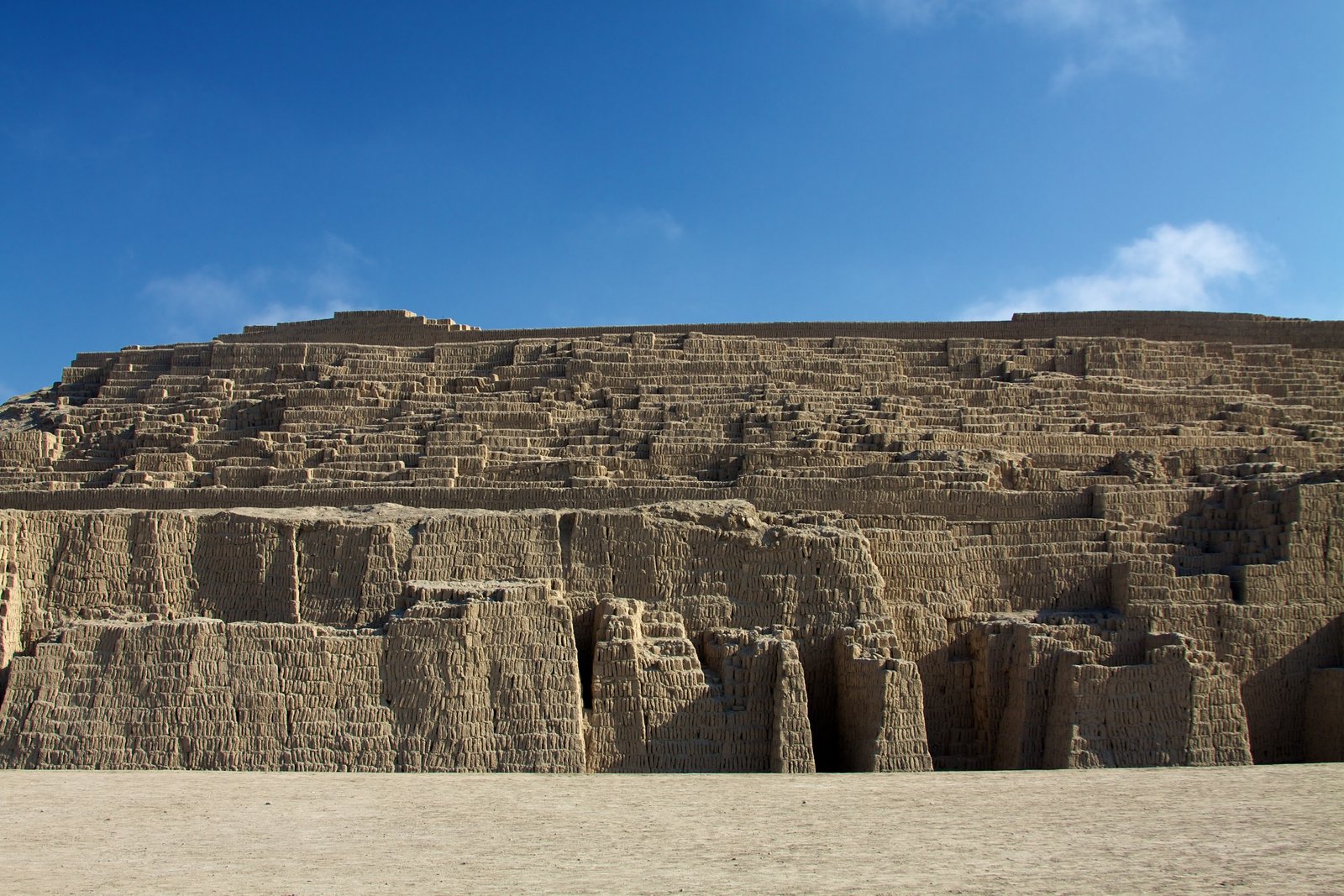
Huaca Pucllana is a 7-stepped adobe pyramid rising 22 metres above the Miraflores district of Lima, Peru — one of the most improbable urban archaeological sites in the Americas. Built by the Lima culture around 400–700 AD for ritual ceremonies, the structure sits enclosed between apartment towers, restaurants, and traffic, illuminated after dark and visible from surrounding rooftops. Active excavation has continued here since 1981, with new burials and textiles uncovered each season.
Key facts
- Location
- Miraflores district, Lima, Peru — 12°6′48″S, 77°1′59″W
- Period
- Lima culture, c. 400–700 AD; later reused by Wari, c. 800–1000 AD
- Dimensions
- 500 m × 100 m base; 22 m height; 7 stepped levels
- Construction
- Adobe bricks stacked vertically (“bookshelf” technique for earthquake resistance)
- Function
- Ceremonial center; offerings to sea deities; later Wari necropolis
- Excavation
- Active since 1981, led by archaeologist Isabel Flores Espinoza (MNAAHP)
- On-site facilities
- Museum, restaurant with pyramid views, guided tour circuit
History
The Lima culture, a pre-Inca coastal civilisation, constructed Huaca Pucllana over several generations beginning around 400 AD. Rather than laying bricks flat, the builders stacked them vertically in free-standing sections separated by narrow spaces — the so-called “bookshelf” technique, which allows the structure to flex during earthquakes without catastrophic cracking, a remarkable engineering response to Peru’s seismic environment.
Archaeological evidence from excavations points to ceremonies dedicated to sea deities: offerings recovered include fish, spondylus shells, guinea pigs, and llamas. The pyramid’s name derives from the Quechua pucllay, meaning “place of games” or “ritual activity,” though whether this reflects the Lima-era function or a later Inca-period interpretation is disputed by scholars.
When the Lima culture declined around 700 AD, the Wari Empire absorbed the coast and reused the site for a necropolis, interring Wari nobles in tombs cut into the Lima-era structures. After the Wari withdrawal, the huaca fell into disuse and was gradually covered by urban growth. Systematic excavation began in 1981 under Isabel Flores Espinoza of Peru’s National Museum of Archaeology, Anthropology, and History (MNAAHP). Each field season continues to produce mummies, ceramics, and textiles.
What you see
The surreal quality of Huaca Pucllana lies in its collision of timescales: from the upper terraces, visitors look down at ten-story apartment buildings that press within metres of the pyramid’s flanks, while Lima’s traffic circles below. The adobe brick surface — sun-dried clay in warm ochre tones — retains sharp edges after 1,500 years in Lima’s near-rainless climate. The on-site museum displays textile fragments, polychrome ceramics, and the remains of ceremonial camelid sacrifices. After dark, floodlighting transforms the pyramid into a luminous presence above the neighbourhood, visible from the tables of the adjacent restaurant.
Practical information
- Address
- Calle General Borgoño, cdra. 8 s/n, Miraflores, Lima
- Opening hours
- Tuesday–Sunday 09:00–17:00 (last entry 16:30)
- Entry fee
- Paid admission; guided tours included in entry price
- Night visits
- Available some evenings for guided tours; check current schedule
- Restaurant
- Huaca Pucllana restaurant on-site (one of Lima’s most celebrated); separate reservation required
Getting there
Huaca Pucllana lies in the heart of Miraflores, Lima’s upscale residential and tourist district. From Miraflores hotels it is walkable in under 15 minutes. Taxis and app-based ride services (InDriver, Uber) reach the site from Lima Centro in 20–40 minutes depending on traffic. The nearest Metropolitano bus corridor stop is Angamos (15-minute walk). No public parking is available at the site; drop-off on Calle General Borgoño.
Nearby
- Parque Kennedy — Miraflores central park, 1.2 km west; weekend craft market
- Larco Museum — Pueblo Libre district, 8 km north; world-class pre-Columbian collection including Lima-culture ceramics
- Pachacamac — 31 km southeast; major Wari and Inca oracle complex directly connected to Huaca Pucllana’s cultural successors
- Miraflores Malecon — coastal cliff walk 1.5 km west; paragliding over the Pacific
Sources
Find it on the map
See this place and what’s around it →📷 Become a Cultural Heritage Online photographer
Share your photos of places: they stay published under your name as the author. The more they're seen, the more you get noticed — and soon a contest will reward the most appreciated photos.
Log in or sign up free to add a photoIs this page about you?
This page is read by travellers and heritage enthusiasts who find it on Google. Tell us how you are connected to this place and we will take it from there.