
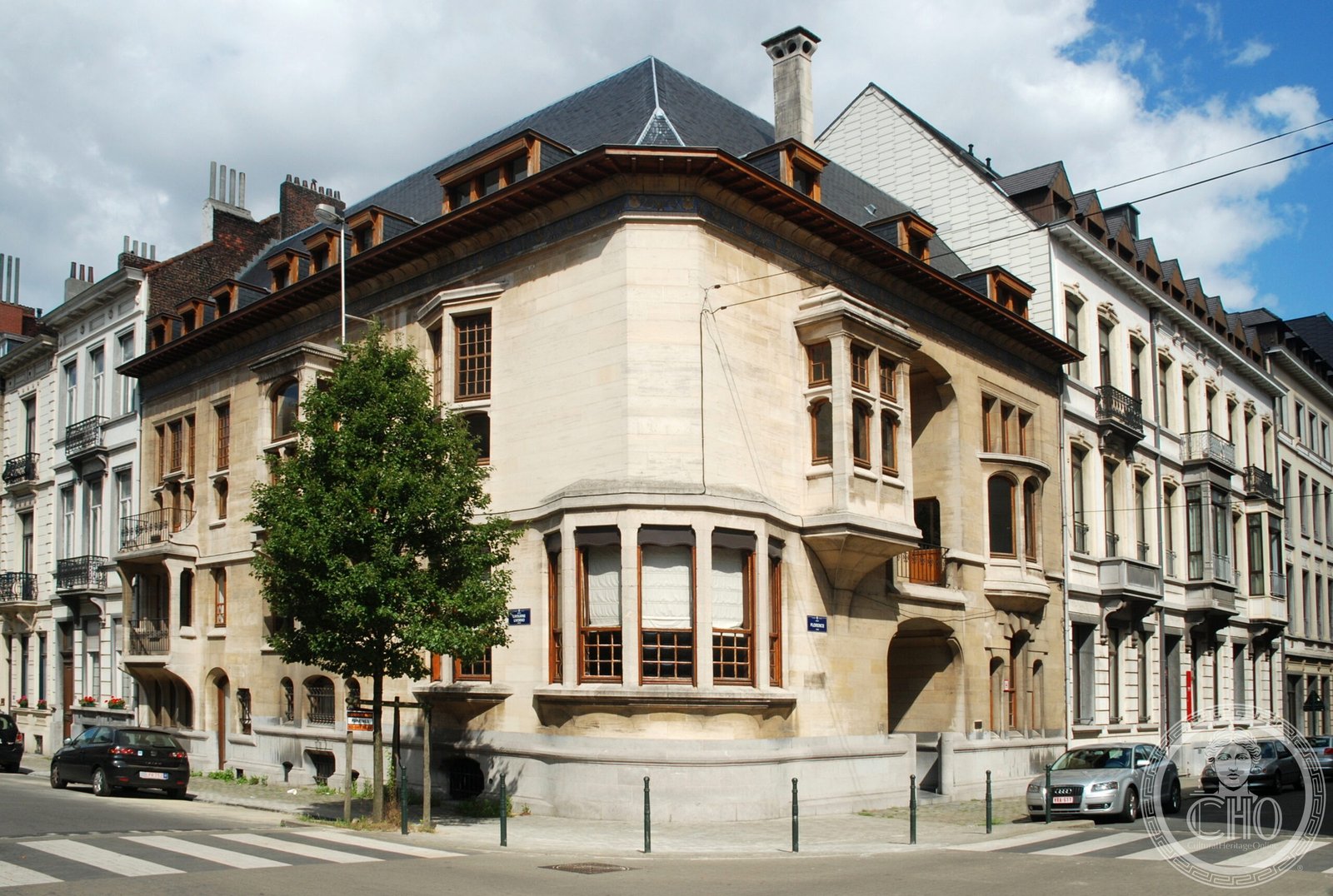
The town house of the man who tried to index all the world’s knowledge — built with the same patient order.
At a glance
The Hôtel Otlet is a corner town house in Brussels, built between 1894 and 1898 by the architect Octave van Rysselberghe for Paul Otlet, the jurist and bibliographer often called a founder of documentation science. Standing where the Rue de Florence meets the Rue de Livourne, a few steps from the Avenue Louise, it is an early and still cautious example of the architect’s move into the Art Nouveau style. Where the great Horta houses shout, the Hôtel Otlet speaks quietly: a restrained composition of stone and brick whose modern spirit lies in its proportions and its ironwork rather than in any flourish.
Key facts
- Architect: Octave van Rysselberghe
- Built: 1894–1898
- Client: Paul Otlet, jurist, bibliographer and entrepreneur
- Location: corner of the Rue de Florence and the Rue de Livourne
- Style: Art Nouveau, in a sober early form
- Interior: woodwork and stained glass by Henry van de Velde
- Setting: a few steps from the Avenue Louise
History
Paul Otlet was a wealthy young Brussels intellectual who would spend his life building systems to organise the world’s recorded knowledge, work that anticipated much of modern information science. In the 1890s he commissioned a private house from Octave van Rysselberghe, an established architect then beginning to absorb the new Art Nouveau language taking hold in the city.
The house was built between 1894 and 1898 on a prominent corner site in the prosperous quarter around the Avenue Louise. It marks Van Rysselberghe’s careful, measured entry into the style, rather than a wholesale conversion to it.
The interior decoration — woodwork and stained glass — was designed by Henry van de Velde, one of the founders of Art Nouveau, adding a second major name to the house. The building survives as one of the lesser-known Art Nouveau houses of Brussels, valued today both for its architecture and for its association with Otlet.
What you see
The house turns the street corner with a calm, balanced facade of dressed stone and brick. The openings are generous and regular; curved lines and metalwork appear in the balconies, the railings and the detailing rather than across the whole front.
It is the architecture of restraint: an Art Nouveau of proportion and craft instead of spectacle. That very sobriety is what makes the Hôtel Otlet a useful counterweight to the famous, exuberant houses of Horta a short distance away.
Practical information
- The Hôtel Otlet is a private property and is normally seen only from the street.
- The corner of the Rue de Florence and the Rue de Livourne gives the best view of both fronts.
- Time needed: a short stop on an Art Nouveau walk through the Louise quarter.
Getting there
The house lies in the Louise district south of central Brussels, reached by tram along the Avenue Louise or a walk from the Place Stéphanie; several Horta houses are within walking distance.
Nearby
- The Horta Museum in nearby Saint-Gilles.
- The Hôtel Tassel and Hôtel Solvay, Horta’s landmark houses.
- The shops and avenues of the Louise quarter.
Sources
- Wikipedia (EN), “Hôtel Otlet”.
- Brussels regional heritage inventory (irismonument.be).
Find it on the map
See this place and what’s around it →Record researched and written by Luigi De Marchi for Cultural Heritage Online, 2026.
📷 Become a Cultural Heritage Online photographer
Share your photos of places: they stay published under your name as the author. The more they're seen, the more you get noticed — and soon a contest will reward the most appreciated photos.
Log in or sign up free to add a photoIs this page about you?
This page is read by travellers and heritage enthusiasts who find it on Google. Tell us how you are connected to this place and we will take it from there.