
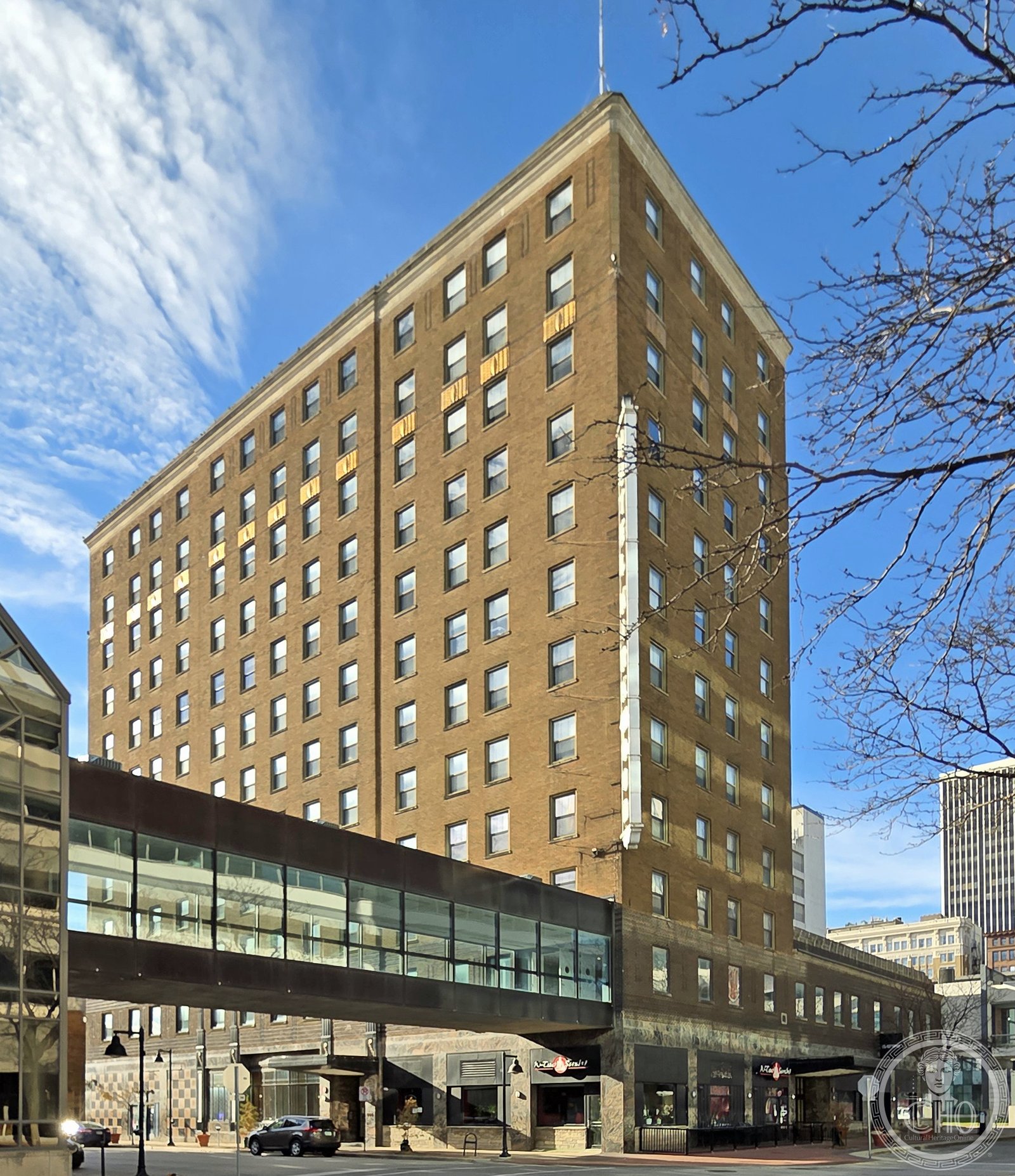
A twelve-story Art Deco hotel at 400 Walnut Street in downtown Des Moines — the largest hotel on Des Moines’s “Hotel Row” when it opened in 1930, designed by the Chicago firm of H.L. Stevens & Company, and now converted to luxury apartments whose former lobby has become a venue for classical music and events.
At a glance
The Hotel Kirkwood stands at 400 Walnut Street in downtown Des Moines, Iowa. Designed by the Chicago architectural firm of H.L. Stevens & Company and built in 1930 for developers E.F. Tagney and S.F. McGinn, the twelve-story brick building rises to a height of 133 feet and was, at its opening, the largest hotel on Des Moines’ “Hotel Row” — the stretch of Fourth Street between Walnut and Court Avenue where the city’s major hotels were concentrated in the early 20th century. The building replaced an earlier Hotel Kirkwood that had stood on the same site since 1862. The 1930 building was built in proximity to Union Station and the Rock Island Depot, positioning it as a destination for travelers arriving by rail. Listed on the National Register of Historic Places in 2003, the Kirkwood has since been converted to luxury apartments called “The Kirkwood,” with the historic lobby repurposed as a venue for classical music and events.
Key facts
- Built: 1930
- Style: Art Deco
- Architects: H.L. Stevens & Company, Chicago
- Developers: E.F. Tagney and S.F. McGinn
- Height: 133 feet (41 m), 12 stories
- Location in context: Largest hotel on Des Moines “Hotel Row” (4th Street between Walnut and Court); near Union Station and Rock Island Depot
- NRHP listed: December 10, 2003 (ref. 03001256)
- Previous building: Earlier Hotel Kirkwood (1862) stood on same site
- Current use: The Kirkwood — luxury apartments; former lobby now a venue for classical music and events
- Address: 400 Walnut Street, Des Moines, Iowa 50309
- GPS: 41.58611, −93.62222
History
The Kirkwood Hotel name had anchored Des Moines’ commercial district since 1862, when the first Hotel Kirkwood was built on the site at 400 Walnut Street. The tradition of hospitality on this corner — more than six decades old when the present building was constructed — gave the 1930 Kirkwood a continuity of identity that the developers, E.F. Tagney and S.F. McGinn, could leverage in marketing the building to the city’s business travelers and visitors. The choice of the Chicago firm H.L. Stevens & Company to design the new building reflected Des Moines’ ambitions as a regional capital: Chicago architects brought prestige and the vocabulary of metropolitan commercial design to Iowa’s largest city.
The 1930 Kirkwood opened at the moment when Des Moines was consolidating its role as Iowa’s financial and political center. The building’s location on “Hotel Row” near Union Station and the Rock Island Depot placed it at the center of the city’s transportation infrastructure — the node through which the Iowa legislature, the agricultural commodity markets, and the state’s insurance industry drew visitors from across the state and the region. The building served as a hotel through most of the 20th century before its conversion to residential use, a trajectory shared with many of the great early 20th-century urban hotels that formed the civic texture of American downtowns: built for a city organized around railroad travel, preserved on the National Register of Historic Places for the Art Deco quality of their design, and ultimately repurposed for the residential demand that characterizes 21st-century downtown revitalization.
What you see
The Hotel Kirkwood’s Art Deco design is carried primarily in its massing, its sleek exterior geometrical detailing, and its treatment of the cornice — the three elements the building’s NRHP nomination specifically identifies as the loci of the building’s Art Deco character. The twelve-story brick structure uses the vertical massing strategy characteristic of Art Deco hotels of the period: a base zone articulated at street level, a mid-tower shaft with the characteristic geometrical window treatment, and a crown zone where the cornice detailing concentrates the decorative program. H.L. Stevens & Company — a Chicago firm that designed hotels across the Midwest during the peak years of Art Deco commercial development — applied to the Kirkwood the same restrained sophistication that characterizes their best work: more interested in the quality of the geometry and the precision of the material execution than in the exuberant ornamentalism of the most celebrated Art Deco towers.
The building’s lobby — now a venue for classical music and events under the residential conversion — is a good index of the Art Deco interior vocabulary of the period: the proportions, the material finishes, and the lighting treatment that the most accomplished designers of the 1920s and 1930s developed as the domestic register of a style better known in its commercial and entertainment variants. The lobby’s post-conversion use as a music venue reflects a broader pattern in the cultural life of converted historic buildings — spaces designed for the ceremonial hospitality of the hotel form finding new life in the cultural programming of 21st-century residential communities.
Practical information
- The Kirkwood is an active residential building; interior public access is not available except during special events at the former lobby (now a music/event venue; check local listings).
- The exterior is visible from Walnut Street and Fourth Street in downtown Des Moines.
- The NRHP listing plaque is at the main entrance on Walnut Street.
Getting there
The Hotel Kirkwood is at 400 Walnut Street in downtown Des Moines, Iowa. Des Moines International Airport (DSM) is approximately 4 miles southwest of downtown via Interstate 235. The DART (Des Moines Area Regional Transit) bus system serves downtown; the downtown Des Moines streetcar stops (restored historic streetcar) run along Grand Avenue and 6th Avenue. By car, Interstate 235 bisects Des Moines east-west; the downtown Des Moines exits (Keo Way, 3rd Street, 6th Avenue) provide access to the Walnut Street corridor. The building is a short walk from the Iowa State Capitol (1886), the Civic Center of Greater Des Moines, and the Principal Park baseball stadium on the Des Moines River.
Nearby
- Iowa State Capitol (1886) — approximately 8 blocks east on Grand Avenue; the French Second Empire capitol building with its iconic golden dome, designed by John C. Cochrane and Alfred H. Piquenard; open for public tours and free general admission to the grounds and rotunda
- Des Moines Art Center — approximately 2 miles northwest at 4700 Grand Avenue in Greenwood Park; the landmark museum housed in a 1948 building by Eliel Saarinen, expanded by I.M. Pei (1968) and Richard Meier (1985); free general admission
- Principal Financial Group headquarters — approximately 4 blocks south on Eighth Street; the insurance and financial services headquarters in a cluster of towers that represent the mid-20th-century downtown development of Des Moines as one of the nation’s leading insurance industry centers
Sources
- Wikipedia: “Hotel Kirkwood” (Des Moines, Iowa)
- NRHP Nomination: Hotel Kirkwood, ref. 03001256, National Park Service (William C. Page)
- Wikimedia Commons: Hotel_Kirkwood.jpg, CC BY-4.0, McGhiever
Find it on the map
See this place and what’s around it →Record researched and written by Luigi De Marchi for Cultural Heritage Online, 2026.
📷 Become a Cultural Heritage Online photographer
Share your photos of places: they stay published under your name as the author. The more they're seen, the more you get noticed — and soon a contest will reward the most appreciated photos.
Log in or sign up free to add a photoIs this page about you?
This page is read by travellers and heritage enthusiasts who find it on Google. Tell us how you are connected to this place and we will take it from there.