
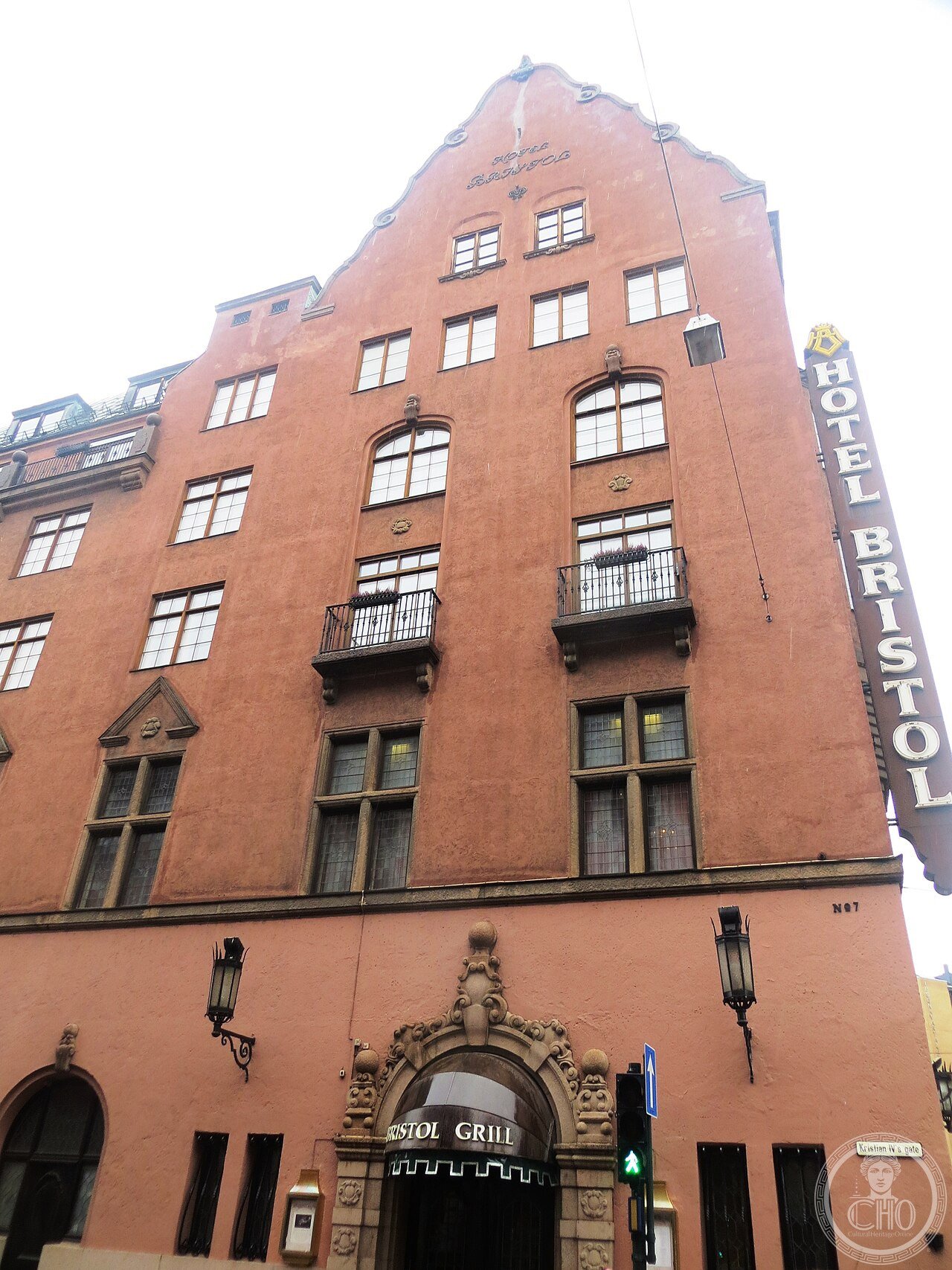
When architect Finn Rahn’s Hotel Bristol opened in January 1920, its ten-metre-high Moorish hall was Norway’s most expensive hotel project ever built — and it has never lost its taste for drama.
At a glance
Hotel Bristol stands on Kristian IVs gate 7 in central Oslo, a Historicist building of rendered brickwork and granite detail opened in 1920 at a construction cost of four million Norwegian kroner — the highest ever spent on a Norwegian hotel at that time. Architect Finn Rahn (born 1879) gave the hotel its signature interior: Den Mauriske Hall, a pillar-encircled atrium with a soaring ten-metre ceiling inspired by Moorish architecture. A century of literary and artistic life has followed, from the clandestine wartime drafting of the Oslo intelligence report to thirty-five years of Frank Sarközi’s jazz piano in the Vinterhaven winter garden. Today the hotel belongs to the Thon Hotels group and operates 251 rooms following a restoration completed in 2019.
Key facts
- Built: 1918–1920 by architect Finn Rahn (born 1879)
- Style: Historicist with Moorish Revival interior elements
- Status: Operating luxury hotel (Thon Hotels), 251 rooms and 10 suites
- Address: Kristian IVs gate 7, 0164 Oslo, Norway
- GPS: 59.9152, 10.7397 — Open in Google Maps
- UNESCO/Listed: Registered Norwegian cultural heritage monument (#163579)
History
Construction began in 1918 and the hotel held a soft opening on 16 January 1920 with the inauguration of Den Mauriske Hall dance restaurant, followed by the full hotel launch on 1 June of the same year. The four-million-krone project was the most expensive hotel ever built in Norway to that date. Among its innovations, it was the first Norwegian hotel to install hot and cold running water in every one of its original hundred rooms.
In July 1936, Oslo hosted an international congress of mathematicians, and the city chose Hotel Bristol for the participants’ formal dinner. Three years later, in 1939, Hans Ferdinand Mayer — a German signals engineer with access to Luftwaffe secrets — typed the “Oslo Report” during his stay: a document that reached British intelligence and remains one of the most significant unsolicited intelligence disclosures of the Second World War. The hotel was requisitioned during German occupation between 1940 and 1945 and served as an emergency hospital after the December 1943 explosion of a German munitions ship in Oslo harbour.
In 1974 businessman Olav Thon purchased Hotel Bristol, eventually building it into the foundation of the Thon Hotels chain. A 120-room extension followed in 2000. A comprehensive renovation completed between 2016 and 2019 modernised the guest facilities while preserving the period character of the historic public spaces. The Vinterhaven (Winter Garden) pianist Frank Sarközi performed there for thirty-five years, attracting guests including Mikhail Gorbachev and Bill Clinton.
What you see
The facade on Kristian IVs gate presents rendered brickwork articulated with granite details and restrained classical mouldings — typical of the sober Norwegian Historicist idiom of the early twentieth century. The building’s mass and formal street alignment give it a civic gravity that sits comfortably beside its governmental and commercial neighbours in the Kvadraturen district.
The interior is another register entirely. Den Mauriske Hall — the Moorish Hall — rises ten metres through a colonnade of slender pillars framing an open atrium, the ceiling pitched above as if lifted from a Andalusian palace. Period chandeliers and original 1920s ornamental detail survive in the Mauriske Salonger rooms. The Vinterhaven (Winter Garden) is a glass-roofed lounge where the sound of a jazz piano at close range has been the defining sensory experience for a century of guests.
Practical information
- Open to hotel guests and restaurant/bar visitors; Mauriske Hall and Vinterhaven accessible to non-guests during service hours
- Best visited year-round; winter evenings in the Vinterhaven are particularly atmospheric
- Guided heritage tours of the building available on request from the concierge
- Allow 30–60 minutes to explore the public spaces; combine with nearby Kvadraturen district
Getting there
Oslo Gardermoen Airport connects to Oslo Central Station in approximately 20 minutes by Flytoget express train. From the Central Station the hotel is a twelve-minute walk west through the Kvadraturen district, or a direct tram connection stops at Stortinget. Karl Johans gate and the National Theatre are a five-minute walk from the hotel entrance.
Nearby
- Grand Hotel Oslo, 500 m — Norway’s oldest luxury hotel (1874), Nobel Peace Prize banquet venue and former daily haunt of Henrik Ibsen
- Stortinget (Norwegian Parliament), 400 m — Henrik Bull’s 1866 neoclassical chamber with public gallery tours
- National Museum, 700 m — Norway’s largest art and design museum, opened in its new building in 2022
- Akershus Fortress, 900 m — fourteenth-century castle and citadel overlooking the inner Oslofjord
Sources
Find it on the map
See this place and what’s around it →📷 Become a Cultural Heritage Online photographer
Share your photos of places: they stay published under your name as the author. The more they're seen, the more you get noticed — and soon a contest will reward the most appreciated photos.
Log in or sign up free to add a photoIs this page about you?
This page is read by travellers and heritage enthusiasts who find it on Google. Tell us how you are connected to this place and we will take it from there.