

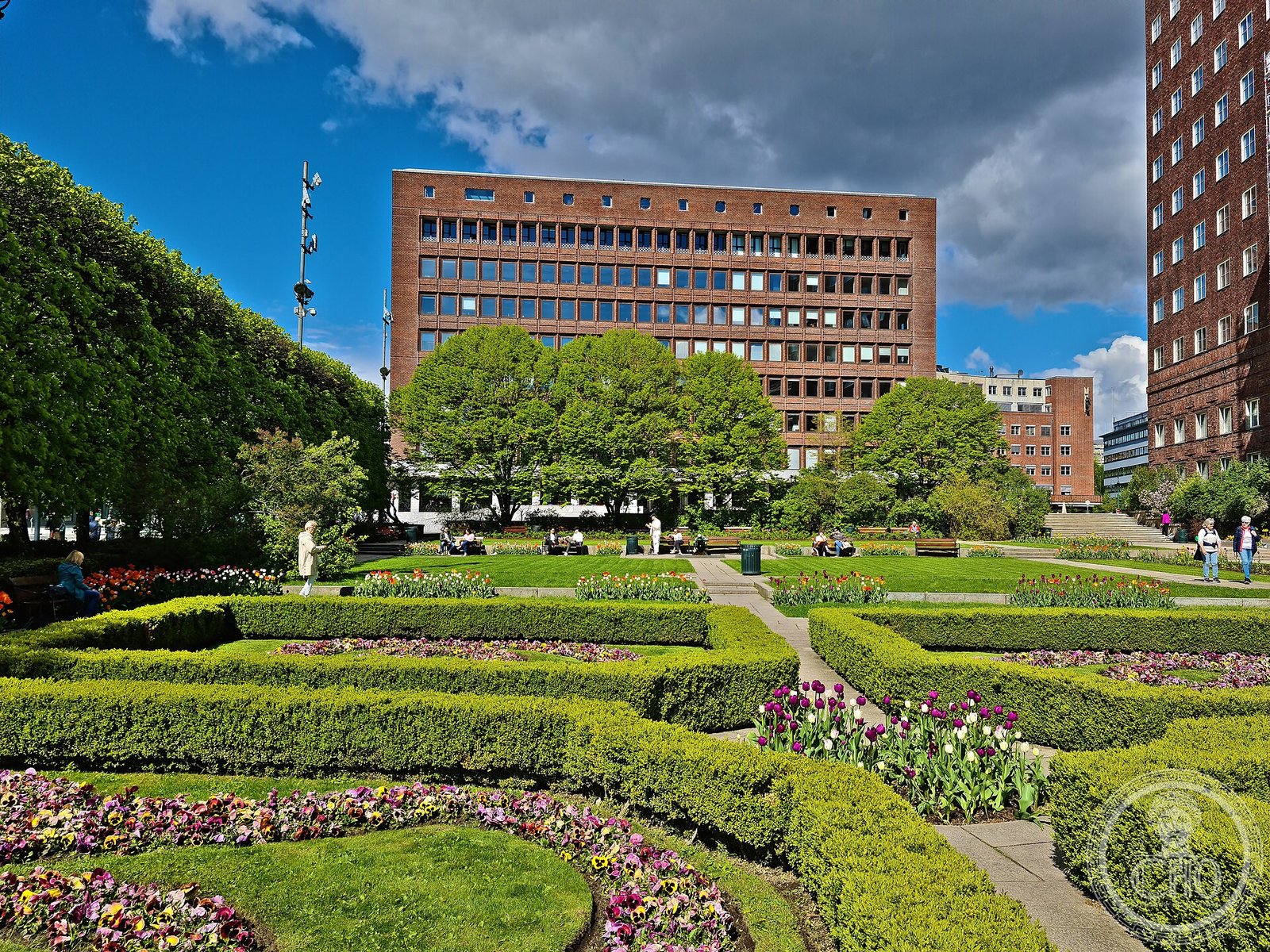
Oslo built its modern civic identity in the long pause between two wars. A red-brick city hall conceived in 1918 and finished in 1950, and a sculpture park of more than two hundred figures, were both decades in the making — monuments to a small nation deciding what kind of public space it wanted.
At a glance
Two interwar projects shape the way Oslo presents itself today. The City Hall, or Rådhuset, rises in twin red-brick towers above the waterfront at Pipervika, facing the Oslofjord; begun in 1931 and opened only in 1950, it has hosted the Nobel Peace Prize ceremony every December since. A short distance west, in Frogner Park, Gustav Vigeland spent the same decades filling 80 acres with 212 bronze and granite figures — the largest sculpture installation in the world by a single artist. Neither belongs to the Art Nouveau or Liberty moment; both belong to the monumental, functionalist confidence of Scandinavia between the wars, when public architecture and public sculpture were treated as instruments of national identity.
Key facts
- Country: Norway
- Key period: 1918–1950 (Functionalism and monumental interwar art)
- Oslo City Hall: Arnstein Arneberg and Magnus Poulsson; competition won 1918, ground stone 1931, opened 15 May 1950
- Vigeland installation: Gustav Vigeland (died 1943); designed from 1924, completed posthumously; 212 bronze and granite sculptures
- Signature elements: the City Hall’s two towers (63 m and 66 m) and 49-bell carillon; Vigeland’s Monolith, 14.12 m high, carved with 121 human figures
- Civic role: the City Hall hosts the Nobel Peace Prize ceremony on 10 December each year
History
The competition for a new Oslo city hall was won in 1918 by Arnstein Arneberg and Magnus Poulsson, but the project moved slowly. The ground stone was laid in September 1931 and construction proper began in February 1933; the shell was completed in November 1936, and the building was finally opened on 15 May 1950. The long gestation left its mark on the design, whose 1930 final draft had been substantially reworked under the influence of functionalism. The finished Rådhuset is built of red brick with two asymmetrical towers, one rising to 63 metres and the other to 66, the eastern tower carrying a carillon of 49 bells.
In the same decades Gustav Vigeland was building the other half of Oslo’s monumental identity. From 1924 he developed what became the Vigeland installation in Frogner Park, releasing his final plan in 1932; the Bridge, with its 58 figures, was the first section opened to the public, in 1940. Vigeland died in 1943, and the installation was completed after his death to his designs. Its centrepiece, the Monolith, rises 14.12 metres and is carved from a single block of granite into 121 intertwined human figures.
The two works share an ambition rare in so small a capital: to give the city permanent civic monuments at the scale of a much larger nation. The park was protected under Norway’s Heritage Act in 2009, the first park in the country to receive that status, and remains the most visited attraction in Norway.
What you see
The Rådhuset reads first as mass and material: two square brick towers, deliberately unequal, anchoring a long horizontal block that turns its main front to the fjord. The red brick — laid in units of roughly 27.5 by 13 by 8.5 centimetres — gives the building a Nordic weight quite different from the white classicism of the same years elsewhere in Scandinavia. The interiors carry large decorative programmes by Norwegian artists, and the central hall is the setting for the annual Nobel ceremony.
Frogner Park is experienced as a single axial walk. The route crosses the 100-metre Bridge lined with bronze figures, passes the great Fountain with its 60 bronze reliefs, and climbs to the plateau where the Monolith stands at the centre of a circle of granite groups. The material shifts deliberately — bronze on the bridge, Iddefjord granite on the heights — and the figures, all nude and without attributes, read as a continuous meditation on the human life cycle.
Practical information
- Oslo City Hall: open to visitors with free entry outside official events; guided tours run in season
- Frogner Park / Vigeland installation: open year-round, free, no gates — the Vigeland Museum nearby charges separately
- Best paired: both lie west of the centre and can be combined in a single day
- Time needed: two to three hours for the park; an hour for the City Hall
Getting there
Oslo Airport (OSL) at Gardermoen connects to Oslo Central Station by airport express train in about 20 minutes. The City Hall stands on the waterfront at Rådhusplassen, a short walk west of the station and the Aker Brygge quay. Frogner Park is reached by tram (lines toward Majorstuen and Frogner) in about 10 minutes from the centre, or on foot in around half an hour. Oslo’s trams, metro and buses share a single zoned ticket.
Related in CHO
- Copenhagen — Nordic Classicism and the Brick Expressionists
- Helsinki — Alvar Aalto and Nordic Functionalism
- Stockholm — Nordic Classicism and the Stockholm school
Sources
Find it on the map
See this place and what’s around it →📷 Become a Cultural Heritage Online photographer
Share your photos of places: they stay published under your name as the author. The more they're seen, the more you get noticed — and soon a contest will reward the most appreciated photos.
Log in or sign up free to add a photo