
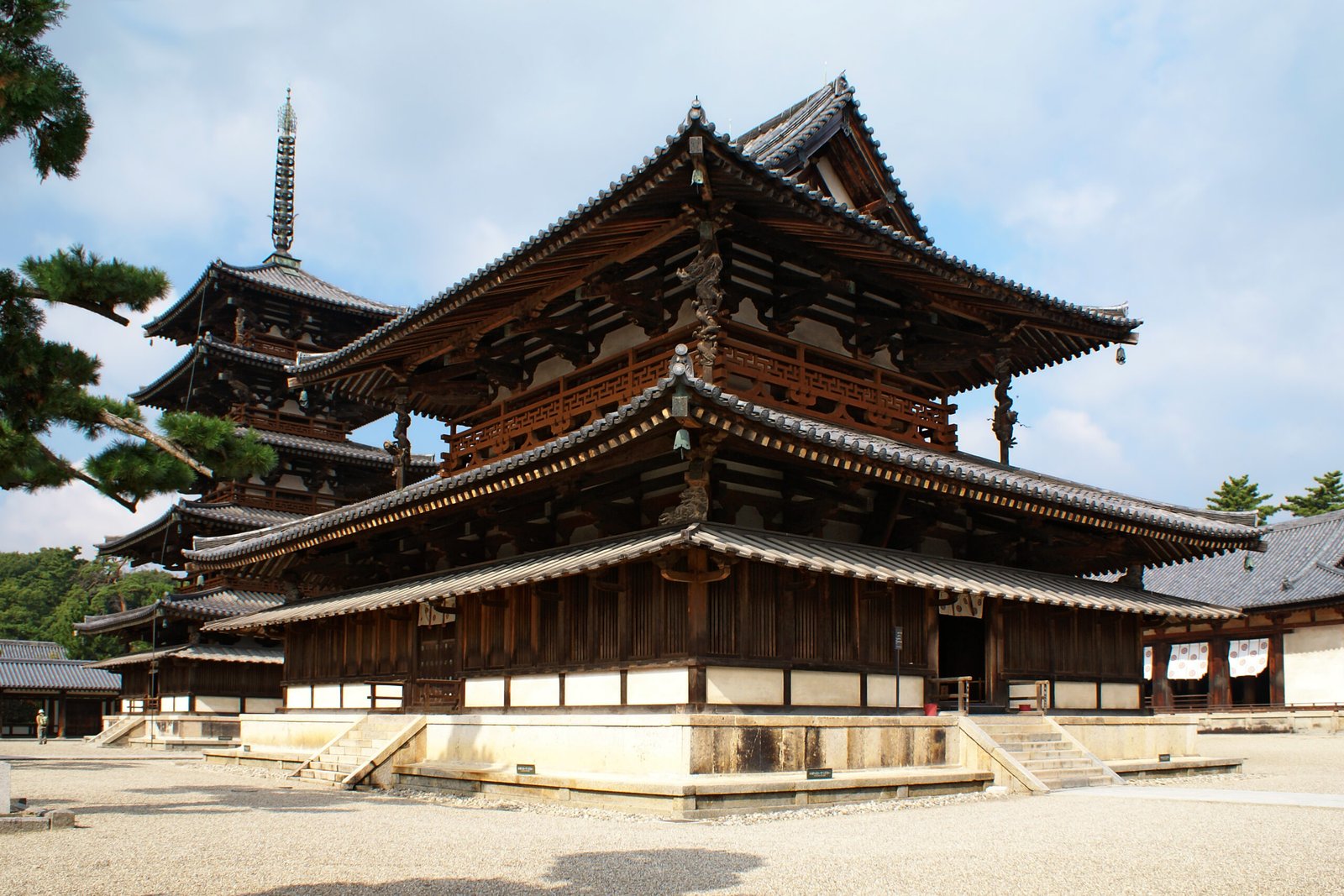
The oldest wooden structures on earth: a 7th-century Buddhist temple complex in Nara Prefecture, Japan, built under Prince Shotoku and surviving intact for 1,350 years.
At a glance
In the rice fields of Nara Prefecture, 12km southwest of the ancient capital of Nara, the temple complex of Horyuji contains buildings that have survived intact from 607 AD, making them the oldest wooden structures standing anywhere on earth. The West Precinct holds the five-storey pagoda and the Main Hall (Kondo), forming the oldest Buddhist temple complex in Japan. Both were built under Prince Shotoku, the regent who introduced Buddhism and Chinese learning to Japan, whose significance in Japanese cultural history is comparable to Charlemagne in European history.
Key facts
- Founded: 607 AD by Prince Shotoku; current buildings mostly 7th-8th century
- UNESCO World Heritage Site: 1993, Buddhist Monuments in the Horyuji Area
- Oldest timber: Main hall timbers felled c. 670 AD; 1,350-year-old structural wood still in continuous use
- Pagoda: Five storeys, 32.5 metres; shinbashira central pillar anchored underground for earthquake resistance
- Tori Busshi Bronze Triad: 623 AD, earliest dated Buddhist sculpture in Japan
- Kudara Kannon: 2.1-metre wooden bodhisattva; Tachibana Lady Shrine: bronze miniature temple 60cm tall, finest 7th-century metalwork in the world
History
Horyuji was founded in 607 AD by Prince Shotoku, regent to Empress Suiko, as a centre for Buddhist learning. Shotoku issued Japan’s first written constitution in 604 AD and dispatched embassies to Tang China to import continental learning. The temple burned in 670 AD and was rebuilt shortly after. The rebuilt structures are what stand today, placing their construction between 670 and 710 AD, the Asuka period of Japanese history.
The complex represents the direct transmission of Chinese and Korean Buddhist architecture into Japan. The West Precinct layout follows a continental plan from the Korean kingdom of Baekje, and the craftsmen almost certainly included Korean and Chinese masters working alongside Japanese apprentices. When Western historians first documented Horyuji in the early 20th century, they were astonished to find buildings constructed before Charlemagne was born still standing and structurally sound.
What you see
The West Precinct is the heart of the complex. The five-storey pagoda, 32.5 metres tall, uses a massive central pillar anchored deep in a foundation stone, allowing the outer structure to sway independently during earthquakes — a technique that has kept the pagoda standing through every earthquake since 670 AD. The Golden Hall beside it houses the Shaka Triad of 623 AD; the inscription on the halo records the casting date, making this the earliest dated sculptural work in Japan.
The East Precinct, founded 739 AD on Prince Shotoku’s palace site, centres on the Yumedono (Hall of Dreams), an octagonal pavilion housing a gilt camphorwood statue of Shotoku himself. The Great Treasure Hall displays the Kudara Kannon, a 2.1-metre wooden bodhisattva, and the Tachibana Lady Shrine, a bronze miniature temple barely 60cm tall whose tiny interior figures represent a complete Pure Land paradise scene.
Practical information
- Address: 1-1 Horyuji Sannai, Ikaruga, Ikoma District, Nara Prefecture 636-0115, Japan
- Hours: Daily 08:00-17:00 (Feb 22 to Nov 3); 08:00-16:30 (Nov 4 to Feb 21)
- Admission: 1,500 yen, includes West and East Precincts and Treasure Hall
- Photography: Permitted in the grounds; interiors vary by building
- Audio guide: English-language guides available at the entrance
Getting there
From Nara city: JR Yamatoji Line from Nara Station to Horyuji Station takes 11 minutes, then bus or 20-minute walk. From Osaka: direct JR trains from Tennoji Station take approximately 35 minutes. The temple is 12km southwest of Nara and well signposted from the station.
Nearby
- Todai-ji (Nara city, 12km) — world’s largest bronze Buddha, cast 752 AD
- Kasuga Grand Shrine (Nara city) — 8th-century Shinto shrine in ancient deer park, UNESCO listed
- Yakushi-ji (Nara city, 8km) — Nara Period temple with two surviving 8th-century pagodas
- Asuka (20km south) — original capital of Japan before Nara, with keyhole-shaped burial mounds
Sources
- UNESCO World Heritage List — Buddhist Monuments in the Horyuji Area (1993)
- Nara National Research Institute for Cultural Properties — dendrochronological studies
- Horyuji Temple official website: www.horyuji.or.jp
- Wikipedia: Horyuji — architectural and historical summary
- Frederic, Louis. Japan Encyclopedia. Harvard University Press, 2002.
Find it on the map
See this place and what’s around it →📷 Become a Cultural Heritage Online photographer
Share your photos of places: they stay published under your name as the author. The more they're seen, the more you get noticed — and soon a contest will reward the most appreciated photos.
Log in or sign up free to add a photoIs this page about you?
This page is read by travellers and heritage enthusiasts who find it on Google. Tell us how you are connected to this place and we will take it from there.