
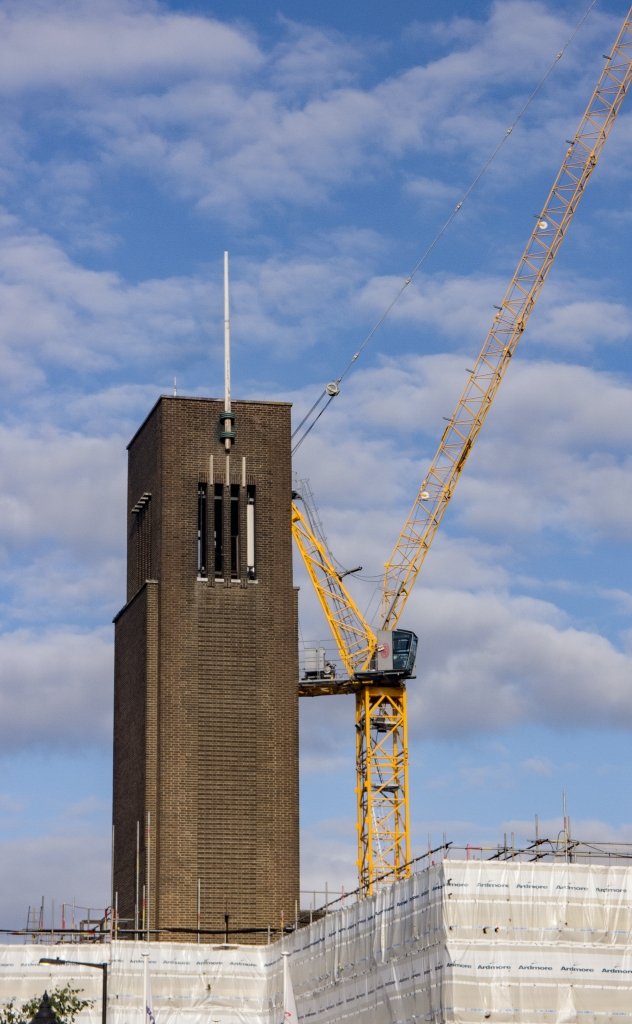
Brick, asymmetry and a clean clock tower: the building that brought modern architecture to England’s town halls.
At a glance
Hornsey Town Hall, on the Broadway at Crouch End in north London, opened in 1935. The young New Zealand-born architect Reginald Uren won the competition for it with a design in the new continental manner, brick, asymmetrical, with a slim clock tower, owing much to Willem Dudok’s town hall at Hilversum. It is often called the first Modern Movement public building in England.
Key facts
- Location: The Broadway, Crouch End, London
- Architect: Reginald Uren
- Opened: 1935
- Style: Modern Movement (Dudok-influenced)
- Award: RIBA London Architecture Medal, 1935
History
The borough of Hornsey held a competition for a new town hall, and Uren’s modern design beat more traditional rivals. Built in warm brick, it grouped a council chamber, offices and a public hall around a courtyard, with a tower as its only vertical accent.
It won the RIBA medal in the year it opened, a sign that modern architecture had arrived in English public building. After the borough was absorbed into a larger council, the hall passed through decline and has since been restored for arts and community use.
What you see
There is no symmetry and almost no ornament: planes of brick, long bands of windows, and a clean clock tower rising at one side. The debt to Dudok’s Hilversum is plain. After the columns and domes of Victorian town halls, the restraint was a quiet revolution.
Practical information
- Open: arts and events venue; exterior viewable any time
- Cost: free to view; events ticketed
- Best for: the brick massing and the clock tower
- Time needed: 15–20 minutes
Getting there
The town hall is on Crouch End Broadway in north London. It is a bus ride from the nearest Underground and Overground stations at Finsbury Park, Highgate and Hornsey.
Nearby
- Crouch End — the village-like district around the hall
- Alexandra Palace — the great Victorian hall on the hill nearby
Sources
- Wikipedia — Hornsey Town Hall
- Historic England — listed building record
- Wikimedia Commons — image source and licence
Find it on the map
See this place and what’s around it →📷 Become a Cultural Heritage Online photographer
Share your photos of places: they stay published under your name as the author. The more they're seen, the more you get noticed — and soon a contest will reward the most appreciated photos.
Log in or sign up free to add a photoIs this page about you?
This page is read by travellers and heritage enthusiasts who find it on Google. Tell us how you are connected to this place and we will take it from there.