
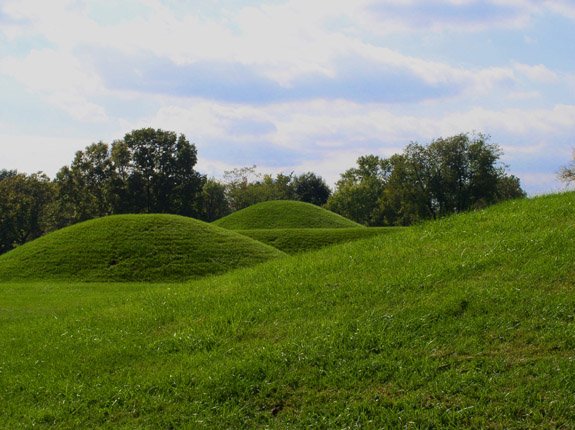
Eight interconnected sites of geometric earthworks in south-central Ohio — circles, squares, octagonals, and parallel-walled ceremonial roads of precise mathematical proportions — built by the Hopewell culture between c. 100 BC and 500 AD, inscribed on the UNESCO World Heritage List in 2023 as the most geometrically sophisticated earthwork tradition in the pre-Columbian Americas.
At a glance
In the river valleys of south-central Ohio, a network of geometric earthworks was constructed by the Hopewell culture between approximately 100 BC and 500 AD. The eight sites inscribed as a UNESCO World Heritage Property in 2023 include enormous circular, square, octagonal, and elliptical enclosures of mathematically precise proportions, connected by parallel-walled ceremonial avenues and surrounded by mortuary mound complexes containing extraordinarily rich burial assemblages of objects traded from across the North American continent. The earthworks represent the culmination of a pan-continental ceremonial tradition involving communities from the Great Lakes to the Gulf of Mexico who were connected by the Hopewell Interaction Sphere — a vast exchange network motivated primarily by ritual.
Key facts
- UNESCO inscription: 2023, as “Hopewell Ceremonial Earthworks”
- Component sites: Eight sites across Ross, Licking, and Union Counties, Ohio
- Newark Earthworks: Octagon Earthworks (c. 19 hectares) + Great Circle (475 m diameter); original complex covered c. 10 km2
- Astronomical encoding: Newark Octagon aligned to the 18.6-year lunar cycle (all eight moonrise/moonset extremes)
- Trade network: Copper from Great Lakes, obsidian from Yellowstone, shark teeth from Gulf Coast, grizzly bear teeth from Rocky Mountains
- Builders: Non-state Hopewell culture communities; dispersed, not city-organised
- Mound City: Chillicothe component; 23 burial mounds within a square enclosure; over 200 cremations excavated
History
The Hopewell culture — named after Mordecai Hopewell, the Ohio farmer on whose land key mounds were first excavated in the 1890s — flourished between approximately 100 BC and 500 AD, overlapping with the height of the Roman Empire in Europe and the Han Dynasty in China. The Hopewell people were not a single political entity or ethnic group but rather a dispersed set of communities across the eastern woodlands of North America who shared a common ceremonial tradition, exchange network, and artistic style. Their settlements were small and non-urban; they built no cities, no palaces, and no systems of writing. What they did build, in the river valleys of Ohio, were earthworks of extraordinary scale and geometric precision — structures that required sustained communal labour, careful planning, and multi-generational continuity of purpose.
The core of the earthwork tradition was the Newark Earthworks in Licking County, where the original complex covered approximately 10 km2 — an area larger than many ancient city-states — with a continuous sequence of enclosures, avenues, and mounds forming a landscape-scale ceremonial geography. The Octagon Earthworks at Newark, one of eight surviving component sites, has been demonstrated through precise survey to encode the complete 18.6-year lunar cycle: each of the octagon’s eight walls is oriented to one of the eight extreme positions of the moon (maximum northern and southern moonrise and moonset over the 18.6-year cycle), an alignment requiring continuous astronomical observation across many generations before construction began. The earthwork tradition ended abruptly around 500 AD; the reasons for the collapse of the Hopewell ceremonial system remain unclear, though climate change, social disruption, and the decline of long-distance trade networks have all been proposed.
The earthworks were subjected to extensive looting and damage from the 18th century onward, and most of the original Newark complex was destroyed by the growth of the modern city of Newark, Ohio. The surviving portions — including the Octagon Earthworks, which are now leased by the Moundbuilders Country Club as a golf course — remain at the centre of an ongoing legal and cultural debate about appropriate use of a UNESCO World Heritage Site. The Ohio History Connection and Native American tribal nations have been working toward returning the Octagon to full public and ceremonial access.
What you see
The eight component sites of the Hopewell Ceremonial Earthworks offer very different experiences. Mound City at Hopewell Culture National Historical Park (Chillicothe) is the most accessible and fully interpreted: a square enclosure approximately 270 x 230 metres containing 23 burial mounds has been reconstructed to its original profile, with a visitor centre providing context on the Hopewell mortuary tradition and the extraordinary objects recovered from the mounds (including thousands of pearls, sheets of mica cut into complex shapes, copper breastplates and headdresses, and obsidian blades). The Great Circle at Newark (Newark Earthworks State Memorial) is a circular enclosure approximately 475 metres in diameter whose interior is 1.2 metres below the surrounding level, creating a remarkable sense of enclosure and separation from the outside world. The Octagon Earthworks — partially open to the public on specific days each year — is the most geometrically dramatic element: a perfectly proportioned regular octagon connected by parallel embankments 60 metres apart to a circular enclosure, the whole oriented with mathematical precision to the lunar cycle extremes.
The earthwork walls themselves are typically 2-4 metres high and 15-30 metres wide at the base, built of carefully layered soils and clays from multiple sources — evidence of deliberate selection of different-coloured earths. The interiors of the enclosures at the time of use were probably maintained as carefully managed open ceremonial spaces, not inhabited residential areas.
Practical information
- Main visitor site: Hopewell Culture National Historical Park, 16062 OH-104, Chillicothe, OH 45601 (NPS managed)
- Hours: Visitor centre open daily; grounds open dawn to dusk
- Entry: Free (federal NPS site)
- Newark Earthworks: Great Circle open daily; Octagon open to the public on specific Heritage Days (check Ohio History Connection schedule)
- Duration: 2-3 hours for Mound City; full day to visit multiple component sites
- Nearest airport: Columbus (John Glenn International), approximately 80 km north
Getting there
Hopewell Culture National Historical Park at Chillicothe is approximately 80 km south of Columbus, Ohio, via US-23. The park is car-accessible; no public transport serves Chillicothe directly from Columbus. The Newark Earthworks are approximately 55 km northeast of Columbus; the Great Circle is on the grounds of the Moundbuilders State Memorial in the city of Newark, easily reached by car. A full visit to multiple component sites requires private transport and at least a full day.
Nearby
- Serpent Mound — A 420-metre-long effigy mound in the shape of an uncoiling serpent, approximately 55 km southwest of Chillicothe; one of the most iconic prehistoric monuments in North America
- Fort Ancient — A hilltop enclosure earthwork complex associated with the earlier Hopewell and later Fort Ancient cultures, approximately 90 km west
- Cahokia Mounds — The largest pre-Columbian city north of Mexico, near St. Louis, Illinois; a later Mississippian culture site (700-1400 AD)
Sources
- Lepper, B.T., “The Newark Earthworks: Monumental Geometry and Astronomy at a Hopewellian Pilgrimage Centre,” in Archaeology of the Appalachian Highlands, UT Press (2004)
- Romain, W.F., Mysteries of the Hopewell: Astronomers, Geometers, and Magicians of the Eastern Woodlands, University of Akron Press (2000)
- Pacheco, P.J. (ed.), A View from the Core: A Synthesis of Ohio Hopewell Archaeology, Ohio Archaeological Council (1996)
- National Park Service, “Hopewell Culture National Historical Park,” nps.gov (accessed June 2026)
- Wikipedia contributors, “Hopewell Ceremonial Earthworks,” Wikipedia, The Free Encyclopedia (accessed June 2026)
Find it on the map
See this place and what’s around it →📷 Become a Cultural Heritage Online photographer
Share your photos of places: they stay published under your name as the author. The more they're seen, the more you get noticed — and soon a contest will reward the most appreciated photos.
Log in or sign up free to add a photo