
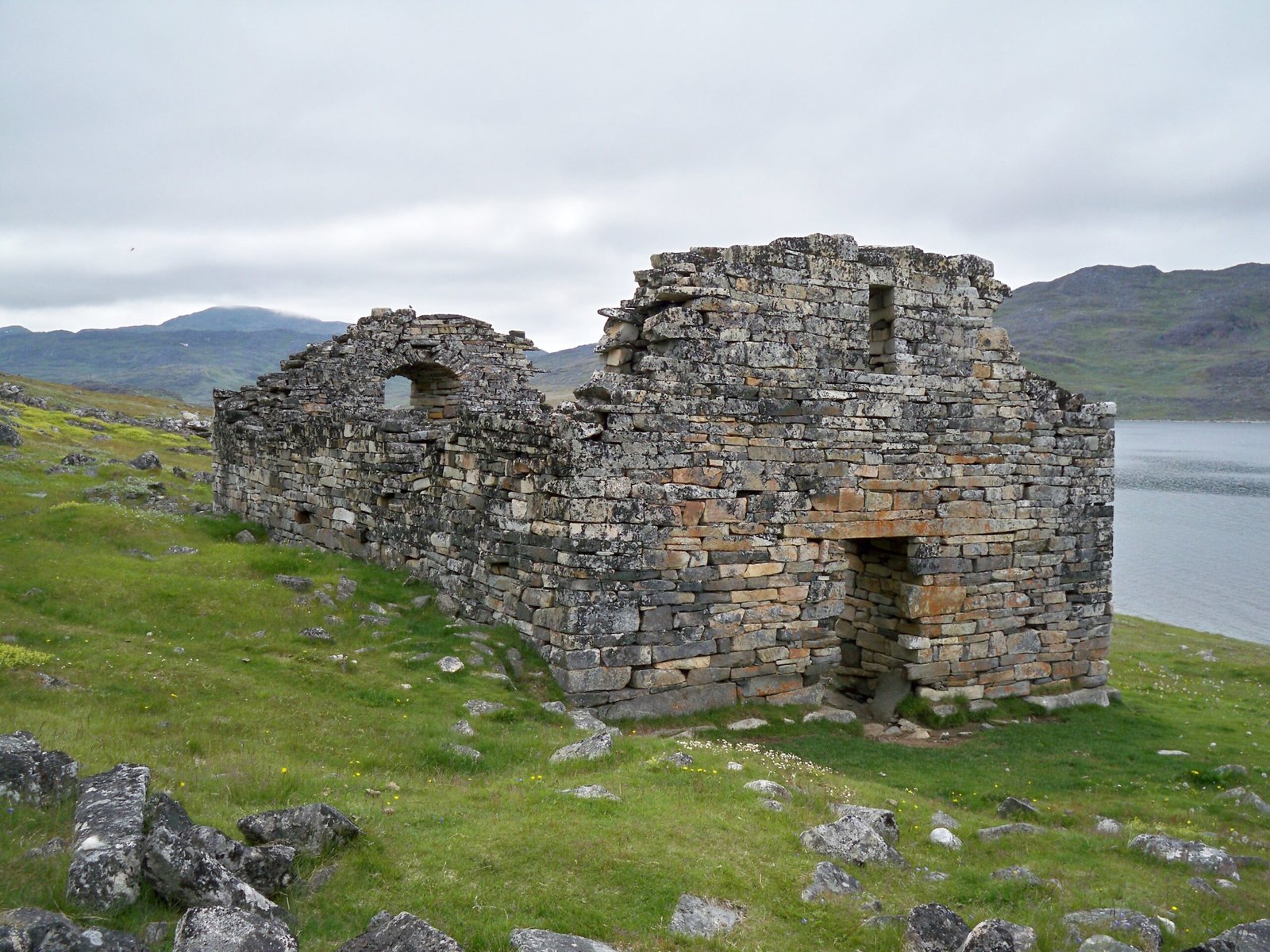
The last standing Norse church in Greenland, and the site of the final recorded event in the five-century story of the Norse Greenlandic colony — a wedding in September 1408, documented by three separate Icelandic annals, after which the colony vanishes entirely from history.
At a glance
On a headland at the head of Hvalsey fjord in southern Greenland, approximately 5 km from the modern town of Qaqortoq, the roofless stone walls of a 14th-century Norse church stand in near-perfect condition beside the ruins of a farm complex and a great hall. Built around 1300 AD as part of one of the larger farms in the Eastern Settlement — the Greenlandic Norse colony established by Erik the Red around 985 AD — Hvalsey Church is the best-preserved Norse structure in Greenland and one of the most evocative sites of human disappearance in the North Atlantic world.
Key facts
- Built: c. 1300 AD (Norse Greenland, Eastern Settlement)
- Dimensions: Approximately 16 x 8 metres internally; walls survive to c. 1.5 metres height
- Construction: Double-wall technique with rubble infill, characteristic of Greenlandic Norse architecture
- Last recorded event: Wedding of Thorstein Olafsson and Sigrid Bjornsdottir, 16 September 1408
- Documentary sources: Three separate Icelandic annals record the 1408 wedding independently
- Colony fate: The Eastern Settlement disappears from all written and physical records within decades of 1408
- Access today: Accessible by boat from Qaqortoq; no permanent staff or infrastructure on site
History
The Norse colonisation of Greenland began around 985 AD when Erik the Red led settlers from Iceland to establish two communities on the southwestern coast: the Western Settlement (near modern Nuuk) and the Eastern Settlement (near modern Qaqortoq). At its peak in the 12th and 13th centuries, the Eastern Settlement contained an estimated 4,000-5,000 people distributed across some 450 farms, twelve parish churches, one cathedral (at Gardar), and an Augustinian monastery. Hvalsey farm and its church were among the larger establishments: the surrounding ruins include a great hall measuring approximately 18 x 7 metres, byres for livestock, and several smaller structures, suggesting a prosperous household within the Norse Greenlandic economy of hunting, pastoralism, and trade in walrus ivory and furs with mainland Europe.
The church was probably built around 1300 AD, during the late period of Norse Greenland’s existence, when the colony was already under stress: the global cooling of the early Little Ice Age was shortening growing seasons; the market for walrus ivory was collapsing as elephant ivory from Africa re-entered European markets; and the Thule Inuit people had been expanding southward from Arctic Canada since approximately 1200 AD, gradually occupying Norse hunting territories. The last unambiguous documentary evidence of the colony is the wedding at Hvalsey Church on 16 September 1408 — recorded by three independent Icelandic annals. After that date, nothing. The fate of the approximately 2,000-3,000 people estimated to have been living in the Eastern Settlement remains one of the most contested questions in North Atlantic historical archaeology. Climate deterioration, starvation, Thule Inuit conflict, plague, and emigration to Iceland or Scandinavia have all been proposed; the evidence supports combinations of several factors.
What you see
The church walls, built of carefully coursed local stone using the double-wall technique — two parallel faces of fitted stone with a rubble-filled core — stand to approximately 1.5 metres on all four sides. The roofless building measured approximately 16 metres long and 8 metres wide internally; narrow window openings remain visible in the walls. The entrance is on the south side. To the west stand the robbed-out ruins of the great hall and several farm buildings, the entire complex occupying a slightly elevated headland with views across the fjord. The preservation is remarkable: no systematic demolition or stone-quarrying took place after abandonment, and the site’s isolation has protected it from the reuse that destroyed most other Norse Greenlandic structures.
Unlike many comparable sites, Hvalsey Church has no permanent infrastructure — no interpretive panels, no maintained path from the shore, no visitor facilities. Arriving by boat and walking across an unmarked landscape to find the walls standing alone in the silence of the fjord is the full experience the site offers.
Practical information
- Location: Hvalsey fjord, approximately 5 km east of Qaqortoq, southern Greenland
- Access: By boat from Qaqortoq (charter or organised tour); no road access
- Entry: Open site, no fees, no facilities on site
- Season: Best visited June-September; fjord may be partially ice-blocked in early season
- Duration: Half-day from Qaqortoq including boat transit
- What to bring: Waterproof clothing, sturdy footwear; no services at the site
Getting there
Qaqortoq is accessible by Air Greenland from Nuuk or by coastal ferry. From Qaqortoq, boat tours to Hvalsey Church are run by local operators during the summer season as half-day or full-day trips. World of Greenland and local guesthouses can arrange transport. Independent travellers can hire small boats from the harbour. The ruins are on the northern shore of Hvalsey fjord; the boat landing is directly below the site.
Nearby
- Gardar Cathedral ruins (Igaliku) — The former bishop’s seat of Norse Greenland, approximately 30 km northeast; the largest Norse building in Greenland
- Brattahlid / Qassiarsuk — Erik the Red’s original farm, approximately 60 km northwest; site of the first Christian church in the Americas (c. 1000 AD)
- Narsarsuaq — The main airport hub for the region, with a WWII US air base history and access to the Greenland ice sheet
Sources
- Dugmore, A.J. et al., “The Norse Landnam on the North Atlantic Islands,” Polar Record 41 (2005)
- Arneborg, J., “Greenland and the Wider World,” in The Oxford Handbook of the Archaeology of Death and Burial (2013)
- Seaver, K.A., The Frozen Echo: Greenland and the Exploration of North America, Stanford University Press (1996)
- McGovern, T.H., “The economics of extinction in Norse Greenland,” in Climate and History, Cambridge UP (1981)
- Wikipedia contributors, “Hvalsey Church,” Wikipedia, The Free Encyclopedia (accessed June 2026)
Find it on the map
See this place and what’s around it →📷 Become a Cultural Heritage Online photographer
Share your photos of places: they stay published under your name as the author. The more they're seen, the more you get noticed — and soon a contest will reward the most appreciated photos.
Log in or sign up free to add a photoIs this page about you?
This page is read by travellers and heritage enthusiasts who find it on Google. Tell us how you are connected to this place and we will take it from there.