

The most ambitious civil engineering project of the New Deal era was not content to be merely functional: Gordon Kaufmann dressed Hoover Dam’s concrete face in Art Deco ornament, turning a 726-foot barrier across the Colorado River into one of the most dramatic architectural works of the twentieth century.
At a glance
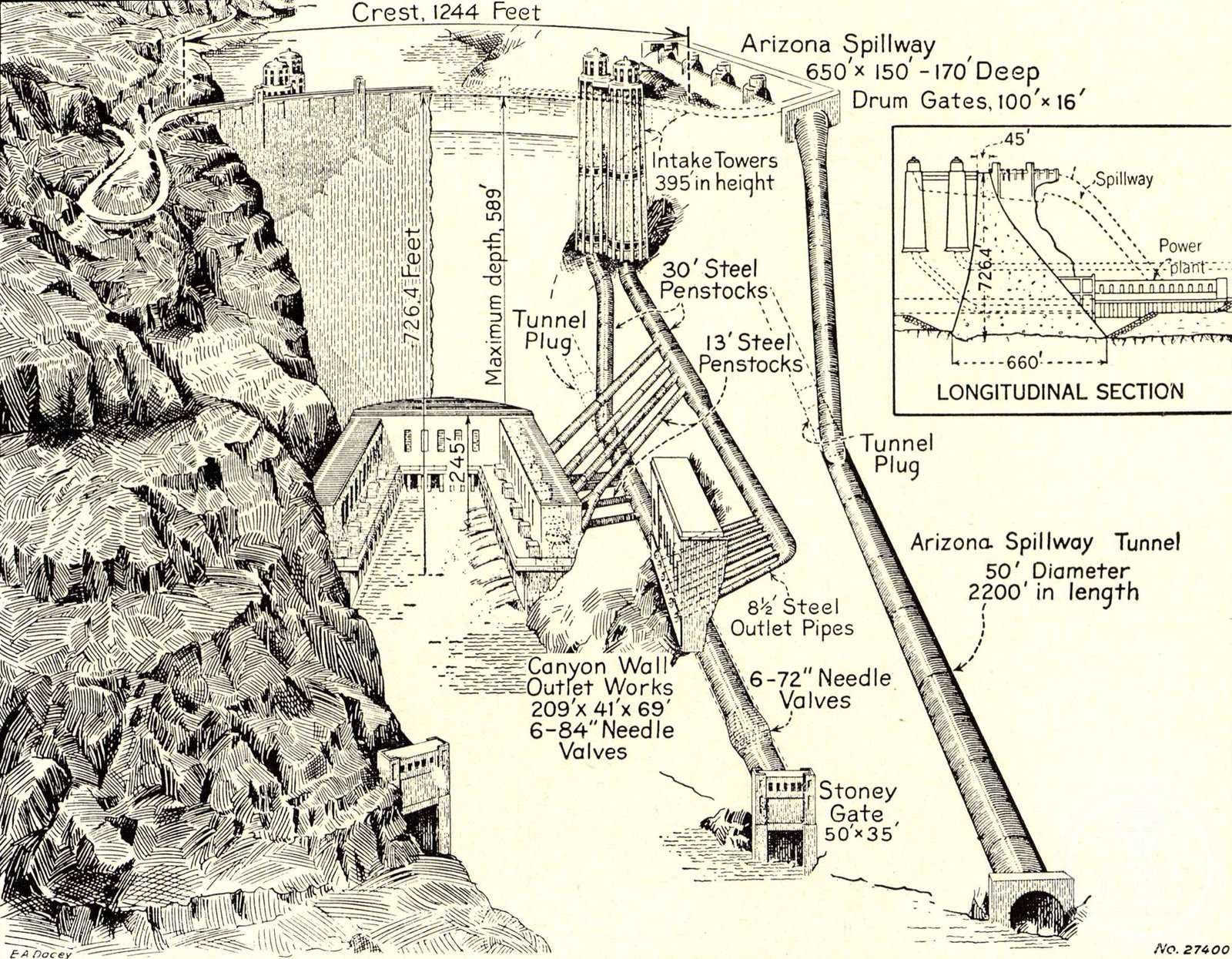
Hoover Dam stands in Black Canyon on the Colorado River, straddling the Nevada-Arizona border about 30 miles southeast of Las Vegas. Construction ran from 1931 to 1936, making it one of the largest public works projects in American history. The dam controls Colorado River flooding, provides water storage for the arid Southwest, and generates hydroelectric power through its turbines. What distinguishes it from purely utilitarian infrastructure is the deliberate Art Deco design vocabulary applied to every visible surface — the intake towers, the turbine housing, the visitor terrazzo floor with its astronomical map, the two bronze winged figures flanking the central flagpole. Gordon B. Kaufmann, the consulting architect, was responsible for this program. The result is a structure that functions as both engineering monument and public artwork.
Key facts
- Location: Black Canyon, Colorado River, Nevada–Arizona border; nearest city: Boulder City, Nevada
- Construction: 1931–1936
- Height: 726 feet (221 meters)
- Consulting architect (Art Deco elements): Gordon B. Kaufmann
- Named for: President Herbert Hoover (1874–1964)
- Historic designation: National Historic Landmark; National Register of Historic Places
- Visitor access: Open to visitors with guided tours
History
The Colorado River had been both life-source and threat to the desert Southwest for centuries before the first concrete was poured in 1931. Spring floods regularly devastated farming communities along its lower reaches in California’s Imperial Valley; summer low-water periods left the same communities without irrigation. The Colorado River Compact of 1922 began the political process of apportioning the river’s water among the seven states of its drainage basin, and by 1928 Congress had authorized construction of a high dam in Black Canyon. The project was officially named Boulder Dam, though it would be renamed Hoover Dam in 1947 to honor the president who championed its authorization.
Construction by the Six Companies consortium began in 1931 under the direction of Frank Crowe, who had pioneered the use of cableways to place concrete in large dam projects. The scale was unprecedented: at 726 feet, the dam would be the tallest in the world at its completion; the reservoir it created, Lake Mead, would be the largest in the United States. The workforce peaked at several thousand men, many of them Depression-era migrants drawn by steady government wages, and construction fatalities were substantial. The dam was completed two years ahead of schedule in 1936.
Gordon B. Kaufmann’s involvement was driven by the Bureau of Reclamation’s decision that a project of this visibility deserved architectural polish. Kaufmann, an Englishman who had built a successful practice in Los Angeles, applied the Art Deco vocabulary to the dam’s functional elements: the intake towers on the Nevada and Arizona sides became streamlined geometric forms with ornamental detail; the turbine housing at the base of the dam was designed with the same vocabulary. The sculptor Oskar J.W. Hansen contributed the terrazzo floor in the visitor lobby, an astronomical map centered on the night of the dam’s dedication, and the two bronze “Winged Figures of the Republic” flanking the flagpole on the crest. The figures are monumental in scale. These touches were not incidental — they reflect the New Deal’s investment in public art as part of public infrastructure.
What you see
The dam’s face is a curved arc of concrete, sloping inward as it rises, that fills the narrow canyon from wall to wall. The geometry is stark and overwhelming: nothing about Black Canyon prepares the eye for the scale of what human hands placed in it. The intake towers on each side of the canyon are particularly striking — four cylindrical concrete columns with Art Deco detailing, rising from the reservoir surface like monumental pylons. Their profiles are simultaneously industrial and ceremonial, as if the engineers and the architect had agreed that a structure of this consequence deserved to announce itself.
On the crest, the twin Winged Figures by Oskar Hansen flank the flagpole: seated bronze male figures, monumental in scale, their heads bowed and wings spread, embodying the concept of eternal vigilance over the national enterprise. The terrazzo floor of the visitor lobby extends this iconographic program inward, mapping the stars as they appeared on the night of September 30, 1935, when President Franklin D. Roosevelt dedicated the dam. The detail rewards attention: the astronomical map is accurate enough that a future generation, knowing only the date encoded in the stars, could identify when the floor was laid.
Practical information
- Admission: Paid admission for tours; fees vary by tour type (powerplant tour, dam tour)
- Hours: Generally open daily; check the Bureau of Reclamation website for current hours and tour availability
- Visitor Center: Modern visitor center on the Nevada side with exhibits on the dam’s history and construction
- Driving: U.S. Highway 93 crosses the dam crest; alternatively, the Hoover Dam Bypass (Mike O’Callaghan–Pat Tillman Memorial Bridge, 2010) offers views of the dam from above without crossing it
- Parking: Paid parking on the Nevada side; free parking available on the Arizona side (longer walk)
Getting there
Hoover Dam is approximately 30 miles southeast of Las Vegas on U.S. Route 93. From Las Vegas, follow US-93 south through Henderson and Boulder City; the dam is at the end of the Boulder City corridor where Nevada meets Arizona. By car from Las Vegas, the drive takes 45 minutes to an hour depending on traffic. There is no public transit connection directly to the dam, but several tour operators offer bus tours from the Las Vegas Strip. The drive along US-93 through Boulder City passes the historically significant dam construction-era infrastructure before arriving at the canyon rim.
Nearby
- Boulder Dam Hotel (1933), Boulder City, Nevada — the Art Deco hotel built to house VIP visitors during dam construction, now a bed-and-breakfast and museum, about six miles northwest of the dam
- Lake Mead National Recreation Area — the vast reservoir created by the dam, extending 112 miles into Nevada and Arizona, with boating, swimming, and hiking access from multiple marinas
- Mike O’Callaghan–Pat Tillman Memorial Bridge (2010) — the concrete arch highway bridge immediately downstream from the dam, offering the most dramatic views of Hoover Dam from above
- Historic Boulder City (1931) — the planned government town built to house Hoover Dam workers, with its original 1930s commercial district largely intact
Sources
- Wikipedia: Hoover Dam
- U.S. Bureau of Reclamation, Hoover Dam: Harnessing a River (official publication)
- Stevens, Joseph E., Hoover Dam: An American Adventure (University of Oklahoma Press, 1988)
- National Register of Historic Places / National Historic Landmark documentation
Find it on the map
See this place and what’s around it →Record researched and written by Luigi De Marchi for Cultural Heritage Online, 2026.
📷 Become a Cultural Heritage Online photographer
Share your photos of places: they stay published under your name as the author. The more they're seen, the more you get noticed — and soon a contest will reward the most appreciated photos.
Log in or sign up free to add a photoIs this page about you?
This page is read by travellers and heritage enthusiasts who find it on Google. Tell us how you are connected to this place and we will take it from there.