
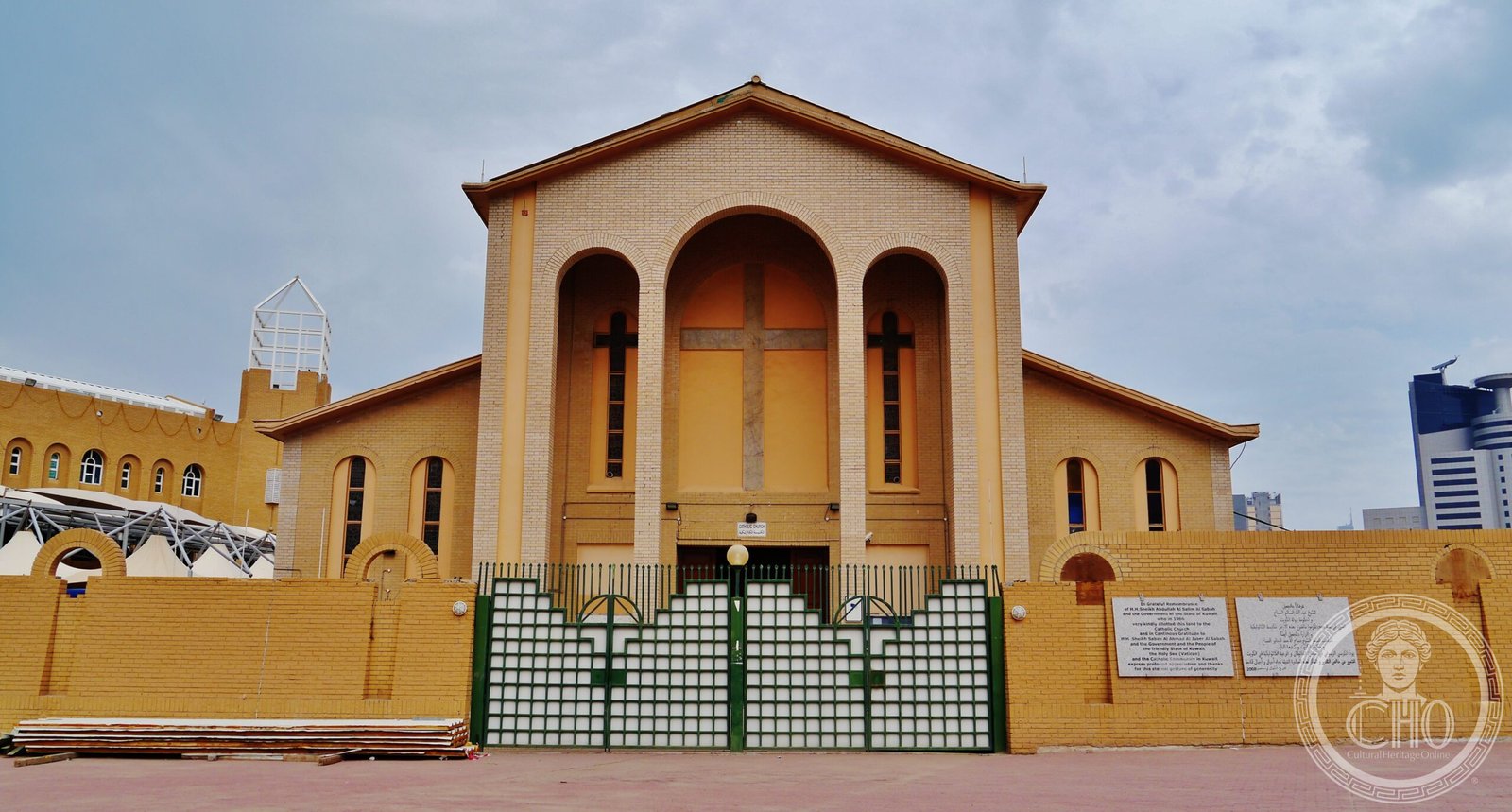
In Kuwait City, the land for this cathedral was donated by the Kuwaiti government in 1956. The foundation stone was laid on 27 January 1957. The building was designed by the Milanese architect Emilio Tenca, commissioned by Kuwait’s first vicar apostolic, Ubaldo Teofano Stella, and consecrated on 16 March 1961, just three months before Kuwait’s independence from the British protectorate on 19 June of that same year. Monsignor Stella deliberately dedicated it as “the Holy Family in the desert”, a name chosen to mirror the condition of transit and migration of the local Catholic community itself. The building, in sand-coloured sandstone, has a raised sanctuary under a marble canopy on four columns, and tall, narrow stained-glass windows, made in Bilbao between 1974 and 1975, depicting scenes from the Creation to Pentecost. An extension in 1997 added parish halls in the same external stone. According to several reports by the US State Department, the Kuwaiti authorities have long maintained a ban on churches displaying external religious signs such as visible crosses or bells. This is a general policy affecting the seven Christian churches officially recognised in the country, although no source consulted explicitly confirms how the rule applies in detail to this specific building. The apostolic vicariate of Kuwait was erected as a prefecture on 29 June 1953 and raised to a vicariate on 4 June 1955. In 2011 it was renamed the apostolic vicariate of Northern Arabia, extending its jurisdiction to Bahrain, Qatar and Saudi Arabia. In 2012 the seat moved to Bahrain, to the new cathedral of Our Lady of Arabia, inaugurated in December 2021; since then this building in Kuwait City has been a co-cathedral. The present vicar apostolic is Aldo Berardi, of the Trinitarians, appointed in January 2023 after the death in office, in April 2020, of his predecessor Camillo Ballin. Kuwait’s Catholic community, estimated by different sources at between one hundred and forty thousand and more than three hundred and fifty thousand people depending on the counting method, is made up almost entirely of migrant workers, largely Indians, especially from Kerala, and Filipinos, with significant numbers of Sri Lankans, Lebanese and other Arab nationalities. Masses are celebrated mainly on Fridays, the day of rest in the Gulf, in at least eight languages according to local diocesan sources, a number that rises to fourteen across the whole vicariate. Unlike Saudi Arabia, where no public church is known to have ever been authorised, Kuwait officially recognises seven Christian denominations with the right to build and register places of worship. In 2025-2026 the Vatican Secretary of State, Cardinal Pietro Parolin, travelled to Kuwait to raise the nearby church of Our Lady of Arabia in Ahmadi to the rank of minor basilica, the first in the Gulf, and on that occasion met the Catholic community in this very co-cathedral.
About Holy Family Co-Cathedral
In Kuwait City, land for this cathedral was donated by the Kuwaiti government in 1956; the foundation stone was laid on 27 January 1957, and the building, designed by Milanese architect Emilio Tenca on commission from Kuwait’s first Vicar Apostolic, Ubaldo Teofano Stella, was consecrated on 16 March 1961, just three months before Kuwait’s own independence from British protectorate status on 19 June that year.
Key facts
- 1956: land donated by the Kuwaiti government.
- 16 March 1961: consecrated, three months before Kuwait’s own independence.
- Named “the Holy Family in the Desert,” reflecting the migrant status of its congregation.
- One of seven officially recognized Christian churches in Kuwait.
- 2012: vicariate seat moves to Bahrain; this building becomes co-cathedral.
- Kuwait’s Catholic community, overwhelmingly Indian and Filipino migrant workers, estimated at 140,000 to over 350,000 depending on the count.
History
Consecrated just months before Kuwait itself became independent, this cathedral was named “the Holy Family in the Desert” by its first bishop — a deliberate reflection of a Catholic community built entirely from migration, not from any local Christian tradition. Seven decades later that community, still composed almost entirely of foreign workers, remains one of the largest functioning Christian congregations anywhere in the Gulf, worshipping in a country that recognizes it while its neighbor Saudi Arabia has historically permitted no public churches at all.
What you see
A sand-colored sandstone facade with a gabled central bay and triple-arched portico carries two large brick crosses flanking a stone cross motif at the entrance, above a raised sanctuary beneath a marble canopy on four columns and tall, narrow stained-glass windows made in Bilbao in the mid-1970s depicting scenes from Creation to Pentecost.
Practical information
- Opening hours: generally open daily outside services; check current hours before visiting.
- Address: Qibla, Block 14, Al-Soor Street, Building 10, Kuwait City, Kuwait.
Getting there
The cathedral stands in the Qibla district of Kuwait City, near the Arabian Gulf shoreline. GPS: 29°21′49″N, 47°57′36″E.
Nearby
- Kuwait City’s Qibla waterfront district — surrounding the cathedral grounds.
Sources
- Wikipedia — “Holy Family Co-Cathedral, Kuwait” and “Christianity in Kuwait”
- Avona.org — Apostolic Vicariate of Northern Arabia records.
- Catholic-Hierarchy.org and GCatholic.org — Vicariate of Northern Arabia records.
- Radio Veritas Asia — “Holy Family Co-Cathedral: Home of Catholic Worship in Kuwait”
- Agenzia Fides and Vatican News — coverage of the Catholic community in Kuwait and the 2025-2026 elevation of Our Lady of Arabia, Ahmadi.
Find it on the map
See this place and what’s around it →📷 Become a Cultural Heritage Online photographer
Share your photos of places: they stay published under your name as the author. The more they're seen, the more you get noticed — and soon a contest will reward the most appreciated photos.
Log in or sign up free to add a photo