

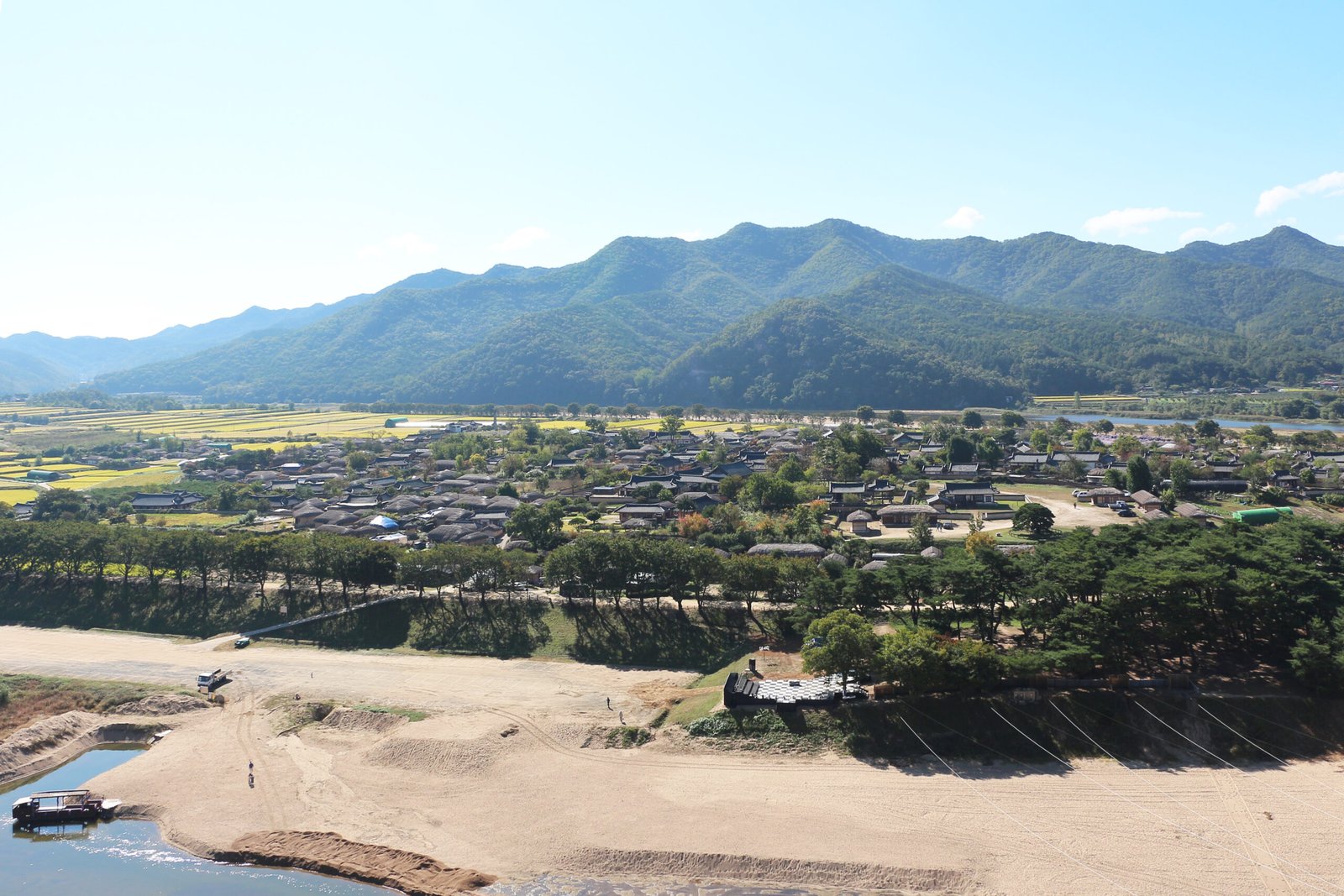
Two living Joseon-era clan villages where Confucian philosophy is written into the landscape — in the curve of a river, the grain of timber roofs, and a mask dance that mocks the powerful.
At a glance
Hahoe and Yangdong are the finest surviving examples of Joseon-dynasty clan villages in Korea — aristocratic communities built and continuously inhabited for six centuries by a single dominant clan family. Unlike open-air museum reconstructions, both villages remain genuinely lived in. Hahoe village sits in a dramatic horseshoe bend of the Nakdong River in North Gyeongsang Province, its thatched and tiled roofs framed by clan forests planted to protect against wind and flood. Yangdong, near the ancient capital Gyeongju, shelters two clans — the Son and the Lee — whose ancestral houses occupy the higher slopes in strict accordance with Confucian social hierarchy. Together, they were inscribed on the UNESCO World Heritage List in 2010 as irreplaceable examples of Korea’s neo-Confucian village planning tradition.
Key facts
- UNESCO inscription: 2010
- Location: Hahoe — Andong, North Gyeongsang Province; Yangdong — near Gyeongju, North Gyeongsang Province
- Period: c. 14th–16th century CE (Joseon Dynasty, 1392–1897)
- Dominant clans: Hahoe — Ryu clan of Pungsan; Yangdong — Son clan and Lee clan
- Village layout principle: Confucian hierarchy encoded in topography — aristocratic anchae houses on high ground, lesser buildings below
- Famous intangible heritage: Hahoe Byeolsingut Talnori (mask dance drama) — UNESCO Intangible Cultural Heritage since 2009
- Status: Living villages; both have resident populations today
History
The founding of Hahoe is traditionally attributed to the Ryu clan of Pungsan, who settled the river bend site during the early Joseon Dynasty — likely in the 14th or 15th century CE. The Ryu clan produced some of the dynasty’s most celebrated Confucian scholars, including Ryu Seong-ryong (1542–1607), who served as Chief State Councillor during the Japanese invasions of the 1590s and whose memory is honoured at the Byeongsanseowon Confucian academy just outside the village. Yangdong’s founding is similarly rooted in aristocratic lineage: the Son clan settled the valley first, followed by the Lee clan through marriage alliance, creating the unusual dual-clan village structure that survives today.
Both villages flourished as seats of yangban (aristocratic) culture throughout the Joseon period. The 17th and 18th centuries saw a flowering of pavilion architecture — jeongja, thatched wooden structures perched above streams and fields — built by scholars as retreats for poetry, philosophy, and calligraphy. The Buyongdae cliff at Hahoe, a sheer sandstone palisade rising directly across the Nakdong River from the village, became a celebrated site for viewing the village from above and for floating lantern ceremonies. Both villages survived the devastation of 20th-century Japanese occupation and the Korean War with their historic fabric largely intact.
What you see
Hahoe presents one of the most photogenic traditional village panoramas in Asia: a cluster of thatched saekijip (straw-roofed houses) and tiled anchae (main aristocratic houses) set within the oxbow of the Nakdong River, backed by pine-forested hills and bordered by rice paddies. The spatial grammar is immediately legible — the higher the house on the slope, the higher the family’s social standing. The Ryu clan’s main residence, Yangjindang (built 1560), is the largest and highest, with tall whitewashed walls and a commanding courtyard. The Chunghaedang house across the village dates to the same era and preserves its original wooden interiors. At the village’s ceremonial heart stands Samsindan, a 600-year-old zelkova elm around which the Byeolsingut mask dance is performed. The Byeolsingut is the most remarkable intangible element: a satirical performance tradition dating to the 12th century in which masked characters — the aristocrat, the Buddhist monk, the butcher, the concubine — enact social conflicts that lampoon hierarchical abuse, extraordinary in a society defined by rigid Confucian order.
Yangdong village, spread across a valley of terraced rice fields, counts over 160 traditional buildings including more than 50 designated cultural assets. The Gwanghagdang pavilion (1440) and the Hyangdan house (1505) represent Korea’s most refined examples of Joseon gentry domestic architecture. The village’s dual-clan plan — Son clan on one ridge, Lee clan on another — is visible from the surrounding hilltops and reflects centuries of carefully managed coexistence.
Practical information
- Opening hours: Hahoe Folk Village — daily 09:00–18:00 (summer until 19:00); Yangdong — daily 09:00–18:00
- Admission: Hahoe — adults ₩3,000; Yangdong — adults ₩3,000 (approximately USD 2.50 each)
- Hahoe Mask Dance: Performed every Saturday at 15:00 (summer and autumn); full Byeolsingut performance during the Andong International Mask Dance Festival (October)
- Photography: Freely permitted; residents ask visitors to respect privacy in occupied courtyards
- Language: English-language signage and guides available at Hahoe; more limited at Yangdong
Getting there
Hahoe: From Andong city, take Bus 46 from Andong Bus Terminal (approximately 40 minutes, ₩1,400). Andong is served by KTX high-speed rail from Seoul Cheongnyangni Station (approximately 2 hours). By car from Andong: 25 minutes on Route 34 west.
Yangdong: From Gyeongju city, take Bus 203 toward Gangseo-ri and alight at Yangdong Village stop (approximately 25 minutes). Gyeongju is directly served by KTX from Busan (30 minutes) and Seoul (2.5 hours).
Nearby
- Byeongsanseowon Confucian Academy — 4 km from Hahoe; UNESCO-listed neo-Confucian academy (2019 inscription)
- Seokguram Grotto and Bulguksa Temple — 30 km from Yangdong near Gyeongju; UNESCO WHS 1995
- Gyeongju Historic Areas — 20 km from Yangdong; capital of the Silla Kingdom, UNESCO WHS 2000
- Dosan Seowon — 25 km north of Hahoe; Confucian academy of Yi Hwang (Toegye), Korea’s most revered neo-Confucian philosopher
Sources
Find it on the map
See this place and what’s around it →📷 Become a Cultural Heritage Online photographer
Share your photos of places: they stay published under your name as the author. The more they're seen, the more you get noticed — and soon a contest will reward the most appreciated photos.
Log in or sign up free to add a photo