

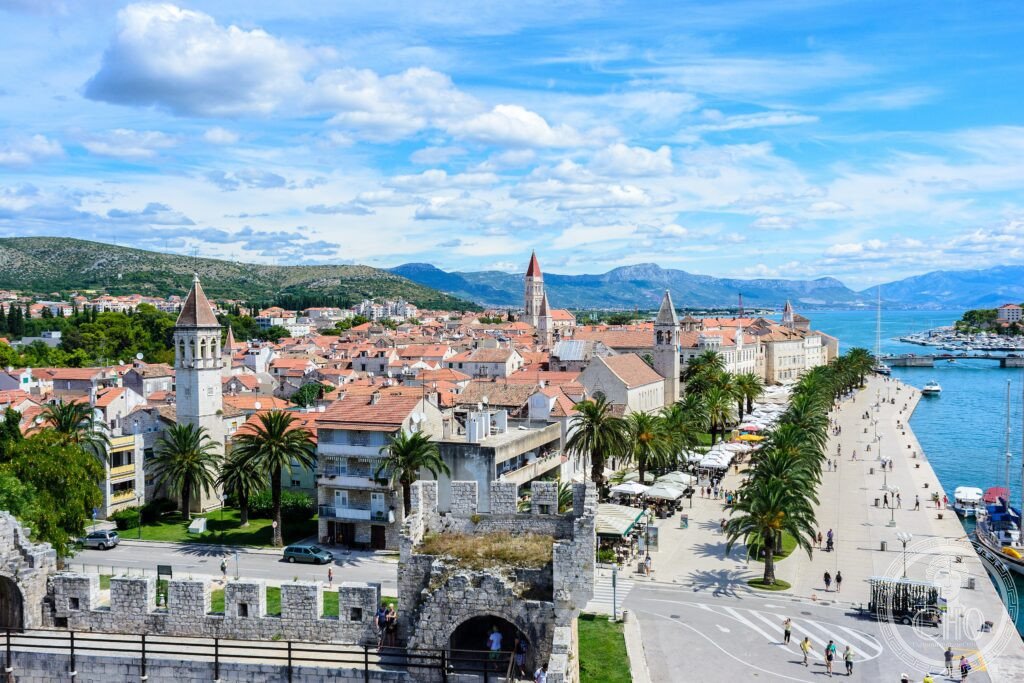
The most completely preserved medieval Venetian island city on the Adriatic coast. Trogir (Greek Tragurion, Latin Tragurium, Italian Traù) was founded as a Greek colony from Issa (the island of Vis) approximately in the 3rd century BC, grew under Roman and Byzantine rule, and spent 377 years (1420–1797) under Venetian governance that gave it the characteristic loggia, clock tower, and patrician palaces of a Dalmatian comunità. The old town’s narrow grid of streets contains the finest Romanesque sculptural portal in Croatia and one of the most intact medieval urban islands in the Mediterranean.
At a glance
Trogir (municipality population approximately 13,000) is on the Dalmatian coast of Croatia, 27 km west of Split, at the point where the coastal highway crosses the narrow channel between the mainland and the island of Čiovo. The old town is built on a small island approximately 600 metres long and 400 metres wide, connected to the mainland by a stone bridge (the north bridge, the main entrance, adjacent to the fortified north gate) and to the island of Čiovo by a second bridge at the south end. UNESCO inscribed the Historic City of Trogir in 1997. The old town’s approximately 600 inhabitants live within one of the most dense concentrations of Romanesque, Gothic, and Renaissance architecture in Croatia, accumulated over the city’s continuous occupation from the 3rd century BC to the present.
Key facts
- Cathedral of St Lawrence (Katedrala Sv. Lovre, 1213–1598): the greatest Romanesque-Gothic building in Dalmatia and Croatia and the architectural masterpiece of the medieval Adriatic coast. Begun in 1213 under Bishop Treguanus as a replacement for a Romanesque cathedral destroyed in a Saracen raid, the Cathedral of St Lawrence is primarily known for its West Portal, carved by the Croatian master sculptor Radovan (1240 — the most significant date in Croatian medieval art, since Radovan is the earliest sculptor known by name in Croatian history). The portal tympanum depicts the Nativity in a complex iconographic programme combining Byzantine, Romanesque, and Gothic elements. The door jambs are carved with a continuous narrative of the Life of Christ, the calendar of the months (the peasant months, with the agricultural tasks — the most valuable documentary source on 13th-century Dalmatian rural life), the Signs of the Zodiac, and figures of Adam and Eve standing on lions (an image borrowed from Lombard Romanesque tradition). The chapel of St John of Trogir (Kapela Sv. Ivana Trogirskog, 1461–1497) within the cathedral is the most important Renaissance sculpture commission in Croatia, with a relievo programme by Nicola di Giovanni Fiorentino (“Nikola Florentinac”) including the ceiling of coffered stone panels. The finest Renaissance coffered stone ceiling in the Adriatic. The Cathedral belltower (14th–15th century, Gothic with Romanesque elements at its base) is the most prominent landmark of Trogir.
- Kamerlengo Fortress (Kastel Kamerlengo, 1420–1437): the Venetian military fortress at the south-west corner of the island, built immediately after Venice acquired Trogir in 1420. The pentagonal fortress with three towers (the largest, the “round tower”, 20 metres in diameter and 24 metres high) controlled the sea approach to the city from the south. The name Kamerlengo (Italian for “treasurer”) derives from the Venetian treasury official who occupied the fortress. The courtyard is now used as an open-air cinema and concert venue in summer. The tower walk (accessible in summer) gives the best panoramic view of the island, the channel, and the distant mountains of the Dalmatian mainland.
- Cipiko Palace (Palača Cipiko, 15th century): the finest Gothic civilian building in Trogir and one of the most important Gothic secular buildings in Croatia. Built by the Cipiko family (the most important patrician family of medieval Trogir, who produced several mayors, judges, and one important condottiere commander) in the 15th century in a style that blends Venetian Gothic with local Dalmatian craftwork. The palace facade on the main square (Trg Ivana Pavla II, also known as the Piazza/Trg Ivana Pavla) has three levels: a Romanesque ground floor, a Gothic first floor with the characteristic Venetian-Dalmatian biforate (two-light) windows, and an upper loggia of the transitional Gothic-Renaissance period. The Cipiko family also commissioned the magnificent galley Galea Cipiko (built in Trogir in 1571) which participated in the Battle of Lepanto.
- The medieval street grid: Trogir retains its original medieval street layout virtually unchanged from the 13th-century plan. A grid of narrow lanes (some as narrow as 1–1.5 metres) intersecting at right angles, with occasional small squares at the intersections. The streets are paved in polished Dalmatian limestone that shines white in the sun and becomes slippery when wet. The building heights (3–4 storeys on the main streets, 2–3 on the back lanes) and the narrow carriageway width create a permanent cool shadow at street level that is one of the defining sensory experiences of the medieval Dalmatian town. The church bells of St Lawrence, St Sebastian, and the Dominican and Franciscan monasteries create a soundscape of overlapping peals that gives the island its characteristic ambient acoustics.
- Heritage: UNESCO World Heritage Site, Historic City of Trogir, inscribed 1997.
- GPS: 43.5167° N, 16.2500° E.
History
The Greek colony of Tragurion was established by settlers from Issa (the island of Vis) approximately in the 3rd century BC on the small island at the point where the Dalmatian coastal range meets the sea. The Greek name Tragurion (possibly from “tragos”, goat) suggests a pastoral landscape. The city became part of the Roman province of Dalmatia (1st century BC) and received the name Tragurium. Byzantine and Croatian rule followed the fall of Western Rome. King Koloman of Hungary incorporated Trogir into the Kingdom of Croatia-Hungary in 1107 with a charter granting the city’s privileges. The Trogir Charter (Privilegium Colomani, 1107) is one of the oldest surviving written documents of Croatian urban history. Venice took the city in 1420 after a Croatian request for protection against the Bosnian king, and governed it for 377 years. The Venetian period produced the Kamerlengo Fortress, the City Loggia (1467, the most elegant Venetian loggia on the Dalmatian coast), the Clock Tower, and the Renaissance chapel of St John. Napoleon’s takeover of Venice in 1797 ended Venetian rule, and Trogir became (in succession) Austrian, Yugoslav, and Croatian.
What you see
The island is best explored on foot (the only practical mode — no cars within the old town). Enter from the mainland side via the north bridge and the Land Gate (Kopnena Vrata, 1593, a Late Renaissance arch with a niche of St John of Trogir above the keystone). Loggia and Clock Tower (Gradska Loža, 1467 Venetian, with a relief panel of the kairós by Nicola Florentinac on the façade; the clock tower was added later, incorporating a medieval campanile; the loggia is now used as a local court). Trg Ivana Pavla II (the main square, with the Cathedral of St Lawrence on the left and the Cipiko Palace on the right; allow 45 min for the Cathedral, particularly the Radovan portal in 1240 and the St John of Trogir chapel inside). The narrow back streets (the lanes east of the main square are the most untouched; the local population does their shopping here on streets almost unchanged since the 13th century). Kamerlengo Fortress south-west corner (climb the tower for the panorama). South seafront promenade (the waterfront between the two bridges, with views across the channel to the mountains of Čiovo).
Practical information
- Admission: old town streets free. Cathedral of St Lawrence approximately 30 HRK (€4). St John chapel approximately 15 HRK additional. Kamerlengo Fortress approximately 25 HRK (€3.30, open in summer only). City Museum approximately 20 HRK. The island is freely accessible at all times from both bridges. The north and south ends of the island give free views across the channel at all times.
- Getting there: Split Airport (SPU) is 8 km east of Trogir (the airport runway is on the mainland immediately adjacent to the Trogir causeway). Direct flights from London (2.5h, British Airways/easyJet/Jet2), Manchester (2.5h, Jet2/TUI), Dublin (3h, Ryanair), Frankfurt (2h, Lufthansa/Condor), and most European cities. The airport shuttle bus to Split City takes approximately 40 min with a Trogir stop. Bus from Split Bus Terminal to Trogir approximately 30 min (frequent services). By car from Split 27 km west on the coastal road (30–40 min in light traffic, longer in summer). Car ferry from Ancona Italy (10h overnight, Jadrolinija) to Split. From Zagreb 280 km south on the A1 motorway (3h).
- The Dalmatian coastal circuit: Trogir is 27 km west of Split (UNESCO WHS 1979, Diocletian’s Palace — the most intact Roman imperial residence in the world, with approximately 220 modern buildings built inside the 4th-century palace walls), 80 km north of Dubrovnik (UNESCO WHS 1979, the most complete medieval fortification circuit in the Adriatic), and 55 km south of Šibenik (the Cathedral of St James, UNESCO WHS 2000 — the only cathedral in the world entirely constructed of stone, without brick or wood, built by local master Juraj Dalmatinac and finished by Nikola Florentinac, 1431–1535). The three UNESCO sites and the ferry-boat islands (Brač, Hvar, Korčula) make the Dalmatian coast the most concentrated heritage tourism region in the Adriatic.
Getting there
Split Airport (SPU): 8 km east. Bus from Split (30 min). By car from Split (30 min, 27 km). Direct flights from London (2.5h). GPS: 43.5167, 16.2500.
Nearby
- Split. 27 km east of Trogir (30 min by bus; frequent). The Diocletian’s Palace (Dioklecijanova palača, built approximately 295–305 AD by the Roman Emperor Diocletian as his retirement palace; UNESCO WHS 1979) is the largest surviving Roman imperial complex in the world (240 x 180 metres, 220 modern buildings constructed inside the original 4th-century walls). The basement halls (the substructures of the palace, a complete mirror image of the rooms above, now used as galleries and market space) give the most immediate sense of Roman architectural scale in Croatia. The Cathedral of Saint Domnius (the mausoleum of Diocletian, converted to a Christian cathedral in the 7th century — the most intact Roman mausoleum converted to a church in the world, with its original octagonal plan, Roman stone carvings, and the medieval campanile added to the Roman rotunda) is the oldest cathedral in the world still in continuous liturgical use from its original Roman structure.
- Šibenik. 55 km north of Trogir (1h by bus, frequent). The Cathedral of St James (Katedrala Sv. Jakova, UNESCO WHS 2000, completed 1535). The only Gothic-Renaissance cathedral in the world built entirely of stone (no brick, no timber — the barrel vaults of the nave are built of interlocking stone panels that act as a stone tent without any iron reinforcement, a structural achievement that has no parallel in European church architecture). The frieze of 71 portrait heads of the local 15th-century burghers (carved around the outer apse by Juraj Dalmatinac, 1441–1442) is the most remarkable example of vernacular portraiture in medieval Croatian art. The city loggia, the castle, and the medieval streets of the old town are in excellent condition.
- Krka National Park. 30 km north-east of Šibenik (45 min by car from Trogir). The most visited national park in Croatia after Plitvice Lakes. The Krka River falls in a series of travertine cascades (the Skradinski Buk waterfall, 45.7 m total drop across 17 travertine steps, is the largest travertine waterfall in Europe) through a canyon of the Dalmatian karst limestone. Swimming is permitted below the Skradinski Buk (a notable exception to the standard European national park rule against swimming). The island monastery of Visovac (Franciscan, 15th century, on an island in the Krka lake created by the longest travertine barrier) is reached by boat from the park dock.
Sources
- Wikipedia, Trogir. Trogir Cathedral. Kamerlengo Fortress. Cipiko Palace, accessed June 2026.
- UNESCO, Historic City of Trogir, WHS reference grad, inscribed 1997.
- Igor Fisković, Radovan: Majstor trogirskog portala, Književni Krug, Split, 1990.
- Damir Demonja and Pavlo Rudan, Rural Tourism in Croatia, Meridijani, Zagreb, 2011.
Find it on the map
See this place and what’s around it →📷 Become a Cultural Heritage Online photographer
Share your photos of places: they stay published under your name as the author. The more they're seen, the more you get noticed — and soon a contest will reward the most appreciated photos.
Log in or sign up free to add a photo