

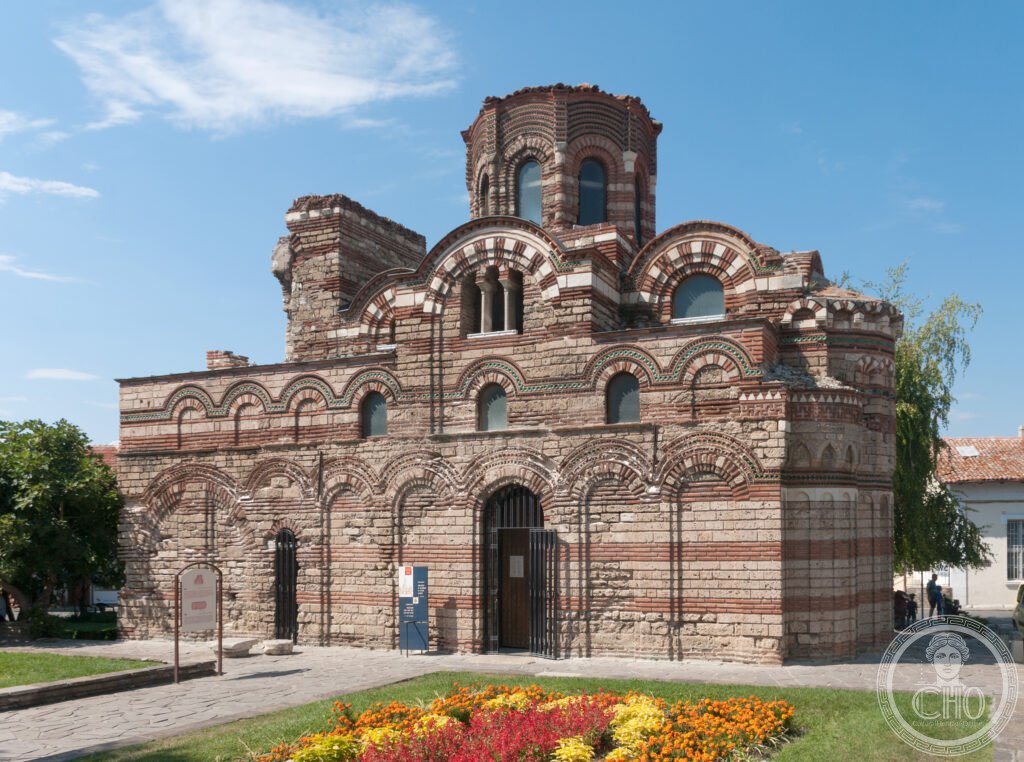
The most remarkable archaeological site on the Bulgarian Black Sea coast. Nessebar (ancient Mesambria, Greek Μεσαμβρία, Thracian foundation approximately 6th century BC) is a small rocky peninsula approximately 850 metres long and 300 metres wide, connected to the mainland by a narrow isthmus, that contains layers of continuous human occupation from the Bronze Age through the Thracian, Greek colonial, Roman, Byzantine, Bulgarian Empire, and Ottoman periods. Within its compact area it preserves the ruins or intact structures of more than 40 churches, making it the most concentrated Byzantine and medieval ecclesiastical heritage site on the Black Sea.
At a glance
Nessebar (population of the old town approximately 900 people; the modern beach resort city Nessebar Nova immediately adjacent has approximately 10,000) is on the Bulgarian Black Sea coast in Burgas Province, 35 km north-east of Burgas and 85 km south of Varna. The old town (the historic peninsula, Nessebar Staro Grad) is connected to the mainland by a causeway approximately 400 metres long (a modern causeway replaced the original narrow isthmus) and contains within its 850m x 300m area not only the 40 church sites but also the ruins of the 6th-century Byzantine fortifications (the Porta Marina sea-gate), the remains of the Greek agora, Roman baths, the medieval bishop’s palace, and more than 100 traditional wooden-upper-storey houses of the 18th–19th century that form the domestic fabric of the historic town. UNESCO inscribed the Ancient City of Nessebar in 1983.
Key facts
- Church of Christ Pantocrator (13th–14th century): the best-preserved and most distinctive Byzantine church in Nessebar and the canonical example of the Nessebar decorative style. Built during the Second Bulgarian Empire (1185–1396), the church is notable for its elaborately decorated exterior: the apse (the rounded east end of the church) is covered in alternating horizontal courses of red brick and cut stone, punctuated with blind niches (each niche has a ceramic rosette of turquoise-green glazed faience inset at its centre), green glazed ceramic banding, and blind arcade galleries. This combination of Byzantine brick construction with polychrome ceramic ornament and stone carving is specific to the Nessebar school of Bulgarian medieval church architecture and is unique to this site in European ecclesiastical building. The church is now deconsecrated and used as an art gallery, making the interior accessible.
- The 40 churches: the extraordinary density of ecclesiastical buildings in Nessebar reflects the importance of the peninsula in Byzantine and Bulgarian religious geography. In a settlement of less than 30 hectares, Nessebar had at various times more than 40 churches (some sources say up to 80 over the full span of occupation). Approximately 10–12 of these survive in reasonable condition, the others as ruins or archaeological sites. The key examples: (1) Old Metropolitan Church (Stara Mitropolia, 5th–6th century, Early Byzantine basilica with three naves and a narthex — the oldest surviving church structure in Nessebar, now an open courtyard museum). (2) New Metropolitan Church (Nova Mitropolia, 13th–14th century, the largest medieval church in Nessebar, now the active parish church of the Orthodox community). (3) Church of St John the Baptist (11th–12th century, small cross-in-square plan, the finest intact early Byzantine church in Nessebar, still consecrated). (4) Church of St Stephen (12th–16th century, the most important frescoed interior in Nessebar, with a complete painted programme of the 16th century covering walls and ceiling, including a Last Judgement, a Tree of Jesse, and a remarkable portrait sequence of the Nessebar donors).
- Thracian and Greek heritage: the Thracians (the indigenous Bronze Age and Iron Age people of the Black Sea coast) founded the settlement of Mesambria on the peninsula in approximately the 6th century BC. A Greek colony from Megara (the Dorian city-state near Corinth) was established approximately 510 BC, and the city became part of the network of Pontic (Black Sea) Greek colonies that stretched from the Bosphorus to the Crimea. The Greek agora (the central public square of the ancient city) is partially excavated and visible at the southern end of the peninsula. A collection of Greek and Thracian coins, ceramics, and inscriptions is held at the National History Museum of Nessebar (in the Old Metropolitan Church courtyard).
- Traditional wooden houses (18th–19th century): the domestic architecture of the Ottoman-era Nessebar is a distinctive type found throughout the Bulgarian Black Sea coast. Stone ground floors (built on the original Byzantine and medieval stone foundations) supporting timber-framed upper floors that project over the narrow streets on wooden cantilevers (the corbelled upper storeys give the streets their characteristic shadowed intimacy). The houses are painted in white, cream, or ochre with dark timber frames and brightly painted shutters. The combination of medieval stone church ruins and 18th-century wooden domestic buildings gives Nessebar’s streetscape a unique texture found nowhere else on the Black Sea.
- Heritage: UNESCO World Heritage Site, Ancient City of Nessebar, inscribed 1983.
- GPS: 42.6578° N, 27.7193° E.
History
Nessebar was occupied continuously from the Bronze Age. The Thracian Mesambria was an important trading post before the Greeks arrived approximately 510 BC. The city passed through Macedonian (336 BC, under Alexander the Great), Seleucid, and Roman rule (absorbed into the province of Moesia in the 1st century BC) before becoming one of the most important Byzantine naval bases on the western Black Sea coast. The Empress Irene of Athens (the first woman to rule the Byzantine Empire in her own right, 797–802) used Nessebar as her base of exile and later as a treaty-signing location with the Bulgarian khan Krum. The city was repeatedly fought over between the Byzantine Empire and the Bulgarian Empire (with the Bulgarians capturing it in 812 AD, 864 AD, and definitively in 1363 AD). The Ottoman conquest (1453, in the broader context of the fall of Constantinople) ended Byzantine rule. The Greeks and Bulgarians of Nessebar maintained the Orthodox Christian community through the Ottoman period, and the church-building activity of the 13th–14th century Bulgarian Second Empire is the most significant architectural heritage of the site.
What you see
The old town is freely accessible from the causeway entrance at the north end of the peninsula (parking on the mainland side of the causeway). The peninsula is small enough to walk completely in 1–2 hours. Standard circuit: entrance gate (the ancient Porta Marina sea-gate’s ruins are on the north side). Christ Pantocrator Church (the art gallery, 5 min walk from the gate, the most colourful and best-preserved Byzantine exterior on the peninsula). Old Metropolitan Church courtyard (archaeological museum with the earliest Byzantine basilica foundations visible). New Metropolitan Church interior (if attending services, the most complete functioning Byzantine liturgical space in the old town). St John the Baptist Church (exterior and interior if open). St Stephen Church (the frescoed interior — the most important art-historical site in the old town; may require asking for the key at the nearby museum). The southern tip of the peninsula (views of the sea on three sides, the traditional wooden houses on the hill, the harbour inlet). Return via the western seafront promenade.
The town is heavily crowded in July and August (peak Black Sea resort season) and is much more pleasant in May–June or September–October, when the light on the polychrome church facades is exceptional and the narrow streets are navigable without shoulder-to-shoulder crowds. The fish restaurants on the harbour quay specialise in Black Sea fish (tzatziga/turbot, sea bass/kefal, and the local Black Sea sprat/kalkan) and are among the best value seafood restaurants in Bulgaria.
Practical information
- Admission: the old town (streets and most church exteriors) free. National History Museum in the Old Metropolitan Church complex approximately 5 BGN (€2.50). Christ Pantocrator art gallery approximately 5 BGN. St Stephen Church fresco museum approximately 5 BGN. New Metropolitan Church (active church, free to visit respectfully during non-service hours). Most other church ruins are freely visible from the outside. Combined museum ticket approximately 15 BGN.
- Getting there: Nessebar is on the Bulgarian Black Sea coast, 35 km north-east of Burgas (the main regional city with an international airport). Bourgas Airport (BOJ). Direct charter flights from London (3.5h), Manchester (3.5h), Berlin (2.5h), Warsaw (2h), and most northern European cities in summer (June–September). The Plovdiv and Sofia airports serve wider international connections. Bus from Burgas to Nessebar approximately 35 min (regular services from the Burgas bus terminal). Bus from Sunny Beach resort (immediately adjacent to Nessebar, 2 km) frequent in summer. By car from Burgas 35 km on the A1/E87 road. From Varna 85 km south on the A2/E87 (1h 30 min). Nessebar is the heritage anchor of the Burgas/Sunny Beach/Nessebar resort complex (one of the largest summer tourism areas in Bulgaria).
- Best combined itinerary: Nessebar (old town heritage, 3–4h) + Sunny Beach (the largest Black Sea resort in Bulgaria, 2 km north — enormous, brash, cheap, and lively; the contrast with the ancient stones of Nessebar is instructive) + Sozopol (35 km south of Burgas: a smaller but equally ancient Greek colony on a similar rock peninsula, with better-preserved traditional houses and a more authentic atmosphere than the over-touristed Nessebar; not UNESCO but arguably more beautiful) + Burgas (the regional city, with the Archaeological Museum).
Getting there
Burgas Airport (BOJ): 35 km south (direct charter flights from UK/Germany). Bus from Burgas (35 min). By car from Burgas (35 km). GPS: 42.6578, 27.7193.
Nearby
- Sozopol. 35 km south of Burgas (40 min by bus or car). The most beautiful and authentic of the Bulgarian Black Sea ancient towns. Founded as Apollonia Pontica by Greek settlers from Miletus approximately 610 BC (the oldest Greek colony in Bulgaria), Sozopol (the Ottoman-era name) occupies a similar rock peninsula to Nessebar but with a better-preserved ensemble of 18th–19th century traditional wooden houses and a less crowded old town. The Apollonia Art Festival (first weeks of September, open-air concerts in the harbour square) is one of the most atmospheric summer festivals on the Black Sea. The Cathedral of St George contains the relics of St John the Baptist (allegedly the arm bone and part of the skull, brought from Antioch — the claim is disputed but the reliquary casket is historically fascinating).
- Kazan (Thracian sanctuary and museum) near Burgas. The Burgas region contains important Thracian archaeological sites including the Thracian tombs at Kazanlak (150 km inland, UNESCO WHS 1979 — a 3rd–2nd century BC Thracian beehive tomb with remarkable coloured frescoes of a Thracian banquet and funeral ceremony, the only intact painted Thracian tomb in Bulgaria). The Valley of the Thracian Kings (approximately 30 km north of Kazanlak, with more than 1,500 Thracian burial mounds) and the Shipka Pass (the mountain pass where Bulgarian volunteers and Russian Imperial Army troops repulsed the Ottoman army in 1877, the decisive action of the Russo-Turkish War that led to Bulgarian liberation — the Shipka Memorial and its golden dome are visible from the pass at 1,185 metres).
- Plovdiv. 180 km inland (2h by bus from Burgas via the A1). Bulgaria’s second-largest city and the 2019 European Capital of Culture. The Old Town (Stari grad, on three of Plovdiv’s seven hills) is a compact ensemble of National Revival-period (19th century) mansions built in the distinctively Bulgarian style of stone lower floors with projecting timbered upper floors, painted in rich colours, on the ruins of Roman Philippopolis (the Roman colony founded by Philip II of Macedon in 342 BC). The Roman amphitheatre (2nd century AD, the best-preserved Roman theatre in Bulgaria, with capacity approximately 7,000, still used for open-air performances) and the Roman forum (partially excavated beneath the central pedestrian zone) are freely visible. Plovdiv is also the hometown of Bulgaria’s most celebrated contemporary painter, Zlatyo Boyadjiev.
Sources
- Wikipedia, Nessebar. Church of Christ Pantocrator, Nessebar. Church of Saint Stephen, Nessebar, accessed June 2026.
- UNESCO, Ancient City of Nessebar, WHS reference 217, inscribed 1983.
- Georgi Atanasov, Nessebar: History and Archaeological Monuments, National Museum of History, Sofia, 2015.
- Richard Hoddinott, Bulgaria in Antiquity: An Archaeological Introduction, Ernst Benn, 1975.
Find it on the map
See this place and what’s around it →📷 Become a Cultural Heritage Online photographer
Share your photos of places: they stay published under your name as the author. The more they're seen, the more you get noticed — and soon a contest will reward the most appreciated photos.
Log in or sign up free to add a photo