

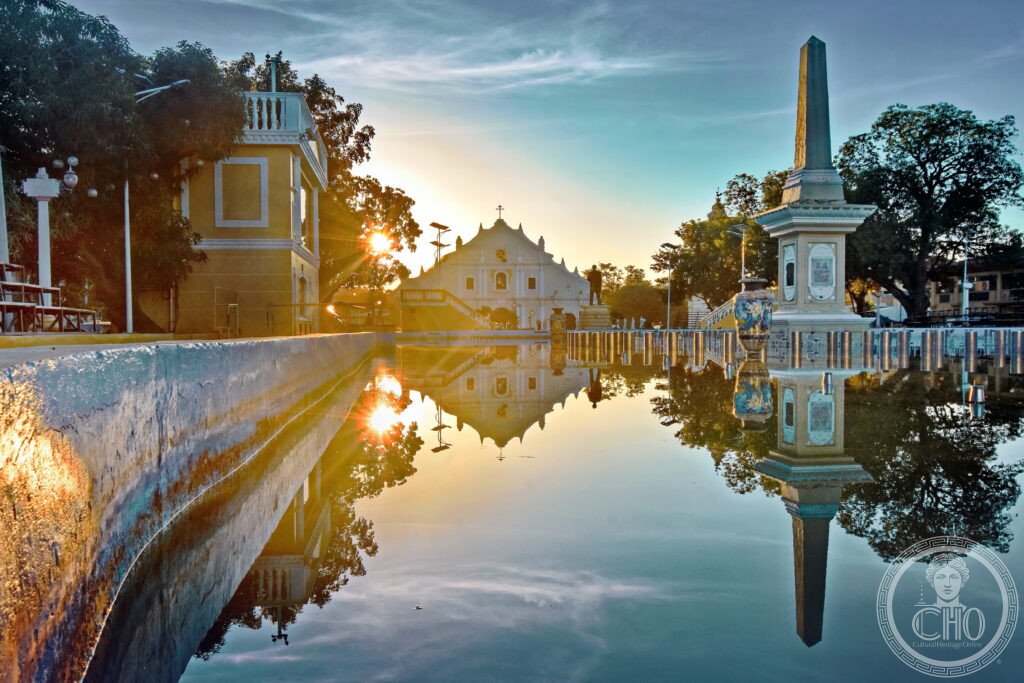
The best-preserved Hispanic colonial town in Asia. Founded in 1572 by the Spanish conquistador Juan de Salcedo as a centre for the evangelisation of northern Luzon. Its Mestizo district of cobblestoned streets and 16th–19th century townhouses (bahay na bato: stone-and-wood hybrid buildings that fused Ilocano, Chinese, and Spanish architectural traditions) survived the 20th century intact and represents the only standing example of the unique urban form produced by the encounter between Spanish colonial rule, Chinese merchant communities, and Philippine vernacular building culture.
At a glance
Vigan (official name: City of Vigan) is a city of approximately 53,000 inhabitants in Ilocos Sur Province, north-western Luzon, Philippines, approximately 400 km north of Manila on the Metate River. It was founded in 1572 by the Augustinian friar Martín de Rada and the conquistador Juan de Salcedo (grandson of the conqueror of Mexico, Miguel López de Legazpi) as a commercial and religious centre for the Spanish colonisation of northern Luzon. The city became the residence of the Bishop of Nueva Segovia (a large diocese covering northern Luzon and parts of what are now Taiwan and mainland China) and a significant trading centre linking Manila to the Chinese, Japanese, and Philippine trading networks of the 16th–18th centuries. The Mestizo district (Calle Crisologo and its surroundings) contains the densest surviving collection of Spanish colonial and Philippine vernacular architecture in Asia. UNESCO inscribed the Historic City of Vigan in 1999.
Key facts
- Bahay na bato (house of stone): the definitive building type of Vigan. A 2–3 storey hybrid house combining a ground-floor stone base (usually volcanic tuff, andesite, or brick) of Spanish or Chinese construction with an upper floor of Philippine hardwood (molave, narra) in the Ilocano vernacular tradition. The upper floor has the characteristic wide overhanging eaves to shade the windows, the azotea (rear terrace), and the sala (main reception room) with its sliding capiz shell (Placuna placenta) windows. Thin, translucent shells set in wooden grid frames that allow diffused light without glass (a pre-colonial Filipino technique adopted into the colonial house type). The combination of these three architectural traditions. Spanish, Chinese, and Philippine. Produced a building type that exists nowhere else.
- Calle Crisologo: the central street of the Mestizo district. A cobblestoned lane approximately 600 metres long lined on both sides with two-storey bahay na bato in continuous façade. The cobblestones are the original volcanic stone. Horse-drawn calesas (carriages) still operate on the street as both a tourist attraction and a practical transport mode (motor vehicles are prohibited in the Mestizo core). The street is the most photographed streetscape in the Philippines. At dawn before the tourist arrivals, the street is empty and completely silent.
- Saint Paul Metropolitan Cathedral (Nuestra Señora de la Asunción): the principal church of Vigan, built in the Baroque “earthquake Baroque” style (a distinctive Philippine adaptation of Baroque architecture in which the façade and the towers are built lower and massively thicker than the European model, to withstand the frequent earthquakes of the Philippine archipelago). The current building dates primarily from 1641 (rebuilt after the 1619 earthquake on the site of the 1574 original). The belltower is separate from the church body (another earthquake Baroque feature), standing approximately 85 metres across an open atrium from the church door.
- Syquia Mansion (Museo San Pablo): the ancestral home of the Syquia family, now a museum. The Syquias were a wealthy Ilocano-Chinese mestizo family whose most famous member, Elpidio Quirino, became the 6th President of the Philippines (1948–53). The house is a well-preserved example of a 19th-century upper-class bahay na bato interior, with original capiz shell windows, narra hardwood floors, period furniture, and the bedroom where Quirino slept as a child.
- Burnay pottery: Vigan is famous for its Burnay earthenware. A distinctive dark-brown glazed stoneware (fired with salt and sugar cane husks) produced by the potter’s district of Vigan (Tabangao) using traditional kick-wheel and wood-fired kiln techniques brought to the Philippines by Chinese potters in the 16th century. The Burnay tradition (Chinese-influenced techniques adapted for Philippine materials) is unique to Vigan and Ilocos. The pots are used for storing bagoong (fermented fish paste) and other fermented condiments that define Ilocano cuisine.
- Heritage: UNESCO World Heritage Site, Historic City of Vigan, inscribed 1999.
- GPS: 17.5747° N, 120.3869° E.
History
The Ilocos coast of north-western Luzon had pre-colonial contacts with Chinese traders before the Spanish arrived. Vigan (then called Bikig or Bigan) was a Chinese trading settlement when Juan de Salcedo arrived in 1571–72. Salcedo, acting under the authority of his grandfather Miguel López de Legazpi (the first Governor-General of the Philippines), pacified the region and founded the colonial city in 1572. The Augustinian friars who accompanied the conquest immediately began constructing the church complex that became the Cathedral of Nueva Segovia. Vigan grew rapidly as the commercial capital of northern Luzon: Chinese traders (called Sangleys by the Spanish) settled in the Parian district adjacent to the Spanish centre, contributing their building techniques, commerce skills, and cultural practices to the resulting mestizo urban culture. The hybrid bahay na bato house type developed through the 17th–18th centuries as the wealth of the mestizo merchant class (Ilocano-Chinese-Spanish families) accumulated.
Vigan experienced the cycles of colonial violence common to the Philippine archipelago: the 1762 British occupation of Manila disrupted the trading networks. The 1806 Diego Silang revolt (the most significant Ilocano independence movement, partly a response to the abuses of the tobacco monopoly) centred on Vigan. The American occupation (1899–1946) brought new infrastructure without destroying the historic fabric. Uniquely, Vigan was spared the American aerial bombing campaign of 1945 because the commanding American general (Arthur Percival) recognised the historic value of the city. This combination of factors. No major earthquake damage, no wartime destruction, no 20th-century redevelopment pressure. Explains the exceptional survival of the historic fabric.
What you see
The core historic area is compact and best explored on foot or by calesa (horse carriage) over 3–4 hours. The typical circuit starts at the Plaza Salcedo (the original Spanish colonial plaza, with the Cathedral and the Provincial Capitol on its edges), walks through Calle Crisologo to the Plaza Burgos (the smaller colonial plaza with the Archbishop’s Palace and the heritage shops), visits the Syquia Mansion museum, and returns through the pottery kilns of Tabangao. The cobblestone streets are uneven and unsuitable for wheeled luggage. Comfortable walking shoes are essential. The best time to be in Calle Crisologo is before 8 am (before the tour groups) and in the late afternoon light (the westward-facing façades glow golden from about 4 pm).
The “Vigan longganisa” (a local pork sausage with garlic, salt, and vinegar, distinctly different from other Philippine longganisa) is a required food stop. The Cafe Leona (in a heritage house on Calle Crisologo) is the standard venue for breakfast. The Pagburnayan (pottery district) is active in the morning. Potters can be watched hand-throwing on traditional kick-wheels and firing the Burnay kilns.
Practical information
- Admission: the Mestizo district streets are free to walk. The Syquia Mansion museum charges approximately PHP 50 (about €0.80). The Cathedral is free. The calesa (horse carriage) circuit of the heritage district charges approximately PHP 150–200 (about €2.50–3.50) for a 30-minute tour.
- Getting there: Vigan does not have an airport. The nearest airport is Laoag International Airport (LAO, in Laoag City, 80 km north). Daily flights from Manila (Philippine Airlines, Cebu Pacific, approximately 45 minutes). From Laoag, shared van (van for hire) to Vigan approximately 1.5 hours (PHP 300–400). Alternatively, bus from Manila’s Parañaque Integrated Terminal to Vigan (several overnight buses, 8–9 hours; Partas, Dominion, Florida Bus). The Vigan bus terminal is a 10-minute tricycle ride from the historic centre.
- Vigan festival: the Kannawidan Festival (January, celebrating Ilocos Sur culture) and the Longganisa Festival (February, celebrating Vigan longganisa) are the most atmospheric times to visit. The Semana Santa (Holy Week) processions through the cobblestone streets are the most powerful religious spectacle.
Getting there
Nearest airport: Laoag (LAO, 80 km north, 1.5h by van). Overnight buses from Manila (8–9h). Tricycle from bus terminal to historic centre. GPS: 17.5747, 120.3869.
Nearby
- Paoay Church (Saint Augustine Church, Paoay). 50 km north of Vigan in Ilocos Norte Province. A UNESCO World Heritage Site (inscribed 1993 as part of the Baroque Churches of the Philippines), the best single example of the earthquake Baroque style. The lateral buttresses of the church are the largest in the Philippines, approximately 3 metres thick at the base, and project at intervals from the entire length of the nave walls. Built 1694–1710 by Augustinian friars using local coral stone. The belltower (separate, in the corner of the atrium) was used as an observation post in the Philippine Revolution of 1896.
- Bangui Wind Farm (Ilocos Norte). 80 km north of Vigan. The most dramatic visual combination in the Ilocos region. 20 wind turbines (each 70 metres tall, 50-metre rotor diameter) set directly on the beach of Bangui Bay, with the South China Sea waves breaking around their bases. The turbines can be walked among. The best light is at sunrise when the mountains of Ilocos Norte form the backdrop. The Bangui Wind Farm is the only place in the Philippines (and one of the few places in the world) where you can stand on a beach next to an operating wind turbine.
- Cape Bojeador Lighthouse (Ilocos Norte). 110 km north of Vigan. The tallest lighthouse in the Philippines (67 metres), built by the American colonial administration in 1892 and still operational. The lighthouse stands on a headland with views over the South China Sea and the mountains of the Cordillera. The surrounding area has the grass-covered Cape Bojeador grounds, colonial-era keeper’s houses, and stairs to the lighthouse platform.
Sources
- Wikipedia, Vigan. Bahay na bato. Earthquake Baroque, accessed June 2026.
- UNESCO, Historic City of Vigan, WHS reference 502, inscribed 1999.
- National Commission for Culture and the Arts, Philippines, Vigan Heritage Conservation Plan, 2016.
- Augusto Villalon, Vigan: A Portrait of the Philippines’ Heritage City, Central Books, 2004.
Find it on the map
See this place and what’s around it →
📷 Become a Cultural Heritage Online photographer
Share your photos of places: they stay published under your name as the author. The more they're seen, the more you get noticed — and soon a contest will reward the most appreciated photos.
Log in or sign up free to add a photo