
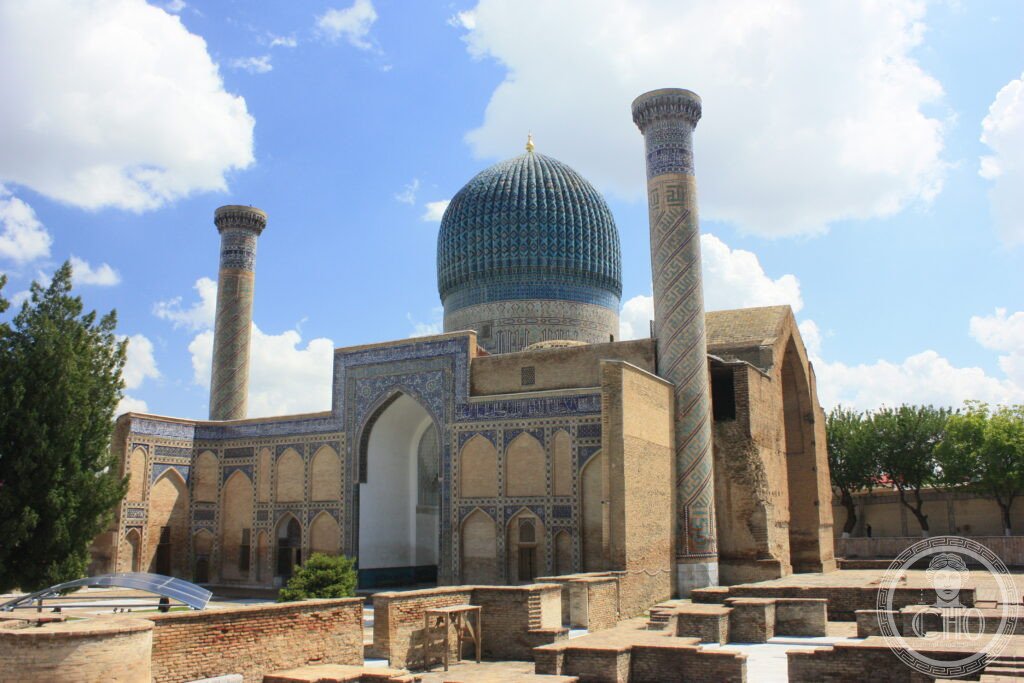
The most important city on the Silk Road and the capital of the greatest empire in the 14th-century world — the Mongol conqueror Timur (Tamerlane) chose Samarkand as the capital of his empire that stretched from Anatolia to India and from the Caspian to China, and spent the last 25 years of his life rebuilding it with a concentration of turquoise-tiled madrasas, mausoleums, and mosques that remains, six centuries later, the most extraordinary ensemble of Islamic Timurid architecture anywhere on Earth.
At a glance
Samarkand (population approximately 570,000) is the second-largest city of Uzbekistan, in the Zerafshan River valley at an altitude of approximately 720 m, in the heart of Central Asia, on the route between China and the Mediterranean that was used for trade from at least the 5th century BC (the Achaemenid Persian Empire, the Macedonian Greeks, the Parthians, the Kushans, the Sassanids, the Byzantines, the Arabs, the Mongols, and the Timurids all controlled this route at different times). The UNESCO inscription covers the Historic City of Samarkand — Crossroads of Cultures, inscribed in 2001.
Key facts
- The Registan: the central square of Timurid Samarkand and the greatest Islamic architectural ensemble in the world. Three tile-covered madrasas (religious schools) are arranged around a central square: the Ulugh Beg Madrasa (1417–20, commissioned by Timur’s grandson Ulugh Beg, who was simultaneously ruler, astronomer, and mathematician), the Sher-Dor Madrasa (1619–36, “Lion-Bearing,” notable for the two tiger-lions with human faces — unusually figurative for Islamic art — in the tympanums of the entrance pishtaq), and the Tilya-Kori Madrasa (1646–60, “Gilded,” whose mosque interior is decorated entirely in gold-leaf painted plasterwork — the most extravagant gilded ceiling in Central Asia). The three facades, with their 35-metre-high entrance portals covered in geometric tile mosaic and stalactite muqarnas vaulting, form a composition of architectural scale and colour intensity unique in the Islamic world. The Registan is illuminated nightly with a son-et-lumière show.
- Gur-e-Amir (Tomb of the Ruler): the mausoleum of Timur and the prototype of all subsequent Islamic mausoleum design in Central Asia and India. It was built by Timur originally as the tomb for his favourite grandson Muhammad Sultan (who died in battle 1403). When Timur himself died in January 1405 (on a military campaign against China), his body was brought back to Samarkand and interred here. The ensemble (entrance pishtaq with blue-and-white tile mosaic, inner courtyard, the fluted turquoise dome on a high drum) established the visual vocabulary that the Mughal emperors of India directly inherited. Shah Jahan, builder of the Taj Mahal, was Timur’s sixth-generation descendant, and the Taj Mahal’s structural layout (elevated tomb with four minarets, reflecting pool, formal garden — the charbagh) is a direct development of the Gur-e-Amir model. Timur’s actual tomb is a dark green nephrite block (the largest carved nephrite object in the world). Soviet archaeologists opened the tomb in June 1941 — the day before the Nazi invasion of the USSR began.
- Shah-i-Zinda Necropolis: the most atmospheric and visually intense heritage site in Samarkand — a 900-metre avenue of tombs and mausoleums of the Timurid period (14th–15th century), densely packed on either side of a covered alley on the slope of the Afrosiab hill. The tile decoration of the Shah-i-Zinda mausoleums is considered the finest example of tilework in Central Asia. The colour range (from deep cobalt blue to turquoise, from white to gold and terracotta), the variety of tile-cutting techniques (mosaic, carved, painted), and the sheer density of decorated surfaces on a confined path make Shah-i-Zinda visually overwhelming. The necropolis centres on the Shrine of Kusam ibn Abbas (a cousin of the Prophet Muhammad, who according to tradition brought Islam to Samarkand and was martyred here), which has been a pilgrimage site since the 11th century.
- Bibi-Khanym Mosque: the largest mosque ever built in the Islamic world at the time of its construction (1399–1404). Timur commissioned the mosque on his return from the sack of Delhi (1398–99), intending it to surpass every mosque that had previously existed. The main dome (41 metres diameter) was the largest in Central Asia, and the 18-metre-high main entrance portal was the largest in the Islamic world. The complexity of the programme — too ambitious to be structurally sound — caused the mosque to begin collapsing within decades of completion. It was partially restored in Soviet times and is currently undergoing systematic Uzbek government restoration. The ruins (only the entrance portal, two flanking minarets, and the main dome survive intact) are entered freely.
- The Ulugh Beg Observatory: the most important astronomical observatory of the pre-telescopic world, built by Ulugh Beg (1394–1449, ruler of Samarkand and grandson of Timur) between 1424 and 1429. The observatory housed a giant circular sextant (a curved marble arc, 40 metres in radius, set vertically in a trench cut into a hillside) for measuring the declination angle of stars with a precision unmatched until the 18th century. Ulugh Beg’s star catalogue (published 1437) listed 1,018 stars with positions more accurate than any previous catalogue. His measurement of the solar year (365 days, 6 hours, 10 minutes, 8 seconds) deviated from the modern value by only 58 seconds. The observatory was destroyed in 1449 (the year Ulugh Beg was assassinated by his own son). The arc trench was excavated in 1908 and is now an open museum.
- Heritage: UNESCO World Heritage Site, Samarkand — Crossroads of Cultures, inscribed 2001.
- GPS: 39.6542° N, 66.9758° E.
History
Samarkand (ancient Marakanda) was the capital of the Sogdian Achaemenid satrapy of Sogdia and was captured by Alexander the Great in 329 BC. The Arabs conquered the city in 712 AD and introduced Islam. The Samanid dynasty (819–999) made Samarkand one of the great Islamic cultural centres of the early medieval period. The Mongol conquest (1220, under Genghis Khan) destroyed the city, and the rebuilding began under the Chagatai Khanate. The transformation into the supreme city of the Islamic world began with Timur (Tamerlane), who was born in Shahrisabz (80 km south of Samarkand) in 1336, rose to supreme power in Central Asia, conquered Delhi, Persia, Anatolia, and the Golden Horde between 1370 and 1404, and spent the wealth and captive artisans of the entire conquered world on the reconstruction of his capital.
After Timur’s death (1405), his son Shah Rukh moved the imperial capital to Herat (now Afghanistan), but Samarkand retained its prestige under Ulugh Beg’s rule (1411–49). The Shaybanid Uzbek conquest (1500) and the subsequent Bukhara Khanate period saw Samarkand decline to the status of a secondary city. Russian conquest (1868) and Soviet modernisation (the city was rebuilt on a new grid plan outside the historic centre) largely spared the Timurid monuments. The post-independence (1991) Uzbek government has invested heavily in restoration and promoted Samarkand as the jewel of the Uzbek tourism programme.
What you see
The three main sites are spread across the modern city and require transport between them (taxi or tourist bus; the Registan and the Gur-e-Amir are 1 km apart on foot; Shah-i-Zinda and Bibi-Khanym are a further 1.5 km north); the most efficient sequence: arrive at the Registan at 7–8 am (before the tour groups, when the light is best on the tile-covered façades) → walk to the Gur-e-Amir (20 min) → Bibi-Khanym mosque ruins (1 km north, 15 min on foot) → taxi to Shah-i-Zinda (1 km; allow 1.5 hours). The Ulugh Beg Observatory (3 km north of the Registan) is best saved for the afternoon; it is small and takes 45 minutes.
The light is best for photography on the Registan in the early morning (east-facing façades) and on the Gur-e-Amir at sunset (the dome catches orange and pink tones very well); the tourist infrastructure (guides, organised transport, English-language audio guides) has developed significantly since 2016 and Samarkand is now one of the easier off-beaten-track UNESCO sites to visit independently.
Practical information
- Admission: Registan approximately UZS 80,000 (about €6); Gur-e-Amir approximately UZS 50,000 (about €4); Shah-i-Zinda approximately UZS 50,000; Bibi-Khanym approximately UZS 50,000; Ulugh Beg Observatory approximately UZS 30,000 (about €2.50); combined ticket available at the tourist information office near the Registan for approximately UZS 200,000 (about €16); prices were updated in 2023 and may have changed.
- Getting there: Samarkand International Airport (SKD) — direct international flights from Moscow (Aeroflot, 3.5h), Istanbul (Turkish Airlines, 5h, seasonal), Delhi (Air India, 3.5h), Dubai (flydubai, 4h), Abu Dhabi (Air Arabia, seasonal); direct flights from Tashkent (Uzbekistan Airways, 1h, multiple daily); by high-speed train from Tashkent: the Afrosiyob high-speed train (350 km/h, Uzbekistan’s first high-speed rail service, 2011) runs Tashkent–Samarkand in approximately 2 hours (approximately UZS 60,000/€5; book at least 2 days in advance; the Samarkand train station is 3 km from the Registan, taxi approximately UZS 30,000).
- Bukhara extension: the Bukhara–Samarkand combination is the standard Uzbek heritage circuit (300 km, 4.5h by regular train or 3.5h by Afrosiyob express); Bukhara (UNESCO WHS 1993) has a similarly remarkable Islamic heritage ensemble (the Ark fortress, the Kalon Minaret, the Po-i-Kalyan mosque complex, the Lyabi-Hauz pool and surrounding madrasas) and a smaller, better-preserved old city; the two-city itinerary (3 nights Samarkand + 2 nights Bukhara) is the most compact and efficient Central Asia heritage experience.
Getting there
Samarkand Airport (SKD): flights from Moscow (3.5h), Istanbul (5h), Delhi (3.5h). High-speed train from Tashkent (2h). GPS: 39.6542, 66.9758.
Nearby
- Shahrisabz (White City) — 90 km south of Samarkand (1.5–2h by car via mountain road or 3h by marshrutka); the birthplace of Timur (Tamerlane, born 1336) and his secondary capital; the Ak-Saray Palace (built 1380–1396, Timur’s summer palace — only the two entrance towers of the monumental pishtaq portal survive, 38 metres tall, originally part of a 70-metre-high entrance arch — the largest arch ever built in the Islamic world; the gate inscription reads “If you doubt our power, look at our buildings”) and the Kok Gumbaz mosque (1435, built by Shah Rukh to commemorate Timur) are the main sites; UNESCO inscribed Shahrisabz in 2000.
- Bukhara — 250 km west of Samarkand (3.5h by Afrosiyob express train); the other great city of Timurid Uzbekistan — the Ark Fortress (7th century, continuously occupied until the Soviet revolution; the last Emir of Bukhara fled through the Ark gates as Red Army soldiers entered in 1920), the Kalon Minaret (1127 — the only building Genghis Khan ordered spared when he destroyed Bukhara in 1220, reportedly so impressed was he by its height), and the Lyabi-Hauz pool (the best-preserved medieval civic water feature in Central Asia, with three 16th-17th century madrasas surrounding it) make Bukhara the essential companion city to Samarkand; UNESCO WHS 1993.
- Khiva (Itchan Kala) — 500 km west of Samarkand (by plane from Tashkent or by Uzbek railway overnight); the most completely preserved historic city in Central Asia — Itchan Kala (the walled inner city of Khiva) is a museum-city entirely enclosed within medieval walls, with 50 monuments of the 17th–19th century including the Islam Khodja Minaret (1910, 57 metres, the tallest in Khiva), the Kalta Minor (unfinished minaret, 1852, only 26 metres of a planned 70-metre structure — the Emir died and construction stopped) and the Tash-Khauli Palace (1832–41, the most elaborate secular Uzbek palace, with 163 carved wooden columns); UNESCO WHS 1990.
Sources
- Wikipedia, Samarkand; Registan; Gur-e-Amir; Shah-i-Zinda, accessed June 2026.
- UNESCO, Samarkand — Crossroads of Cultures, WHS reference 1114, inscribed 2001.
- Lisa Golombek and Donald Wilber, The Timurid Architecture of Iran and Turan, Princeton University Press, 1988.
- Justin Marozzi, Tamerlane: Sword of Islam, Conqueror of the World, HarperCollins, 2004.
Find it on the map
See this place and what’s around it →📷 Become a Cultural Heritage Online photographer
Share your photos of places: they stay published under your name as the author. The more they're seen, the more you get noticed — and soon a contest will reward the most appreciated photos.
Log in or sign up free to add a photo