

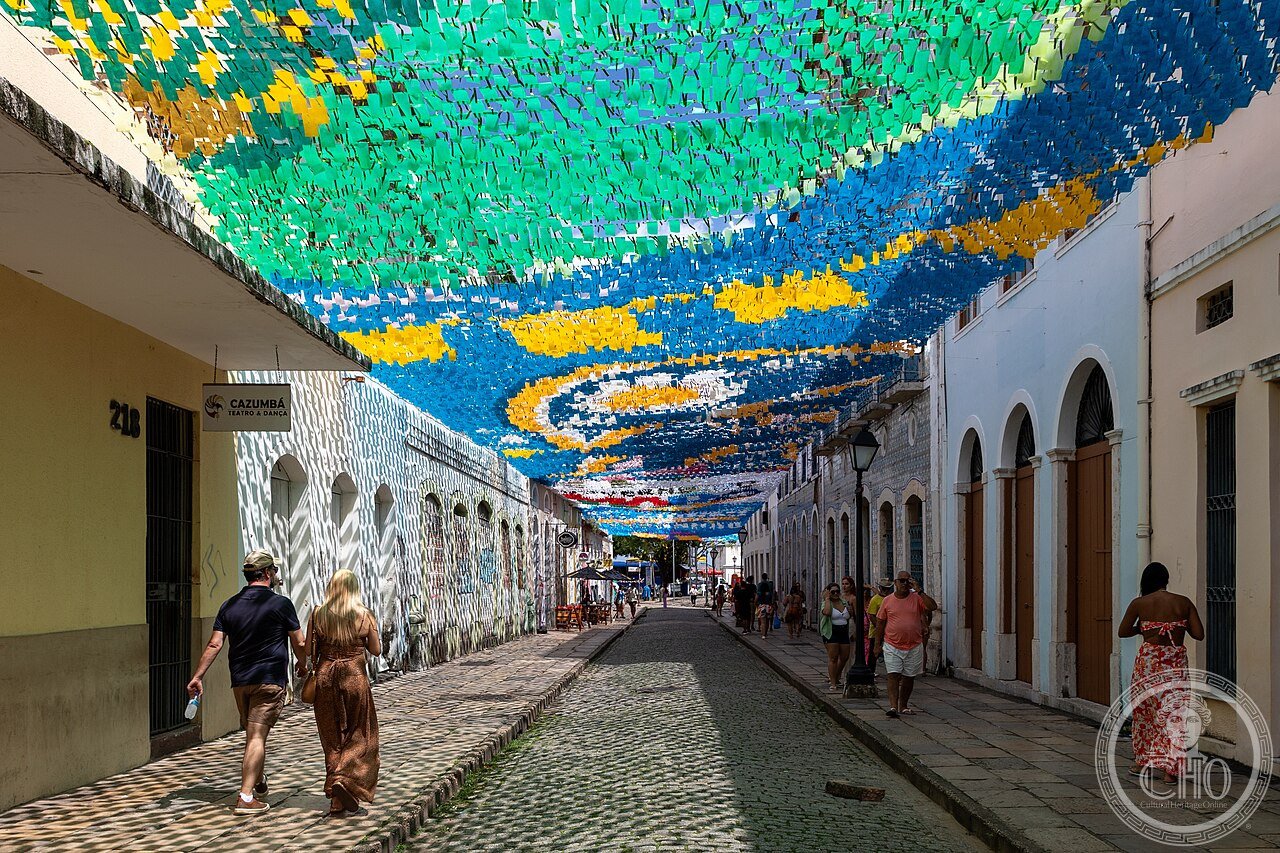
The only city in Brazil founded by the French, captured by the Dutch, and finally colonised by the Portuguese — São Luís preserves a 220-hectare historic centre unlike anything else in the Americas, its 2,500 historic buildings almost entirely clad in hand-painted Portuguese azulejo tiles.
At a glance
The historic centre of São Luís, capital of Maranhão state in northeastern Brazil, is UNESCO-inscribed (1997) as an outstanding example of Portuguese colonial town planning adapted to the tropics. What makes it immediately distinctive from every other colonial city in the Americas is the azulejo — the Portuguese glazed ceramic tile. Here, entire building facades, from ground to roofline, are covered in blue-and-white or multicoloured geometric and pictorial tiles, applied originally in the 19th century as weatherproofing against the intense coastal humidity, and now the defining visual identity of an entire city.
Key facts
- UNESCO inscription: 1997 (World Heritage Site)
- Founded: 1612 CE by French explorers (Fort Saint-Louis)
- Dutch occupation: 1641–1644 CE
- Portuguese colonisation: From 1644 CE (permanent)
- Historic centre area: approx. 220 hectares
- Intact historic buildings: approx. 2,500
- Architectural style: Late Portuguese Baroque, Neoclassical, Rococo — all tile-clad
- State: Maranhão, northeastern Brazil
History and significance
São Luís has a colonial history unique in the Americas. The site was claimed for France in 1612 CE by Daniel de la Touche, who built Fort Saint-Louis and established a short-lived French colony called France Équinoxiale. The Portuguese expelled the French in 1615, but the settlement remained — only to be seized by the Dutch West India Company in 1641 during the broader Dutch Brazilian campaign. After three years of Dutch occupation (1641–1644), the city was retaken by the Portuguese, who colonised it permanently and developed it into a prosperous sugar- and cotton-exporting port.
This triple colonial heritage — French foundation, Dutch interlude, Portuguese development — produced an urban fabric without direct parallel elsewhere. The city that emerged under sustained Portuguese administration in the 18th and 19th centuries adopted the azulejo not as decoration but as a practical engineering solution to the brutal equatorial climate. Maranhão’s coastline combines intense heat with extremely high humidity and driving rain; the imported Portuguese tiles provided an impermeable, low-maintenance skin for the underlying rubble-and-lime masonry. The result, applied across an entire city centre over several decades, is visually breathtaking: street after street of tile-covered facades in blue-and-white geometrics, floral panels, and pictorial scenes, faded by sun and salt air to an extraordinary patina.
UNESCO’s 1997 inscription recognised not just the tiles but the intact urban morphology: the original street grid, lot sizes, and building heights of the 17th–18th century colonial city remain largely intact, making São Luís one of the best-preserved examples of Portuguese colonial urbanism anywhere in the world.
What you see
The historic centre is concentrated in the Praia Grande neighbourhood and adjacent streets running back from the waterfront toward the Palácio dos Leões (the state government palace). The principal axes — Rua Portugal, Rua da Estrela, Rua do Giz — are lined with two- and three-storey buildings whose facades are entirely tile-clad, their iron balconies and large wooden shuttered windows (adapted to tropical ventilation requirements) projecting over narrow pavements.
Individual architectural highlights include the Casa das Tulhas (a 19th-century market building now serving as a craft and food market), the Igreja de Nossa Senhora do Carmo (one of several Baroque churches in the area), and the Palácio dos Leões itself — the former governor’s palace, one of the oldest civil buildings in Brazil, incorporating sections of the original French fort.
The azulejo repertoire itself rewards systematic attention: patterns range from simple geometric chequerboards (the cheapest, most utilitarian tiles) through elaborate Baroque cartouche frames and pastoral scenes to Art Nouveau pictorial panels imported from Portugal and France in the early 20th century. The tiles were produced primarily in Lisbon (most commonly) and later in France and England, and date-stamped examples can be traced to specific manufacturers and decades.
Beyond architecture, São Luís is a major centre of Afro-Brazilian culture. The Bumba Meu Boi festival — held annually in June around the feast of São João — is one of Brazil’s most complex and spectacular folk theatre traditions, with deep roots in African, Indigenous, and Portuguese folk culture. During June the historic streets host nightly performances of extraordinary energy.
Practical information
- Airport: Marechal Cunha Machado International Airport (SLZ) — direct flights from São Paulo, Brasília, Fortaleza, Belém
- Historic centre access: Walkable; the Praia Grande neighbourhood is the core area
- Best time: July–December (dry season); June for Bumba Meu Boi festival
- Casa do Maranhão: Museum of Bumba Meu Boi, Praia Grande — essential cultural context
- Guided tours: Available from the Praia Grande tourism office; half-day tours standard
- Note: Parts of the historic centre remain in various states of restoration; significant conservation investment underway since the 2000s
Getting there
São Luís is well connected by air. Marechal Cunha Machado International Airport (SLZ) receives direct flights from São Paulo (GRU/CGH), Brasília (BSB), Fortaleza (FOR), Belém (BEL), and Recife (REC). Travel time from the airport to the historic centre is approximately 20–30 minutes by taxi or app-based ride. The historic centre itself is compact and best explored on foot.
Nearby
- Lençóis Maranhenses National Park (approx. 250 km east): vast white dune fields with seasonally flooded blue lagoons — one of Brazil’s most surreal natural landscapes
- Alcântara (ferry from São Luís, 22 km): ruined Baroque colonial town with a rocket launch centre — a ghostly counterpoint to São Luís’s restored streets
- Barreirinhas (approx. 270 km east): gateway town for Lençóis Maranhenses
Sources
- UNESCO World Heritage List — Historic Centre of São Luís (1997)
- Prefeitura de São Luís — Secretaria de Turismo
- Wikipedia — Historic Centre of São Luís
- Instituto do Patrimônio Histórico e Artístico Nacional (IPHAN) — iphan.gov.br
Find it on the map
See this place and what’s around it →📷 Become a Cultural Heritage Online photographer
Share your photos of places: they stay published under your name as the author. The more they're seen, the more you get noticed — and soon a contest will reward the most appreciated photos.
Log in or sign up free to add a photo